


Offering
Solutions We Provide






📋 IN THIS GUIDE
E-E-A-T is one of those SEO concepts that everyone has heard of, most people have a rough sense of, and surprisingly few actually build deliberately. It gets mentioned in audits, recommended in strategy documents, and then quietly deprioritized when there are keyword rankings to chase and content calendars to fill.
That worked out okay when E-E-A-T was primarily a Google quality evaluation framework. Slow to build, unclear in direct impact, easy to defer.
It’s harder to defer now. Because the same signals Google uses to evaluate whether your content is trustworthy — named authors with real credentials, external mentions from credible sources, specific experience demonstrated in the writing itself — are the exact signals that ChatGPT, Perplexity, and Google AI Overviews use when deciding which sources to cite. We covered this connection briefly in our LLM SEO guide, but E-E-A-T deserves its own treatment because it’s become foundational to AI search performance in a way it wasn’t for traditional SEO.
Pages without named expert authors are roughly 40% less likely to be cited by AI engines than equivalent content from identified experts. That’s not a marginal difference — it’s significant enough that ignoring author authority in 2026 means accepting a structural disadvantage in AI search visibility.
So this is the practical guide. What E-E-A-T actually means, where most Indian B2B companies are leaving it underdeveloped, and what to do about it.
Want to Know How Your E-E-A-T Signals Stack Up?
We review your content authority and AI citation readiness — free, delivered in 24 hours, with specific recommendations.
Get My Free AI SEO Audit → Talk to Our Team
No commitment · 4,100+ brands trust AResourcePool · Response in 24 hours
What E-E-A-T Actually Is
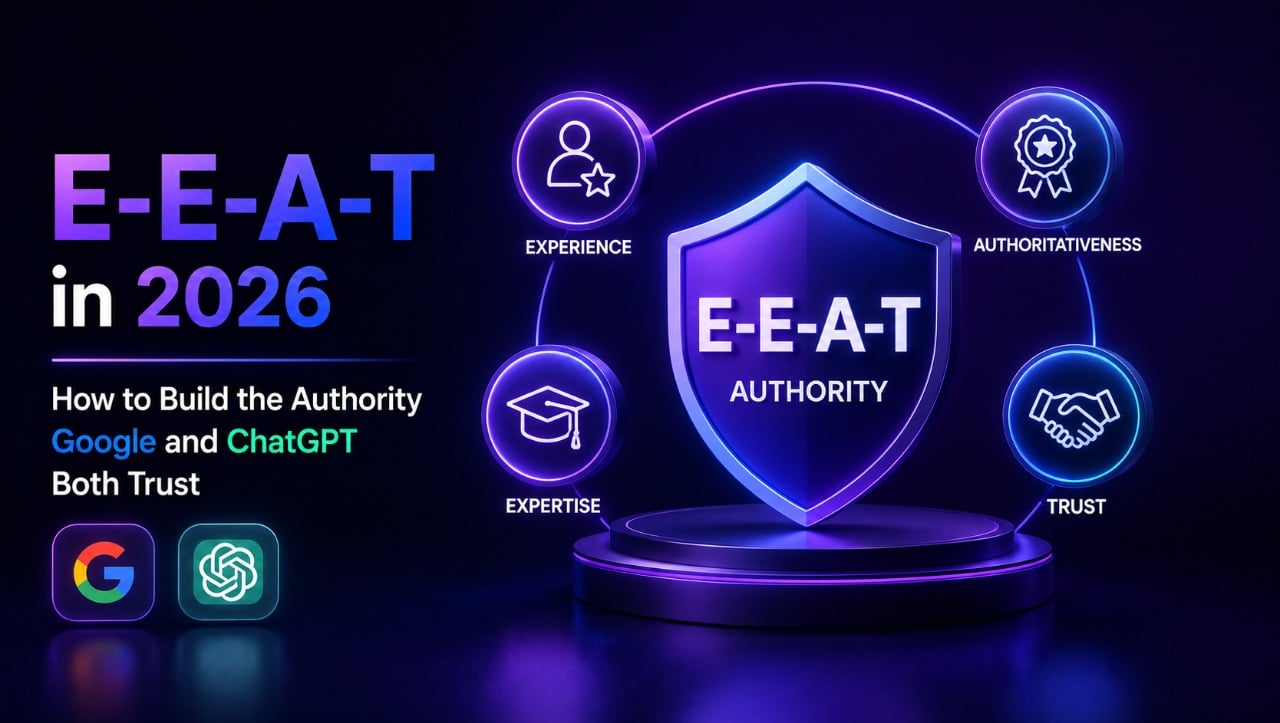
E-E-A-T stands for Experience, Expertise, Authoritativeness, and Trustworthiness. Google introduced the original E-A-T framework in its Search Quality Rater Guidelines — a document used by human evaluators who review content quality and inform how Google’s algorithms are refined. In December 2022, Google added a second E for Experience, making it E-E-A-T.
The addition of Experience is important because it answers a specific question: is this written by someone who has actually done the thing they’re writing about? A cybersecurity guide written by a practitioner who has run penetration tests demonstrates Experience. The same guide written by a content writer who researched it thoroughly but has never worked in security does not — even if the facts are accurate.
One thing worth clarifying before going further: E-E-A-T is not a direct ranking factor. Google has been explicit about this. There’s no E-E-A-T score that feeds directly into rankings. What E-E-A-T is, is a quality framework — a way of describing what good, trustworthy content looks like. The signals that demonstrate E-E-A-T (author credentials, backlinks from credible sources, factual accuracy, external brand mentions) are real ranking inputs even if the framework itself isn’t a single measurable metric.
For AI search, the distinction barely matters. LLMs don’t care about ranking algorithms. They care about which sources appear trustworthy and authoritative when their retrieval systems evaluate content. And the things that make a source appear trustworthy to an LLM are essentially the same things that make it appear trustworthy to Google’s quality raters.
Why AI Engines Use the Same Signals
This is the part that’s worth understanding mechanically, because it explains why E-E-A-T matters for AI search in a structural way rather than just correlating with good content.
When a large language model is trained, it learns from massive amounts of web content. During that training, patterns emerge about what types of sources are accurate, what types are unreliable, and which signals correlate with each. Content from named experts with verifiable credentials tends to be more factually reliable than anonymous content. Content from established domains with quality backlinks tends to be more accurate than content from unknown sites. Content that’s cited by other credible sources tends to be more trustworthy than content that isn’t.
These patterns — which overlap substantially with E-E-A-T signals — get baked into how the model evaluates and weights different sources when retrieving content to generate answers. It’s not that AI engines explicitly check an E-E-A-T score. It’s that the training process teaches them to prefer the kinds of content that E-E-A-T describes.
This is also why E-E-A-T is so central to the broader GEO strategy we’ve been building out in this series. You can implement perfect FAQ schema markup (which we covered in our FAQ schema guide) and still struggle to get cited if the underlying content doesn’t carry authority signals. Schema is a multiplier on authority; it can’t manufacture authority that isn’t there.
Experience — The Most Underbuilt Signal
Of the four E-E-A-T components, Experience is the one I see most consistently underdeveloped — especially at Indian B2B companies, where content is often written by dedicated content teams rather than by the practitioners and domain experts doing the actual work.
Experience in content means demonstrating that the person writing this has personally done, tested, or encountered what they’re describing. It shows up in specific details that only come from doing the thing: a specific number from an actual client engagement, an unexpected outcome from a strategy that didn’t work the way it should have, a nuance that only becomes apparent after running the same type of project multiple times.
Generic summaries of publicly available information don’t demonstrate Experience. Neither does “based on our research.” These signals tell the reader — and the AI — that the author has studied something, not that they’ve done it.
The practical fix for most companies isn’t to replace their content team with practitioners. It’s to change the content production process: have the domain expert contribute the specific experiential details — the real client numbers, the things that actually went wrong, the observations from real projects — and have the content team shape them into readable, well-structured writing. The expert’s voice doesn’t have to be polished. It needs to be present.
Expertise — It’s About the Author, Not Just the Content
Expertise in the E-E-A-T sense is largely about the author, not the content. Google’s quality raters look for evidence that the person writing about a topic has genuine knowledge of it — formal qualifications, professional experience, industry recognition, verifiable credentials.
The mechanism for demonstrating this on a website is straightforward: named authors with detailed bios. Not “Written by the AResourcePool Team” — which is the most common version we see on Indian B2B company blogs and essentially communicates nothing. A real name. A job title that means something specific. Years of relevant experience. Areas of specialization. A LinkedIn profile link that can be verified.
Every piece of content your company publishes that doesn’t have a named author with a proper bio is leaving Expertise signals on the table. And since this is one of the signals most directly linked to AI citation probability — pages without named expert authors are significantly less likely to be cited — it’s also one of the most immediate improvements available for AI search visibility.
For companies with multiple contributing authors, this means creating author profile pages on the website: a dedicated page for each contributor that includes their full bio, their areas of expertise, links to their published work, and any external credentials or mentions. These author pages become entity-building assets — they help Google and AI engines understand who your experts are and what they’re credible on.
The author bio attached to a piece of content is essentially a trust credential for that content. An AI engine seeing “Written by Shweta Sharma, Senior SEO Strategist with 6 years of experience in AI SEO for B2B brands” processes that content differently than one with no author attribution at all.
Authoritativeness — Building It Off Your Own Website
Authoritativeness is about reputation and recognition — what other credible sources think of you, not what you say about yourself. This is where many content-focused E-E-A-T strategies run into a wall: you can write excellent content, but Authoritativeness ultimately depends on external signals.
The main external signals that contribute to Authoritativeness are backlinks from credible domain-relevant sources, brand mentions in industry publications (even without links), citations of your content or expertise by others, and presence on platforms where professionals in your industry congregate.
For Indian B2B companies, the practical path to building Authoritativeness includes a few specific channels that are often underused. Contributing bylined articles to industry publications — even smaller ones — creates attributable expertise signals. Being quoted or cited in roundup articles, industry reports, or market analyses builds brand mentions. Publishing original research or data (even small-scale surveys or client aggregate data, published anonymously and with permission) gives other publications something to cite. And LinkedIn is genuinely important here: a brand that’s consistently active on LinkedIn, publishing original thought leadership rather than just promotional content, builds the kind of industry presence that AI engines pick up on when evaluating authority.
The connection to our earlier guide on AI search vs traditional search is relevant here: we noted that distributing content to external platforms can increase AI citation rates by up to 325% compared to site-only publishing. That finding is essentially the Authoritativeness signal in action — content that exists in more places, attributed to a specific expert, creates the distributed reputation signal that makes AI engines treat a brand as authoritative.
Trustworthiness — The One That Compounds Slowest
Trustworthiness is the broadest of the four components and in some ways the hardest to build deliberately because it’s largely the outcome of getting the other three right over time.
Google’s quality raters evaluate Trustworthiness through things like: Is the content factually accurate? Does the website have clear contact information? Are the business claims verifiable? Is there a transparent privacy policy? Are customer reviews authentic? Does the site make promises it clearly can’t keep?
For AI engines, Trustworthiness manifests differently — it’s about consistency and verifiability. A brand that’s been publishing accurate, specific, expert-attributed content consistently for two or three years is treated as more trustworthy than one that published a lot of content recently without the same track record. A brand whose factual claims can be cross-referenced against other credible sources is more trustworthy than one making claims that aren’t corroborated elsewhere.
There are a few concrete things that meaningfully contribute to Trustworthiness signals without requiring years of waiting. Using specific, verifiable data in content — with citations where appropriate — is one. Maintaining accurate and consistent business information across platforms (website, Google Business Profile, LinkedIn, industry directories) is another. Publishing genuine client case studies with real, specific outcomes rather than vague “we helped them grow” narratives is a third.
The case study point is worth spending a moment on. Generic testimonials — “AResourcePool helped us improve our online visibility” — do very little for Trustworthiness signals. Specific case studies — “[Client type] in [industry], achieved [specific result] within [timeframe] using [specific approach]” — tell a verifiable story. AI engines, like humans, find specific claims more credible than general ones. And they can cross-reference specific claims against other content about the client, the industry, and the outcomes claimed — which builds cumulative trust over time.
What to Actually Do This Month
Rather than a long implementation checklist, here’s a simple prioritization. These three changes collectively cover the highest-impact E-E-A-T improvements available, and all of them can be started within a week.
First: fix your author attribution. Go through your last 20 published pieces. How many have a real named author with a proper bio? For any that don’t, add one. If the actual author can’t be identified, assign content to a subject matter expert who genuinely contributed to it and write a bio that reflects their real credentials. This change alone — adding named, credentialed authors to existing content — can measurably improve AI citation rates within 30 to 60 days.
Second: publish one real case study. Not a testimonial. A case study: client type, challenge, specific approach, specific outcome with numbers. It can be anonymized if needed. One well-written, specific case study does more for your Trustworthiness and Authoritativeness signals than ten generic testimonials. And it creates something AI engines can cite as evidence of real-world expertise.
Third: start building off-site presence systematically. Identify two or three industry publications, LinkedIn communities, or relevant forums where your target buyers spend time. Commit to contributing substantive content there — not promotional content, genuine insight from your actual work — once or twice a month. This is the Authoritativeness channel that most B2B companies neglect entirely, and it’s where the long-term compounding effect of E-E-A-T is most pronounced.
None of this is quick in the sense that you’ll see results overnight. But E-E-A-T has never been an overnight strategy — it’s an accumulation of consistent signals over time. The difference in 2026 is that those signals now affect not just your Google rankings but your visibility in every AI search platform your buyers are using. The urgency is higher. The approach is the same.
For more on how E-E-A-T connects to the specific platforms your buyers are searching on, our guides on getting cited in Google AI Overviews and the GEO vs SEO vs AEO comparison cover the platform-specific mechanics. And if you want to understand how E-E-A-T fits into a broader AI citation strategy alongside FAQ schema and content structure, the AEO services page covers how we put these together in practice.
Frequently Asked Questions on E-E-A-T
Q1. What is E-E-A-T and why does it matter for AI SEO in 2026?
E-E-A-T stands for Experience, Expertise, Authoritativeness, and Trustworthiness — Google’s framework for evaluating content quality. In 2026, it matters for AI SEO because the same signals Google uses to evaluate trustworthiness are the ones AI engines like ChatGPT and Perplexity use when selecting citation sources. Pages from named experts with verifiable credentials, backed by accurate data and consistent external mentions, are significantly more likely to be cited than anonymous corporate content. Pages without named authors are roughly 40% less likely to be cited — making author identity one of the most actionable E-E-A-T improvements available for AI search visibility.
Q2. What is the difference between E-A-T and E-E-A-T?
Google’s original framework was E-A-T: Expertise, Authoritativeness, Trustworthiness. In December 2022, Google added Experience to the front, making it E-E-A-T. Experience addresses first-hand knowledge — whether the author has personally done, tested, or encountered what they’re writing about, rather than just researching it. This matters because AI engines have become better at distinguishing genuine experiential content from well-researched summaries. For B2B service companies, Experience is the most commonly underdeveloped signal — partly because content production is often separated from the practitioners who actually have the hands-on knowledge.
Q3. How do I build E-E-A-T for a B2B service company?
For B2B service companies, E-E-A-T builds through four main channels: author identity (named authors with specific credentials and verifiable professional profiles on every published piece), content depth (comprehensive, specific content that demonstrates genuine domain expertise rather than generalist summaries), external validation (mentions in industry publications, quality backlinks, brand presence on LinkedIn and relevant communities), and client proof (case studies with real, specific outcomes rather than generic testimonials). These signals accumulate over time and collectively create the kind of authority that both Google and AI engines treat as trustworthy citation sources.
Q4. Does E-E-A-T affect how often ChatGPT cites my content?
Yes — directly. Pages without named expert authors are approximately 40% less likely to be cited by AI engines than equivalent content with clear author authority signals. AI citation engines prefer sources that demonstrate verifiable expertise because citing a recognized expert is lower-risk than citing anonymous content. This means adding a proper author bio to your existing published content — without changing anything else about it — can improve AI citation rates on those pages. It’s one of the highest-ROI, lowest-effort changes available for improving AI search visibility alongside FAQ schema implementation, which we cover in our FAQ schema guide.
Q5. How long does it take to build E-E-A-T authority?
Tactical changes — adding author bios, publishing client case studies, earning a few quality backlinks — show initial impact within 60 to 90 days. Deep topical authority, where a domain is recognized across many related queries as the authoritative source on a subject, builds progressively over 6 to 12 months of consistent, focused content publishing. The compounding effect matters here: the 15th piece in a content cluster benefits from the authority built by the first 14, often ranking and earning citations faster despite being newer. Starting early and staying consistent is more important than any single piece of content.
Q6. Is E-E-A-T a direct Google ranking factor?
No — Google has been explicit that E-E-A-T is not a direct algorithmic ranking factor. There’s no single E-E-A-T score. It’s a quality evaluation framework used by human quality raters, and those evaluations inform how Google’s algorithms are trained over time. But the signals that demonstrate E-E-A-T — author credentials, quality backlinks, factual accuracy, external brand mentions — are real ranking inputs even if the framework isn’t a direct metric. For AI SEO purposes, the distinction matters less: AI engines use trust and authority signals directly in citation selection regardless of how Google categorizes them.
Q7. Does E-E-A-T matter more for some industries than others?
Yes. Google applies the highest E-E-A-T standards to YMYL content — Your Money or Your Life topics — which includes finance, health, legal, and safety-related content. For B2B tech and service companies, the bar is somewhat lower than YMYL categories, but it has risen significantly as AI-generated content has flooded the internet and made genuine expertise signals more valuable as a differentiator. Any industry where buyers make significant decisions based on online content — which includes most B2B services — should treat E-E-A-T as a priority investment, not an optional extra.
Build E-E-A-T Authority With AResourcePool
We help Indian B2B brands build the author signals, content depth, and external presence that earn citations across Google, ChatGPT, and Perplexity.
Get My Free AI SEO Audit → 📱 WhatsApp Our Team
🔒 Confidential · No spam · Audit in 24 hours · 8 slots per month
Tags: E-E-A-T 2026, E-E-A-T AI SEO, build author authority, Google E-E-A-T, ChatGPT trust signals, topical authority India B2B, GEO E-E-A-T, AResourcePool
