


Offering
Solutions We Provide





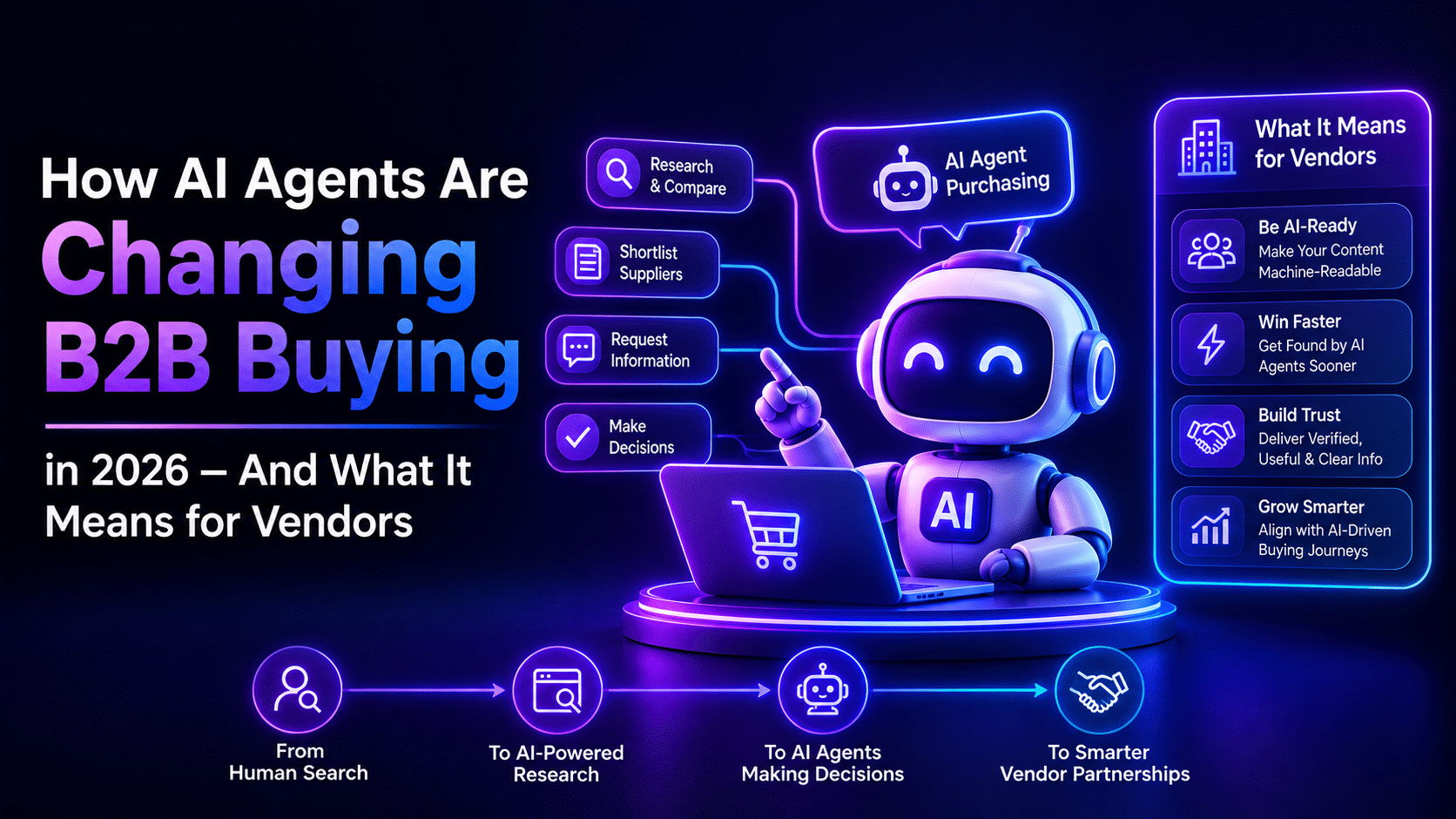

How AI Agents Are Changing B2B Buying in 2026 — And What It Means for Vendors
📋 IN THIS GUIDE
- How B2B Buying Has Actually Changed
- The Numbers That Vendors Should Know
- The New B2B Buyer Journey — Stage by Stage
- The Shortlist Problem: If AI Doesn’t Name You, You Don’t Exist
- What AI Agents Use to Evaluate and Recommend Vendors
- India-Specific Context: Why This Is Already Happening Here
- What Vendors Need to Do Differently
- FAQs
Something changed in how B2B buyers research vendors — and it didn’t happen gradually. Half of B2B software buyers now start their vendor research in an AI chatbot, not a search engine. That’s a G2 finding from 2026, not a projection. Half. Already.
The implications of this single behavioral shift are significant enough that they deserve a dedicated guide. Not because the technology is new — the previous two guides in this series covered what AI agents are and how they compare to AI tools — but because the business consequences for vendors are still being underestimated by most Indian B2B companies.
The question this guide answers: what exactly has changed in the B2B buyer journey, what are AI agents doing specifically in that journey, and what does a vendor need to do differently to stay in the conversation?
Is Your Brand Appearing When AI Agents Research Vendors Like You?
We check your AI citation rate across ChatGPT, Perplexity, Google AI Overviews, and Gemini — free, in 24 hours.
Get My Free AI SEO Audit → Talk to Our Team
No commitment · 4,100+ brands trust AResourcePool · Response in 24 hours
How B2B Buying Has Actually Changed
The traditional B2B buyer journey had a reasonably predictable structure. A problem was identified internally. Someone searched Google for solutions. They visited several vendor websites, downloaded gated content, attended a webinar, requested a demo, evaluated proposals, and eventually signed a contract. The vendor with the best search rankings got the most discovery opportunities. The vendor with the best website content converted the most of those opportunities.
That journey still exists. But it now has a parallel track — and that parallel track is increasingly where shortlists get built before the traditional journey even starts.
Today’s B2B buyer — particularly in technology, SaaS, marketing services, and professional services — often begins with a conversation rather than a search. They open ChatGPT or Perplexity and type something like: “What are the best AI SEO agencies for B2B companies in India?” or “Which project management software is best for remote software teams under 50 people?” The AI responds with a synthesized answer, naming specific vendors and explaining what each is known for.
Those named vendors have an enormous advantage in everything that follows. The buyer has already received a third-party synthesis that positions them as credible options. The vendors not named face a different situation entirely — they may never get the consideration they would have received when every vendor on page one of Google had an equal shot at the click.
The Numbers That Vendors Should Know
The behavioral shift from search-driven to AI-driven vendor discovery is documented well enough that specific numbers are available — and they move faster than most vendor marketing teams have updated their strategy to reflect.
As of 2026, 89% of B2B buyers use generative AI as a key information source in their purchase process. 94% of B2B buyers used a large language model during their buying journey in 2025. 79% of companies are actively adopting AI-driven research tools in procurement. And Gartner’s top strategic prediction for 2026: by 2028, 90% of B2B transactions will be AI-agent-influenced — meaning AI will play a role in research, shortlisting, evaluation, or execution for nine out of ten B2B purchases.
For vendors, the most operationally significant number is the shortlist one. When an AI generates a vendor recommendation in response to a buyer query, it typically names two to five specific companies. The buyer’s attention is concentrated on those companies. Everyone else is invisible in that interaction — regardless of how well they rank on Google, how good their website is, or how competitive their pricing might be.
The competitive dynamic in B2B vendor discovery has shifted from “be on page one of Google” to “be in the AI’s answer.” Page one of Google had ten results. The AI’s answer names two to five. The concentration of attention is significantly higher — and so is the consequence of not appearing.
The New B2B Buyer Journey — Stage by Stage
Understanding where AI agents are inserting themselves into the journey helps vendors identify which stages require the most immediate attention.
Stage 1: Problem recognition and initial research
This stage hasn’t changed structurally — a business identifies a problem or opportunity and starts researching solutions. What’s changed is where that research begins. Previously: Google search, reading articles, visiting vendor sites. Now: an increasing proportion of buyers start with an AI conversation to quickly understand the landscape — “what types of solutions exist for this problem,” “what are the key vendors,” “what should I know before evaluating options.”
The AI’s response to these initial queries is where the first shortlist forms. Vendors cited here have a head start that’s difficult to overcome later in the process.
Stage 2: Vendor discovery and initial shortlisting
This is the stage most transformed by AI agents. In the traditional model, a buyer might visit 15 vendor websites over two weeks to build an initial shortlist of five. With AI assistance, that process compresses dramatically. The buyer asks the AI for a shortlist, receives one with brief summaries of each vendor’s strengths, and uses that as the starting point for deeper evaluation.
The AI building that shortlist draws from its training data and live retrieval — which is exactly the territory covered in GEO optimization and LLM SEO strategy. Vendors that have built AI citation authority — through structured content, topical depth, and distributed brand signals — appear in these shortlists. Those that haven’t, don’t.
Stage 3: Detailed evaluation
Once a shortlist exists, buyers use AI agents to go deeper on each vendor — asking the AI to compare specific capabilities, generate a list of questions to ask in a demo, or summarize what customers typically say about each company. At this stage, the quality and specificity of the information the AI has about your company matters. Vendors with detailed, structured, accurate information in AI training data and retrieval results receive better summaries. Those with thin or inconsistent online presence receive vague or absent summaries — which raises doubt rather than confidence.
Stage 4: Vendor interaction and proposal
This stage still involves humans — demos, calls, proposals, negotiations. But AI agents are beginning to appear even here, with some procurement teams using AI to draft RFP documents, analyze proposals against criteria, and compare pricing structures. Vendors that make their information easy for AI to parse — clear pricing logic, specific capability descriptions, concrete case study outcomes — have an advantage even at the proposal stage.
Stage 5: Decision and post-purchase
AI-agent involvement in final decisions is still emerging. What’s more established is AI’s role in post-purchase evaluation — using agents to track vendor performance against commitments, monitor contract renewal timing, and surface alternatives if performance drops. For vendors, this means the AI visibility work doesn’t end at sale — staying visible in AI answers matters for retention and expansion as well as acquisition.
The Shortlist Problem: If AI Doesn’t Name You, You Don’t Exist
The shortlist dynamic deserves more attention than it typically gets in AI marketing discussions. Let’s make it concrete.
A procurement manager at a mid-sized Indian tech company is evaluating AI SEO agencies. In the old model, they’d search Google for “AI SEO agency India,” visit the top five results, read each website, maybe fill out a few contact forms. Every agency ranking on page one has a real shot at the shortlist.
In the new model, they ask ChatGPT: “What are the best AI SEO agencies for B2B companies in India?” ChatGPT names three agencies. The procurement manager visits those three. Maybe they add one more from a colleague’s recommendation. The agencies that appear in ChatGPT’s answer get evaluated. The agencies that don’t, don’t — even if they’d be a better fit and were ranking well on Google.
This is the structural consequence of AI-intermediated discovery. It doesn’t mean Google rankings are worthless — they still influence what AI engines can retrieve and cite. But ranking on Google without AI citation authority is an increasingly incomplete strategy. As covered in our guide on AI search versus traditional search, only 17% of AI Overview citations come from pages in the organic top 10 — which means Google rankings and AI citations are overlapping but distinct problems requiring overlapping but distinct solutions.
What AI Agents Use to Evaluate and Recommend Vendors
Understanding what signals AI agents weight when generating vendor recommendations helps vendors prioritize what to work on.
Training data familiarity. How well and how accurately is the vendor represented in the AI model’s training data? Brands that have been publishing consistent, accurate, expert-attributed content for years — and that have been mentioned by others in credible publications and communities — have stronger training data representation. This is the slow-building but durable part of AI visibility.
Live retrieval quality. For queries that trigger live web search, the AI retrieves and reads current pages. The pages that get cited are those that load fast, present content in accessible HTML, answer the relevant query directly in the opening section, and include structured FAQ sections with proper schema markup. The FAQ schema guide and structured data guide in this series cover these technical requirements in detail.
E-E-A-T signals. Named expert authors with verifiable credentials, specific case study outcomes, client testimonials that reference real results, and external validation from industry publications — these signals affect how AI systems assess the credibility of vendor information. The E-E-A-T guide in this series covers exactly what to build and in what order.
Topical depth. AI engines develop associations between brands and topics through the breadth and consistency of content. A vendor that has published comprehensively on a subject — not just one page, but a cluster of interconnected, substantive pieces covering the topic from multiple angles — is recognized as a domain authority. This recognition transfers into recommendation confidence: the AI is more likely to name a brand it has strong topical associations with than one it has only surface-level exposure to.
Distributed brand signal. How much is the vendor discussed outside their own website? Reddit, LinkedIn, industry publications, analyst coverage, comparison sites — these external signals tell AI systems that a brand is recognized and discussed by the industry, not just self-promoting. A vendor visible only on their own domain has a weaker AI representation than one discussed across multiple credible platforms.
India-Specific Context: Why This Is Already Happening Here
The shift to AI-driven B2B buying is sometimes discussed as a Western market trend that will eventually reach India. That framing is wrong for 2026.
India is the second-largest ChatGPT market globally. Perplexity AI grew 640% year-on-year in India in 2025. LinkedIn — the primary professional network where AI-generated content summaries and vendor comparisons are increasingly common — has seen substantial growth among Indian B2B professionals. Indian procurement managers and founders at technology companies are actively using AI tools in their vendor research process right now.
What makes the Indian context distinctive is the competitive asymmetry. Most Indian B2B vendors have not yet built AI citation authority. The competition for appearing in ChatGPT or Perplexity answers for Indian B2B vendor queries is still significantly lower than the competition for Google page-one rankings in the same categories. The vendor that builds this visibility now — through consistent content clusters, proper schema implementation, E-E-A-T signals — is establishing a position that will be significantly harder to displace once the space fills up.
The same first-mover argument applies to how buyers experience the shortlisting process. Right now, when an Indian buyer asks an AI for a vendor recommendation in many B2B categories, the AI names established international brands or a handful of domestic early-movers. That’s a gap — and it’s the kind of gap that closes quickly once market participants recognize it. The vendors that move in 2026 are the ones with compounding advantages in 2028.
What Vendors Need to Do Differently
The practical response to AI-driven buyer discovery is a combination of content strategy, technical implementation, and brand signal building — most of which this blog series has been building toward across its previous guides.
At the content level: the goal shifts from ranking for keywords to becoming the source AI engines cite for the queries your buyers ask. This requires a content cluster approach — not isolated optimized pages, but 10 to 15 interconnected pieces that collectively establish your domain as the recognized authority on your core topics. The GEO complete guide is the right place to start for understanding how this cluster architecture works.
At the technical level: FAQ schema markup, proper Article schema with named author information, fast page loading, and content that is accessible in HTML without JavaScript rendering dependencies. These are the signals that improve how completely AI crawlers can read and index your content. The structured data guide and page speed guide cover the technical implementation.
At the brand signal level: building presence beyond your own website. This means active LinkedIn thought leadership, genuine participation in relevant communities, earned mentions in industry publications, and ensuring your brand is discussed and recommended in the places AI training data and live retrieval systems read. Distribution of content to credible external platforms — not just publishing on your own domain — significantly increases the probability that AI engines develop the kind of multi-source familiarity with your brand that leads to consistent recommendations.
The underlying shift is from treating AI search as a channel to optimize for and instead treating it as the environment in which B2B vendor reputation is now formed. The brands that understand this — and build for it — will have structural advantages in vendor discovery that compound over the next two to three years.
Frequently Asked Questions
Q1. How are AI agents changing the B2B buying process in 2026?
AI agents are inserting themselves into multiple stages of B2B buying — particularly research and shortlisting. Buyers use AI tools like ChatGPT and Perplexity to generate vendor shortlists, compare capabilities, and produce evaluation summaries rather than manually visiting multiple websites. Gartner predicts 90% of B2B transactions will be AI-agent-influenced by 2028. For vendors, the consequence is that brand discovery has shifted from search rankings to AI citations — vendors that don’t appear in AI answers often don’t make the shortlist, regardless of their Google position or website quality.
Q2. What percentage of B2B buyers now use AI to research vendors?
The numbers are significant and growing rapidly. Half of B2B software buyers now start their research in an AI chatbot rather than a search engine (G2, 2026). 89% use generative AI as a key information source in their purchase process. 94% used a large language model during their buying journey in 2025. 79% of companies are actively adopting AI-driven research tools in procurement. These are current behavioral patterns — not projections — that Indian B2B vendors are already being evaluated against in the market.
Q3. How does AI-driven vendor discovery work differently from traditional search?
In traditional search, a buyer visits several websites from a ranked results page and builds a shortlist manually. In AI-driven discovery, the buyer asks an AI for a vendor recommendation and receives a synthesized answer naming two to five specific vendors. Those named vendors enter the buyer’s consideration set with an advantage. Vendors not named face a situation where they may never receive the website visit they would have gotten from a Google click. The competitive dynamic shifts from competing for clicks on a list to competing for inclusion in a synthesized answer — a fundamentally different optimization problem.
Q4. What do B2B vendors need to change to stay visible in AI-driven buying?
Vendors need to shift from traditional search ranking toward AI citation authority. This means: publishing structured content clusters that establish topical authority, implementing FAQ schema markup for AI-readable Q&A content, building E-E-A-T signals through named expert authors and specific case study outcomes, and building brand presence beyond their own website through LinkedIn, industry publications, and relevant communities. The goal shifts from “rank for keywords” to “become the source AI engines cite when buyers ask questions in your category.” This series’ GEO guide, structured data guide, and E-E-A-T guide cover the implementation in detail.
Q5. Is AI-driven B2B buying more common in some industries than others?
Technology and software categories see the highest AI-driven research adoption, with B2B Tech showing 82% AI Overview trigger rates on Google queries (BrightEdge, 2026). Professional services, marketing services, and consulting follow closely. Industries with complex vendor comparisons — where buyers evaluate multiple options against detailed criteria — are fastest to adopt AI-assisted research. For Indian B2B companies in tech, SaaS, digital marketing, IT services, and professional services, AI-driven buyer discovery is already the dominant pattern among forward-looking procurement teams.
Q6. How quickly is AI adoption changing B2B buying behavior in India?
Faster than most Indian vendors have adjusted to. India is the second-largest ChatGPT market globally. Perplexity AI grew 640% year-on-year in India in 2025. Indian procurement teams at technology companies and startups are actively using AI tools to research vendors before formal outreach. The competitive opportunity for Indian B2B vendors is that AI citation authority in most Indian B2B categories is still low — the first-mover window for building AI visibility is open now, and it will close as the market catches up over the next 12 to 18 months.
Get Found When AI Agents Research Vendors in Your Category
AResourcePool helps Indian B2B brands build the AI citation authority that puts them in the shortlist — starting with a free audit of where you currently stand.
Get My Free AI SEO Audit → 📱 WhatsApp Our Team
🔒 Confidential · No spam · Audit in 24 hours · 8 slots per month
Tags: AI agents B2B buying 2026, how AI changes B2B purchase, agentic AI vendor discovery, B2B buyer journey AI India, AI procurement 2026, AI vendor shortlisting India, AResourcePool
