


Offering
Solutions We Provide





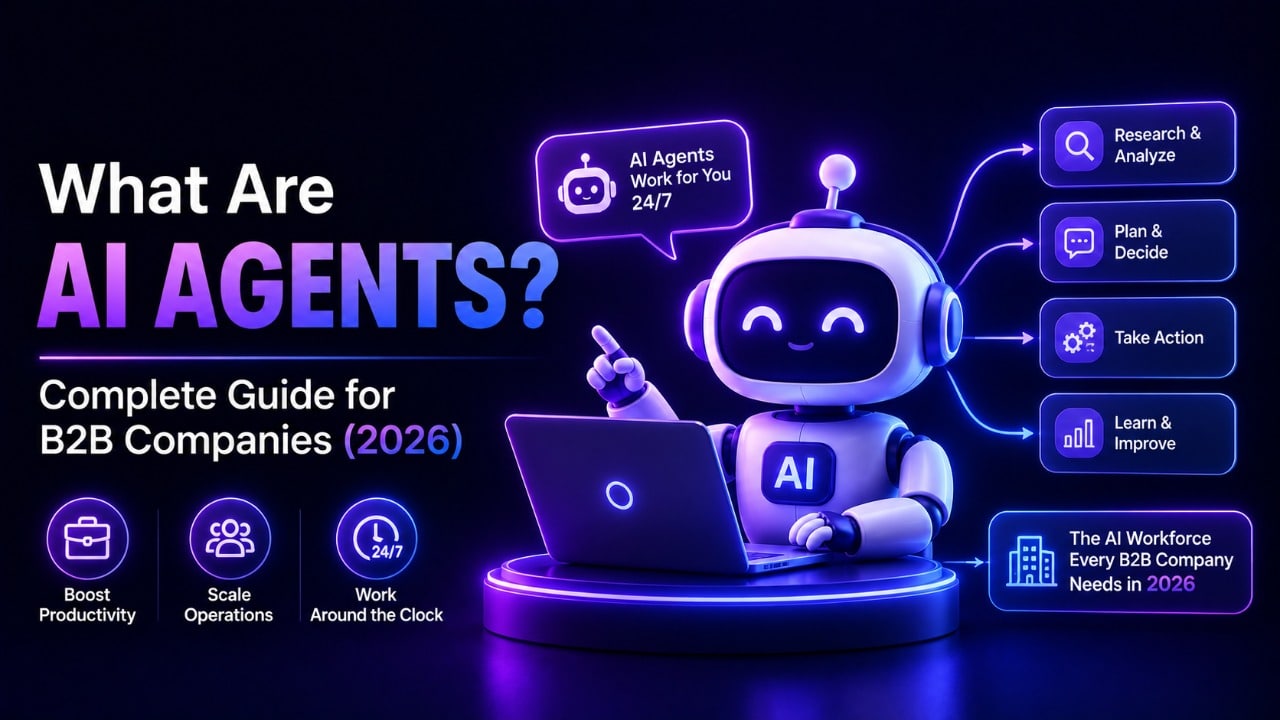

What Are AI Agents? Complete Guide for B2B Companies (2026)
📋 IN THIS GUIDE
- What an AI Agent Actually Is — The Clear Definition
- AI Agents vs Chatbots vs Traditional Automation
- How AI Agents Work: The Four Core Components
- Types of AI Agents Used in B2B Companies
- Real B2B Examples: What Agents Are Actually Doing in 2026
- The Adoption Reality — Where Most Companies Actually Are
- The AI Search Connection — Why This Matters for GEO
- What This Means for Indian B2B Companies
- Where to Start — Without Overcomplicating It
- FAQs
A Gartner prediction that’s been circulating in B2B marketing circles this year: by 2028, 90% of B2B buying will be influenced or executed by AI agents. That’s not a fringe forecast. It’s Gartner’s top strategic prediction for 2026, backed by surveys of nearly 1,200 buyers and supply chain leaders globally.
And yet, when you ask most B2B marketing and sales teams what an AI agent actually is — how it’s different from a chatbot, from workflow automation, from just “using AI tools” — the answers get vague fast. That gap between the size of the trend and the clarity of understanding is a real problem, because companies that don’t understand the mechanism can’t make sensible decisions about when and how to deploy it.
This guide is meant to close that gap. Clear definitions, real B2B examples, honest adoption data, and a practical starting point — specifically for Indian B2B companies trying to figure out where this fits in their current operations.
Want AI-First Visibility for Your B2B Brand?
As AI agents reshape how buyers research and shortlist vendors, being found in AI answers becomes essential. We help you get there.
Get My Free AI SEO Audit → Talk to Our Team
No commitment · 4,100+ brands trust AResourcePool · Response in 24 hours
What an AI Agent Actually Is — The Clear Definition
An AI agent is a software system that uses artificial intelligence to perceive context, make decisions, and take actions toward a defined goal — with varying levels of autonomy, and without requiring step-by-step human instruction for each action it takes.
The key word in that definition is goal. Traditional software receives instructions. An AI agent receives an objective. The distinction sounds small but it’s fundamental to how these systems behave in practice.
Give a traditional automation tool the instruction “send a follow-up email three days after a demo” and it will do exactly that, every time, regardless of whether the prospect has already responded, booked a call, or unsubscribed. The rule runs. Give an AI agent the goal “move this prospect through the pipeline” and it will assess the prospect’s behavior, decide whether a follow-up email is the right action or whether a LinkedIn message or a case study would be more effective, take that action, and then reassess based on what happens — all without a human directing each step.
Futurism’s 2026 AI in B2B statistics report describes agents this way: they “extend beyond simple chatbots by chaining reasoning steps, invoking tools or APIs, and sometimes collaborating with other agents to complete multi-step workflows.” That chaining of reasoning steps is what separates an agent from everything that came before it in the automation space.
AI Agents vs Chatbots vs Traditional Automation
These three things get conflated constantly, and the conflation matters because they represent genuinely different capabilities with different deployment requirements and different potential ROI.
| Feature | Traditional Automation | Chatbot | AI Agent |
|---|---|---|---|
| Takes input from | Preset triggers and rules | User queries in real time | Goals and objectives set by business |
| Decision-making | None — follows fixed script | Limited — selects from preset responses | Dynamic — reasons through options and adapts |
| Can it use tools? | Only predefined integrations | Rarely | Yes — web search, APIs, databases, other agents |
| Adapts when plan fails? | No — stops or escalates | No | Yes — reassesses and tries alternative approach |
| Works across sessions? | Yes, if configured | Mostly no | Yes — maintains context across extended workflows |
| B2B example | Sends email when form submitted | Answers “what’s your pricing?” on website | Identifies high-intent prospects, personalizes outreach, books meetings, reports results |
The practical distinction for B2B teams: chatbots and automation tools are inputs to a system someone else has to design. AI agents are systems that design and execute their own sub-processes. That’s why the ROI ceiling is higher — and why the risk of poorly deployed agents is also real, which the adoption data below makes clear.
How AI Agents Work: The Four Core Components
Understanding the mechanism helps avoid both the hype trap and the dismissal trap. AI agents in 2026 are built on four core components that work together.
1. Perception — Reading the environment
An agent needs to understand its context before it can act. This means reading data from wherever it’s available — CRM records, website analytics, email responses, search results, competitor content, market data. The quality of what an agent can perceive directly determines the quality of decisions it makes. This is why companies with clean, well-organized data see better results from agents than those with scattered or incomplete data. Data quality is the most frequently cited blocker to effective agent deployment, according to multiple 2026 enterprise surveys.
2. Reasoning — Deciding what to do
Based on what it perceives, the agent uses a large language model to reason through its options. This is where the “intelligence” part actually happens. The model evaluates possible actions against the goal, considers constraints and parameters the business has set, and selects the approach most likely to achieve the objective. Modern agents can run multiple reasoning loops — try an approach, evaluate results, reconsider, try something different — within a single workflow execution.
3. Action — Doing the thing
Reasoning without execution is just analysis. AI agents have access to tools that let them act: sending emails, updating CRM records, publishing content, searching the web, calling APIs, generating reports, booking meetings. The breadth of tools an agent can access determines its potential scope. Enterprise agents in 2026 often have access to 20 or more integrated tools — which is why “agentic AI” is increasingly described as less like a feature and more like a junior team member with full system access.
4. Memory — Learning from outcomes
Agents that can retain context across sessions — remembering what worked in previous interactions with a prospect, what content performed well last quarter, which outreach sequences had higher reply rates — compound their effectiveness over time. This is still an area of active development, and agent memory architectures vary significantly across platforms. But it’s the capability that makes “AI as a team member rather than a tool” the framing that keeps appearing in 2026 enterprise case studies.
Types of AI Agents Used in B2B Companies
Not all AI agents work the same way or serve the same function. For B2B companies in India and globally, the most commonly deployed categories in 2026 are:
Lead generation and qualification agents. These agents identify potential prospects from defined criteria, research them across multiple data sources, score them against ideal customer profile criteria, and prioritize the ones most likely to convert — without a human manually working through a list. A 12-person sales team overwhelmed by 280 inbound form fills per week but only able to qualify 60 before leads went cold deployed a qualification agent that engaged every lead within minutes, significantly improving response rates and conversion. That example, from a 2026 B2B marketing analysis, captures the core use case: volume that human teams can’t handle, handled by an agent that doesn’t sleep.
Content and AI search agents. These agents research topics, identify gaps versus competitors, draft content to a brief, optimize it for AI search engines like ChatGPT and Perplexity (the discipline covered in our GEO complete guide), and track post-publication performance. For B2B brands trying to maintain consistent AI search visibility — publishing enough high-quality, structured content to earn ongoing citations from ChatGPT and Perplexity — content agents are one of the most practically relevant deployment options.
Customer support agents. These handle repetitive queries autonomously, escalate genuinely complex issues to human agents, and learn from resolutions to handle similar cases better over time. In B2B contexts with high-volume technical support or account management queries, the cost difference between human-handled and agent-handled tickets is substantial — dropping from $5-15 per resolved ticket to $0.20-1.00 in well-deployed implementations.
Market and competitive intelligence agents. These monitor competitor content, track industry news, summarize developments in specific categories, and flag signals that might require a strategic response. For Indian B2B companies trying to stay current on fast-moving topics like AI search and agentic AI, these agents can replace hours of manual monitoring per week.
Real B2B Examples: What Agents Are Actually Doing in 2026
Statistics are useful, but concrete examples are more useful still. Here are real workflow examples from 2026 deployments that illustrate what agents do in practice:
Outbound prospecting. An AI sales agent is given a target account list and a goal: book 30 qualified meetings this month. The agent researches each account, finds the right contacts, personalizes an outreach message based on each company’s recent news and likely pain points, sends it through the right channel (email, LinkedIn, or a combination), monitors responses, follows up with non-responders at optimal intervals, and flags replies that need human follow-up. It does this across all 200 accounts simultaneously. A human SDR might work through 15 accounts in a day. The agent runs all 200 in parallel, continuously.
Content pipeline maintenance. A B2B SaaS company gives an agent the goal: maintain 3 new SEO-optimized blog posts per week, each structured for AI search citation. The agent identifies topics based on search demand and competitor gaps, drafts each post with proper FAQ sections and structured data recommendations, flags each draft for a subject matter expert to review and add original insights (the 30% that differentiates the content), and publishes after approval. The human’s job shifts from doing the 70% structural work to reviewing and adding the 30% that actually requires expertise.
Lead nurturing sequences. An agent monitors where each prospect is in the pipeline and what signals they’re showing — content they’ve viewed, emails they’ve opened, pages they’ve visited. Based on this, it determines what content or outreach would be most useful at that moment and sends it. Not a preset sequence, but a dynamic decision: this particular prospect just read three case studies and visited the pricing page — the right action is a demo offer, not another educational email.
The Adoption Reality — Where Most Companies Actually Are
The headline adoption statistics for AI agents in 2026 are striking. 79% of companies say they’re adopting AI agents (PwC). 40% of enterprise applications will include task-specific agents by end of 2026, up from less than 5% in 2025 (Gartner). The AI agents market is valued at $10.9 billion in 2026, growing at a 44-46% CAGR.
The more honest picture sits beneath those numbers. 62% of organizations are experimenting with AI agents — but only 11% have deployed them in production at scale. And Gartner projects that over 40% of agentic AI projects are at risk of cancellation by 2027, primarily because companies deployed without clear governance, scoped use cases, or realistic expectations.
“The companies capturing meaningful value aren’t simply adding AI to existing work — they are re-architecting workflows around what agents can do.” — McKinsey, 2026 B2B Pulse Survey
That gap between adoption rhetoric and production reality is important context for any Indian B2B company trying to form a sensible strategy. Being cautious here isn’t being late — it’s being smart. The 74% of executives who report ROI within the first year share a common characteristic: they started with one specific, high-value use case, measured it against a clear baseline, and scaled only after proving results. The companies canceling projects are the ones that tried to deploy AI agents broadly before establishing that discipline.
The AI Search Connection — Why This Matters for GEO
There’s a dimension of the AI agents trend that’s particularly relevant for B2B companies focused on digital visibility, and it connects directly to the AI SEO work covered in this blog’s earlier series.
AI agents are changing how B2B buyers research vendors. As of 2026, half of B2B software buyers start their research in an AI chatbot rather than Google Search (G2, 2026). 89% of B2B buyers use generative AI as a key information source. When an AI agent — or a human using an AI tool — asks “what are the best AI SEO agencies in India,” the answer that comes back is determined by which brands have built the kind of GEO visibility covered in our LLM SEO guide. That means the GEO and AEO work — FAQ schema, E-E-A-T signals, structured data, topical authority — isn’t just about showing up in ChatGPT when humans ask questions. It’s about showing up when AI agents are doing the research on behalf of human buyers.
Gartner’s projection that 90% of B2B transactions will be AI-agent-influenced by 2028 is largely about this dynamic. The AI agent intermediating a B2B purchase will draw on the same citation patterns as a human using ChatGPT or Perplexity. Which brands appear in those AI-generated shortlists depends on who has built GEO authority — not just who has the best Google rankings.
For Indian B2B companies reading this: the Google AI Overviews guide, the Perplexity optimization guide, and the ChatGPT citation guide in this series are not just about today’s search behavior. They’re about building the visibility foundation that positions your brand correctly as AI agents increasingly mediate B2B buying decisions.
What This Means for Indian B2B Companies
The AI agents trend is not arriving in India in slow motion. India is already the second-largest ChatGPT market globally. AI-assisted research is common among Indian B2B procurement teams in tech, SaaS, and professional services. The buyers that Indian B2B companies sell to — whether domestic or international — are already using AI tools in their evaluation process.
What makes the Indian context particularly interesting is the combination of rapid adoption among buyers and slow adoption among vendors. Most Indian B2B agencies, SaaS companies, and service providers have not yet deployed AI agents in their marketing or sales operations. That means the competitive gap between early adopters and the rest of the market is still small enough to close — and wide enough to matter.
Companies that automate their lead qualification, content production, and competitor monitoring with agents in 2026 will operate at a structural cost and speed advantage over those doing the same work manually in 2028. The compounding effect of agent-assisted operations — more qualified leads processed, more content published, more market intelligence gathered, faster response times — creates the kind of scale differential that’s difficult to close once it’s been established.
For Indian B2B companies specifically, the most immediately actionable entry point is the AI search and content visibility angle: using AI agents to maintain the consistent GEO content output that earns ongoing citations from ChatGPT, Perplexity, and Google AI Overviews. This is something AResourcePool’s AI SEO services are specifically built around — not just auditing where you stand, but building the ongoing content and visibility infrastructure that keeps you appearing in AI-generated answers over time.
Where to Start — Without Overcomplicating It
Given everything above, the natural question is: what should an Indian B2B company actually do first?
The most reliable answer from 2026 deployment data is boring but consistent: pick one specific workflow, deploy an agent for that workflow only, measure the outcome against a clear baseline, and prove ROI before expanding.
For most B2B service companies, the three most practical starting points are:
Lead qualification — if inbound leads are sitting uncontacted for more than an hour because the team is stretched, an agent that engages every inbound lead within minutes pays for itself quickly in conversion improvement.
Content and AI search visibility — if publishing consistent, well-structured content for GEO purposes is a stated priority but keeps getting deprioritized, an agent that handles the research and drafting portion of the workflow makes consistent output achievable at realistic team sizes.
Market intelligence — if tracking competitor activity, industry news, and AI search trends is something that should happen weekly but usually doesn’t, an agent that delivers a weekly summary synthesized from across the web costs less than the manual hours it replaces.
Starting with the AI search and content angle makes particular sense for companies already working to build GEO visibility — it directly extends the strategy covered in the FAQ schema guide, the E-E-A-T guide, and the structured data guide in this series by making it operationally sustainable rather than aspirational.
Frequently Asked Questions on AI Agents
Q1. What is an AI agent?
An AI agent is a software system that uses artificial intelligence to perceive context, make decisions, and take actions toward a defined goal — with varying levels of autonomy and without requiring step-by-step human instruction. Unlike a chatbot that responds to queries or traditional automation that follows fixed rules, an AI agent receives an objective and independently determines what steps to take. It can use tools, call APIs, search the web, analyze data, and adapt its approach based on what it finds — all within parameters set by the business deploying it.
Q2. How are AI agents different from chatbots?
Chatbots are reactive — they wait for input, respond, and stop. They follow a script or response model. AI agents are proactive — they receive a goal and pursue it through a sequence of self-determined steps. A chatbot answers “what is your return policy.” An AI agent, given the goal “reduce customer churn by 10%,” would independently analyze customer data, identify at-risk accounts, draft and send personalized retention messages, monitor responses, and adjust its approach based on results — without a human directing each step. The core difference is autonomy: chatbots respond, agents pursue.
Q3. What are the main types of AI agents used in B2B companies?
For B2B companies in 2026, the most commonly deployed types are: lead generation and qualification agents (autonomous prospect research, scoring, and outreach), content and SEO agents (topic research, drafting, AI search optimization), customer support agents (repetitive query handling and escalation), sales development agents (outbound prospecting and meeting booking), and market intelligence agents (competitor monitoring and trend synthesis). Most successful deployments start with one type focused on one high-value workflow before expanding.
Q4. What is the difference between AI agents and traditional marketing automation?
Traditional marketing automation follows preset rules: if user does X, send email Y. The workflow is fixed — a human designs every branch in advance. AI agents receive a goal and determine the workflow themselves. An AI marketing agent given the goal “generate 50 qualified leads this month” would independently decide which channels to use, what content to create, which prospects to prioritize, and how to adjust when initial approaches underperform — adapting in real time. The key difference is adaptability: automation is rigid, agents are adaptive. Automation is a tool someone designs; an agent is a system that designs its own sub-processes.
Q5. Are AI agents replacing human employees in B2B companies?
Current evidence suggests augmentation rather than wholesale replacement. McKinsey’s 2026 B2B Pulse Survey found growth leaders report seller efficiency (59%) and better customer experiences (53%) as primary benefits — not headcount reduction. The typical pattern is that AI agents handle high-volume, repetitive, data-processing parts of a role — initial outreach, lead scoring, content drafting, report generation — while humans focus on relationship-building, complex judgment calls, and the specific expertise that genuinely differentiates the company. The function changes; the human role shifts, but usually doesn’t disappear entirely in well-designed implementations.
Q6. How should an Indian B2B company start with AI agents?
Identify one specific workflow that is high-volume, repetitive, and currently costing significant human time. Start with that single use case, measure the outcome against a clear baseline, and prove ROI before expanding. McKinsey’s research warns against bolting agents onto existing processes — the companies seeing results are redesigning workflows around what agents can do. For Indian B2B companies already working on AI search visibility, using an agent to maintain consistent GEO content output is a practical and measurable starting point that directly extends the GEO and AEO strategy.
Q7. What is the ROI of AI agents for B2B companies?
74% of executives who have deployed AI agents report ROI within the first year. Typical results include 6 to 10% revenue increases, with top performers reporting 18% ROI. Companies using agentic workflows report 1.7x ROI on average. However, Gartner projects over 40% of agentic AI projects are at risk of cancellation by 2027 — primarily due to lack of governance, unclear use cases, and unrealistic expectations. The companies generating consistent ROI started with one well-defined use case, measured it against a clear baseline, and scaled only after validating results.
Build AI-First Brand Visibility Before Your Competitors Do
As AI agents reshape B2B buying, appearing in AI-generated answers becomes a growth channel. AResourcePool helps Indian B2B brands build that visibility — starting with a free audit.
Get My Free AI SEO Audit → 📱 WhatsApp Our Team
🔒 Confidential · No spam · Audit in 24 hours · 8 slots per month
Tags: what are AI agents, AI agents B2B 2026, agentic AI India, AI agents vs chatbots, AI agents marketing examples, autonomous AI B2B, AI agents guide India, AResourcePool
