


Offering
Solutions We Provide






By DP Singh, Senior SEO Content Strategist at AResourcePool · Published: April 29, 2026 · ⏱ 11 min read · Updated with latest 2026 GEO statistics
📋 TABLE OF CONTENTS
- What is Generative Engine Optimization (GEO)?
- GEO vs SEO vs AEO: Key Differences
- Why GEO Matters for Indian B2B Businesses in 2026
- How AI Engines Select & Cite Content
- 7 Proven GEO Strategies to Rank on ChatGPT & Perplexity
- Platform-Specific Tactics: ChatGPT, Perplexity, Google AI Overviews
- GEO Optimization Checklist (2026)
- How to Measure Your GEO Performance
- Frequently Asked Questions on GEO
TL;DR: Generative Engine Optimization (GEO) is the practice of structuring your content so that AI search engines like ChatGPT, Perplexity, Google AI Overviews, and Gemini cite your brand in their generated responses. In 2026, GEO is as critical as traditional SEO was in 2010 — and Indian B2B brands that ignore it are losing buyers to competitors who have already embraced it.
Search has changed. Not incrementally — fundamentally. If you typed a query into Google today and saw an AI-generated paragraph appear above the blue links, you have already experienced the shift. Welcome to the era of Generative Engine Optimization (GEO) — the discipline of making your content the source that AI models choose to cite, quote, and surface.
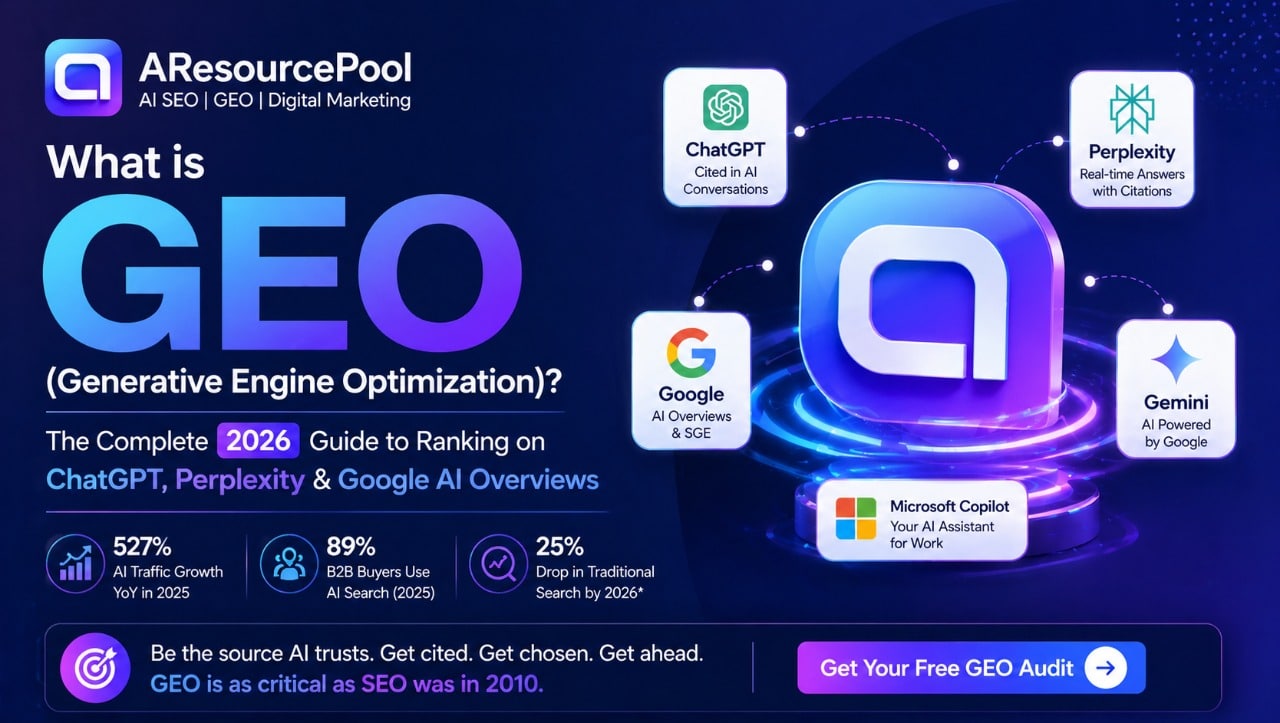
According to Previsible’s 2025 AI Traffic Report, AI-referred sessions jumped 527% year-over-year in the first five months of 2025. (Source: Search Engine Land, 2025) Gartner predicts traditional search engine volume will drop by 25% by 2026 due to AI assistants and chatbots. In India specifically, Perplexity AI grew over 640% year-on-year — and B2B buyers are now opening ChatGPT before they open Google.
📊 Key Stat: 89% of B2B buyers now consider AI search a top source throughout the buying process (2025 B2B Buyer Survey). If your brand isn’t cited in AI answers, you don’t exist for those buyers.
This guide is your complete, action-ready framework for Generative Engine Optimization in 2026 — built specifically for Indian B2B businesses and marketing teams ready to stop losing ground to AI-first competitors.
1. What is Generative Engine Optimization (GEO)?
Generative Engine Optimization (GEO) is the practice of optimizing your website content, structure, and authority signals so that AI-powered answer engines — including Google AI Overviews, ChatGPT, Perplexity AI, Microsoft Copilot, and Gemini — include your content as a cited source in their generated responses.
When a user asks ChatGPT “which is the best AI SEO agency in India?” or searches Perplexity for “top generative engine optimization companies,” the AI engine doesn’t just return links. It reads thousands of sources, synthesizes a conversational answer, and cites two to five sources it finds most authoritative. GEO is the art and science of being one of those cited sources.
💡 Simple Definition: Traditional SEO gets your page ranked on Google’s list of blue links. GEO gets your brand mentioned inside the AI’s answer — which users read and trust without ever clicking to your website.
Why Was GEO Coined? The Origin Story
The term GEO was first coined in 2023 by researchers at Princeton University, who published a foundational paper defining Generative Engine Optimization as a framework for content creators to improve visibility in generative engine responses. Since then, the discipline has evolved rapidly — with millions in venture capital flowing into GEO platforms and agencies.
GEO is also referred to by several names across the industry: AEO (Answer Engine Optimization), LLMO (Large Language Model Optimization), GSO (Generative Search Optimization), and AIO (AI Optimization). All describe the same fundamental goal: being chosen by AI as the authoritative source to cite.
🤖 Is Your Brand Visible on ChatGPT & Perplexity?
Get a free GEO Visibility Audit — we check your brand citation rate across 5 major AI engines and show you exactly what’s missing.
Get My Free GEO Audit → Talk to an Expert
No commitment · Delivered in 24 hours · 4,100+ brands already trust us
2. GEO vs SEO vs AEO: The Key Differences Explained
Many marketers confuse GEO, SEO, and AEO. Here is a clear breakdown of how each discipline differs — and why you need all three in 2026:
| Feature | Traditional SEO | AEO (Answer Engine Optimization) | GEO (Generative Engine Optimization) |
|---|---|---|---|
| Optimizes For | Google blue link rankings | Featured snippets, voice search | AI-generated answer citations |
| Target Platforms | Google, Bing, Yahoo | Google, Alexa, Siri | ChatGPT, Perplexity, Google AI Overviews, Gemini, Copilot |
| User Action | Clicks on your link | Hears/reads a direct answer | Sees your brand cited in AI response (may not click) |
| Content Format | Long-form, keyword-rich | Structured Q&A, concise answers | Authority-first, data-rich, source-worthy |
| Key Metrics | Rankings, organic traffic, CTR | Featured snippet wins, voice appearances | LLM Share-of-Voice, Citation Frequency, AI mention rate |
| Schema Used | Article, Product, LocalBusiness | FAQ, HowTo, Speakable | FAQ, Article, Speakable, Entity definitions |
| 2026 Importance | Still essential (foundational) | Now absorbed into GEO | 🔥 Most critical new discipline |
The bottom line: GEO is not a replacement for traditional SEO. It is an additional optimization layer that the most competitive brands in 2026 are building on top of their existing SEO foundation. Brands that master GEO while maintaining strong traditional SEO have a compounding advantage — every AI citation also reinforces their domain authority in Google’s traditional index.
3. Why GEO is Critical for Indian B2B Businesses in 2026
India is experiencing one of the fastest AI search adoption rates in the world. Understanding why GEO matters specifically for Indian B2B brands requires looking at the data:
📊 India AI Search Stats: Perplexity AI grew 640% year-on-year in India in 2025. ChatGPT surpassed 900 million weekly active users worldwide by early 2026 (Source: Genmark AI Report, 2025) (OpenAI). India is the 2nd largest ChatGPT market globally.
The B2B Buyer Journey Has Changed
The modern Indian B2B buyer no longer starts their vendor research on Google. They open ChatGPT or Perplexity and ask conversational questions like “best AI SEO agency for SaaS companies in India” or “which company can help me rank on Google SGE?” The AI’s answer shapes their shortlist — before they ever visit a website.
According to a 2025 B2B buyer survey, 89% of B2B buyers now consider AI search a top source throughout the buying process. B2B SaaS companies saw AI search grow to approximately 4.5% of organic traffic by September 2025 — with 127% growth in just three months. That number is accelerating rapidly.
Zero-Click is the New Normal
Google’s AI Overviews now appear in an estimated 30–40% of all search queries, directly answering questions without requiring a click to any website. Google’s own data shows AI-generated summaries now trigger on 13% of all search queries — double what it was just months ago.
For Indian B2B companies, this means: if your brand is not being cited in AI answers, you are losing buyers to competitors who are — even if you outrank them on traditional Google. This is the GEO gap, and AResourcePool’s AI SEO services are specifically designed to close it.
4. How AI Engines Select & Cite Your Content
To optimize for GEO, you must first understand how AI search engines actually decide which sources to include in their generated responses. The process follows what is known as a Retrieval-Augmented Generation (RAG) pipeline:
Step 1 — Crawling & Indexing
AI engines crawl and index content from across the web, similar to traditional search engines. Crawlability is table stakes — if your page cannot be crawled, it cannot be cited. Fast page speed, clean technical SEO, and schema markup all affect how completely AI engines index your content.
Step 2 — Semantic Relevance Matching
When a query is submitted, the AI system identifies the most semantically relevant passages — not just keyword matches, but topical depth and context. This means your content must comprehensively cover a topic (not just target keywords) to be considered relevant by AI engines.
Step 3 — E-E-A-T Weighting
From semantically relevant sources, the AI engine weights content by E-E-A-T signals — Experience, Expertise, Authoritativeness, and Trustworthiness. Sources with named expert authors, verifiable data, and strong domain authority are disproportionately favored as citation candidates.
Step 4 — Citation Selection
The model assembles its answer and selects two to five sources to cite. Sources that provide direct, clearly structured answers with clean formatting are vastly more likely to be selected. This is why content that directly answers the query in the first 200 words, uses FAQ formatting, and includes verifiable statistics consistently outperforms long-winded content in GEO.
💡 Key Insight: AI models don’t rank pages like Google does. They select sources for their answers. A page can rank #1 in Google but never get cited by ChatGPT if it lacks the structural elements AI engines prioritize — namely, direct answers, data richness, and E-E-A-T authority.
5. 7 Proven GEO Strategies to Rank on ChatGPT & Perplexity
Based on data from thousands of AI citation audits, these are the seven strategies that consistently improve your brand’s citation rate across major AI engines in 2026:
Strategy 1 — Direct Answer First (TLDR-First Structure)
AI systems that use real-time retrieval (Perplexity, Google AI Overviews) evaluate a page’s relevance primarily on its opening 200 words. Your content must directly and completely answer the primary query at the very beginning — not build up to it. Write your most important answer first, then provide supporting detail. This mirrors the TLDR-first structure that top-performing GEO content uses consistently.
Strategy 2 — Data-Rich Content with Verifiable Statistics
Content with specific, verifiable statistics is significantly more likely to be cited by AI engines. Include data points with source citations, year references, and precise numbers. Comparison articles that cite data are the most-cited content format, accounting for 32.5% of all AI citations across major platforms. When you state “AI referral traffic grew 527% year-over-year (Previsible, 2025),” you give AI engines a specific, citable claim — exactly what they prefer to surface.
Strategy 3 — FAQ Schema Markup with Comprehensive Answers
FAQ sections with proper JSON-LD schema markup are one of the highest-impact GEO tactics available. Each FAQ answer should be 80–120 words — long enough to be substantive, short enough to be directly quotable by AI. Use natural question phrasing that mirrors how buyers actually ask questions to AI tools. Generic one-line answers will not get cited; detailed, complete answers will.
Strategy 4 — E-E-A-T Authority Signals
AI engines strongly favor content from recognized experts. Build E-E-A-T signals through: named expert authorship with verifiable credentials, quotes from industry authorities, detailed author bios linked to LinkedIn, mentions in authoritative third-party publications, and case studies with real client outcomes and named companies. Google’s E-E-A-T framework directly influences which sources AI Overviews choose to cite.
Strategy 5 — Semantic Keyword Clusters (Not Single Keywords)
GEO rewards topical authority — comprehensive coverage of a topic — over single keyword optimization. Instead of targeting “AI SEO services,” build a content cluster that covers: what is AI SEO, how AI SEO differs from traditional SEO, GEO strategy, LLM optimization, AI citation building, and case studies. AI engines cite sources they recognize as comprehensive authorities on a topic, not pages optimized for a single search term.
Strategy 6 — Community & Third-Party Presence
Major LLMs pull heavily from platforms like Reddit, LinkedIn, and YouTube. Reddit alone has 100 million daily active users generating conversations about brands that AI engines read and reference. Building your brand presence on these platforms — through thought leadership posts, community participation, and YouTube explainer content — significantly boosts how often AI engines recommend your brand in generated answers.
Strategy 7 — Freshness & Continuous Content Updates
Perplexity AI in particular rewards content with recent publication dates and frequent updates. Freshness matters more for GEO than for traditional SEO. A blog post updated in April 2026 with current statistics will consistently outperform a better-written but older article. Treat your content as a living asset — update statistics, add new data, and refresh examples at least quarterly.
6. Platform-Specific GEO Tactics: ChatGPT, Perplexity & Google AI Overviews
Each AI engine has distinct characteristics that require tailored optimization approaches:
ChatGPT (Browse Mode) — Speed + Crawlability First
ChatGPT Search browses the web in real time for recent queries. To rank well: ensure fast page speed (LCP under 2.5 seconds), clean crawlability with no JavaScript gates, frequently updated content, and structured data. ChatGPT cites sources inline — your meta description often becomes the citation excerpt, so write it to function as a complete, standalone answer.
Perplexity AI — Freshness + Data + Clear Sourcing
Perplexity is highly citation-driven and rewards content with clear sourcing, verifiable data, and recent publication dates. Freshness matters more here than on any other platform. Perplexity processes over 500 million queries per year and actively surfaces the most current, data-backed content available. Include year-specific data, source your statistics explicitly, and update your content at minimum once per quarter.
Google AI Overviews — Schema + E-E-A-T + Traditional SEO Foundation
Google AI Overviews appear in an estimated 30–40% of all search queries and draw citations from Google’s existing index. Being cited in AI Overviews requires: strong schema markup (FAQ, Article, HowTo), robust E-E-A-T signals, high domain authority, and content that already performs well in traditional Google search. AResourcePool’s AI SEO strategy builds both traditional ranking authority and AI Overview citations simultaneously — maximizing your visibility across both surfaces.
Microsoft Copilot — Bing SEO + Microsoft Ecosystem
Copilot pulls heavily from Bing’s index and Microsoft-owned surfaces. Bing Webmaster Tools verification, Bing SEO fundamentals (meta tags, sitemaps, clean architecture), and presence in Microsoft’s knowledge graph all directly boost your Copilot citation rate. Many Indian B2B companies overlook Bing entirely — which creates an easy competitive advantage for those who optimize for it.
7. GEO Optimization Checklist for 2026
Use this checklist to audit your current GEO readiness. Every item checked means a higher probability of being cited by AI engines:
- First 200 words directly and completely answer the primary query
- FAQ section with 8-12 questions and 80-120 word answers per question
- FAQPage JSON-LD schema markup implemented in <head>
- Article/BlogPosting JSON-LD schema with author, publisher, dateModified
- Named expert author with verifiable credentials in author bio
- Minimum 3-5 verifiable statistics with source citations included
- Content updated within the last 90 days (freshness signal)
- Page LCP (Largest Contentful Paint) under 2.5 seconds
- No JavaScript gates blocking AI crawler access to content
- Semantic keyword clusters covering related topics comprehensively
- Internal links to related topic pages (builds topical authority)
- Content submitted in Google Search Console and Bing Webmaster Tools
- Brand mentions building on Reddit, LinkedIn, and YouTube
- Comparison tables and structured data included in content
- Meta description written as a direct, standalone answer (80-155 chars)
- E-E-A-T signals present: experience, expertise, authority, trust
📌 Pro Tip from AResourcePool: Run this checklist against your top 5 most important service pages first. Pages with GEO optimization consistently see 25–40% improvement in AI citation rate within 60 days. If you want us to run this audit for you — completely free — claim your free AI SEO audit here.
8. How to Measure Your GEO Performance in 2026
One of the biggest challenges in GEO is measurement — AI citations do not always translate directly into trackable website clicks. Here is how to measure your GEO performance effectively:
Primary GEO Metrics to Track
LLM Share-of-Voice: How often does your brand appear in AI-generated responses for target queries compared to competitors? This is the most direct GEO performance metric. Test 20-30 target queries manually in ChatGPT, Perplexity, and Google AI Overviews monthly to track your citation rate trends.
Citation Frequency: Count how many times your brand, website, or specific content is cited by AI engines across your target query set. Tools like HubSpot’s AI Search Grader, Geoptie, and AResourcePool’s proprietary GEO audit provide structured citation frequency data.
AI Referral Traffic in GA4: In Google Analytics 4, AI referral traffic appears under traffic sources from chatgpt.com, perplexity.ai, and similar domains. While AI-referred sessions represent a small percentage of total traffic, they convert at 4-5x the rate of traditional search visitors — making quality far more important than volume for GEO measurement.
Branded Search Volume Trends: GEO drives brand awareness even when users don’t click through. Monitor your branded keyword search volume in Google Search Console — an increase indicates that AI citations are driving brand awareness that converts to direct searches later.
📊 Conversion Insight: Visitors from AI platforms convert at 4-5 times the rate of traditional search visitors (The Washington Post, 2026). GEO traffic is the highest-quality organic traffic available in 2026 — optimize for citation quality, not click volume.
🚀 Ready to Get Your Brand Cited on ChatGPT & Perplexity?
AResourcePool is India’s leading GEO and AI SEO agency. We’ve helped 4,100+ businesses get cited by AI engines — and we’ll do the same for you. Start with a free GEO audit that benchmarks your brand across 5 major AI platforms.
Claim My Free GEO Audit → 📞 Talk to an Expert Now
Only 8 free audits available per month · No commitment required · Delivered in 24 hours
9. Frequently Asked Questions on GEO (Generative Engine Optimization)
Q1. What is Generative Engine Optimization (GEO)?
Generative Engine Optimization (GEO) is the practice of structuring, writing, and distributing content so that AI-powered search engines — like Google AI Overviews, ChatGPT Search, Perplexity AI, Microsoft Copilot, and Gemini — include your content as a cited source in their generated responses. Unlike traditional SEO which ranks blue links, GEO gets your brand mentioned directly inside AI-generated answers that users read and trust without clicking to your site.
Q2. What is the difference between GEO, SEO, and AEO?
SEO (Search Engine Optimization) optimizes content to rank as blue links in traditional Google results. AEO (Answer Engine Optimization) originally targeted voice search and featured snippets. GEO (Generative Engine Optimization) optimizes content to be cited inside AI-generated conversational responses on platforms like ChatGPT, Perplexity, and Google AI Overviews. In 2026, GEO has largely subsumed AEO as most AI engines now use generative response mechanisms rather than simple answer extraction.
Q3. Why is GEO important for B2B businesses in India in 2026?
B2B buyers now open ChatGPT or Perplexity before they open Google to shortlist vendors. AI-referred sessions jumped 527% year-over-year in 2025. In India, Perplexity grew 640% year-on-year and ChatGPT is the 2nd-most used platform among Indian professionals. Gartner predicts traditional search volume will drop 25% by 2026. (Source: Gartner, 2024) Without GEO, B2B brands risk being invisible to buyers during the most critical vendor shortlisting phase — even if they rank well on traditional Google.
Q4. How long does it take to see results from GEO?
Most brands begin seeing improvements in AI citation rates within 30–60 days of implementing a structured GEO strategy. Citation rates typically improve by 25–40% in the first quarter when schema markup, FAQ optimization, and E-E-A-T content improvements are implemented together. Full authority across ChatGPT, Perplexity, and Google AI Overviews builds progressively over 4–6 months. AResourcePool clients typically see their first AI citations within 45 days of starting our GEO program.
Q5. What type of content ranks best in AI-generated answers?
Research shows comparison articles lead with 32.5% of all AI citations, followed by opinion pieces and research-backed guides. Content that consistently wins AI citations includes: structured FAQ sections with complete 80-120 word answers, data-backed content with verifiable statistics, expert-authored E-E-A-T content with named credentials, clearly formatted how-to guides, and content that directly answers the primary query in the first 200 words. FAQ Schema markup and Article Schema both significantly boost AI citation probability.
Q6. How do I check if my brand appears in ChatGPT or Perplexity?
To audit your GEO visibility: (1) Open ChatGPT, Perplexity, and Google AI Overviews and search 10-20 queries your buyers would use, such as “best [your service] company in India” or “how to [solve your customer’s problem]”. (2) Note whether your brand appears and how it is positioned. (3) Use HubSpot’s free AI Search Grader for a baseline score. (4) For a comprehensive audit across 5 AI platforms with competitor benchmarking, request AResourcePool’s free GEO audit at aresourcepool.com/ai-seo-services.
Q7. Is GEO a replacement for traditional SEO?
No. GEO is an additional optimization layer, not a replacement for traditional SEO. Brands that excel at GEO in 2026 are typically those with strong traditional SEO foundations — the two disciplines share many underlying principles around quality content, authority signals, and technical optimization. Traditional SEO drives click-through traffic; GEO drives brand citations in AI responses. The most effective strategy in 2026 combines both, as GEO optimization (E-E-A-T, schema, structured content) also amplifies traditional Google rankings.
Q8. What does AResourcePool do for GEO and AI SEO?
AResourcePool is India’s leading AI SEO and GEO agency, helping B2B brands rank on ChatGPT, Perplexity, Google AI Overviews, Gemini, and Microsoft Copilot. Our GEO services include: LLM Share-of-Voice tracking and reporting, FAQ schema markup implementation, semantic keyword cluster development, E-E-A-T content strategy, AI citation building, technical SEO for AI crawlers, and monthly GEO audit reporting across 5 platforms. With 4,100+ clients, 25K+ #1 keyword rankings, and 10+ years of experience, we deliver measurable AI search visibility — guaranteed. Get your free GEO audit at aresourcepool.com/ai-seo-services.
Conclusion: GEO is Not the Future — It’s the Present
Generative Engine Optimization is not a trend to watch in 2027. It is a competitive necessity in 2026. With AI-referred sessions up 527% year-over-year, ChatGPT reaching 900 million weekly users, and Google AI Overviews now appearing on 30-40% of all searches, the brands being cited in AI answers are quietly stealing market share — without their competitors even realizing it.
For Indian B2B businesses, the GEO opportunity is particularly compelling. Competition for AI citations is still relatively low compared to traditional SEO — meaning early movers can capture significant AI search visibility before the space becomes as crowded as Google’s first page. The window to establish GEO authority at lower cost is open right now, and it will not stay open forever.
The 7 strategies in this guide — direct answers first, data-rich content, FAQ schema, E-E-A-T authority, semantic clusters, community presence, and freshness — represent the proven framework for GEO success in 2026. Implement them systematically, measure your LLM Share-of-Voice monthly, and you will see your brand appear with increasing frequency in the AI answers your buyers are reading right now.
If you would like AResourcePool to implement this framework for your business — from technical schema markup to full GEO content strategy — our team is ready to start with a free, no-commitment audit of your current AI search visibility.
Start Ranking on ChatGPT & Perplexity — Today
Join 4,100+ businesses that trust AResourcePool for AI SEO and GEO. Get your free audit in 24 hours.
Get My Free AI SEO Audit →
📱 WhatsApp Our Experts
🔒 100% confidential · No spam · Response guaranteed in 24 hours
Tags: Generative Engine Optimization, GEO, AI SEO, GEO vs SEO, ChatGPT SEO India, Perplexity optimization, Google AI Overviews, AEO, LLM optimization, AI SEO services India, rank on ChatGPT, B2B AI SEO, GEO strategy 2026, AResourcePool
Internal Links Used:
AI SEO Services ·
AEO Services ·
Contact Us
