


Offering
Solutions We Provide






By DP Singh, Senior SEO Content Strategist at AResourcePool ·
Published: April 30, 2026 · ⏱ 12 min read ·
View all AResourcePool blogs →
Published: April 30, 2026 · ⏱ 12 min read ·
View all AResourcePool blogs →
📋 TABLE OF CONTENTS
- Why the SEO vs GEO vs AEO Question Matters in 2026
- What is Traditional SEO? (And What It Can No Longer Do Alone)
- What is AEO (Answer Engine Optimization)?
- What is GEO (Generative Engine Optimization)?
- GEO vs SEO vs AEO: Side-by-Side Comparison Table
- Real-World Examples: Same Query, Three Different Results
- Where GEO, SEO, and AEO Overlap (And Why That’s Good)
- Why This Matters Specifically for Indian B2B Brands
- Your 3-Layer Action Plan: SEO + AEO + GEO Together
- Frequently Asked Questions
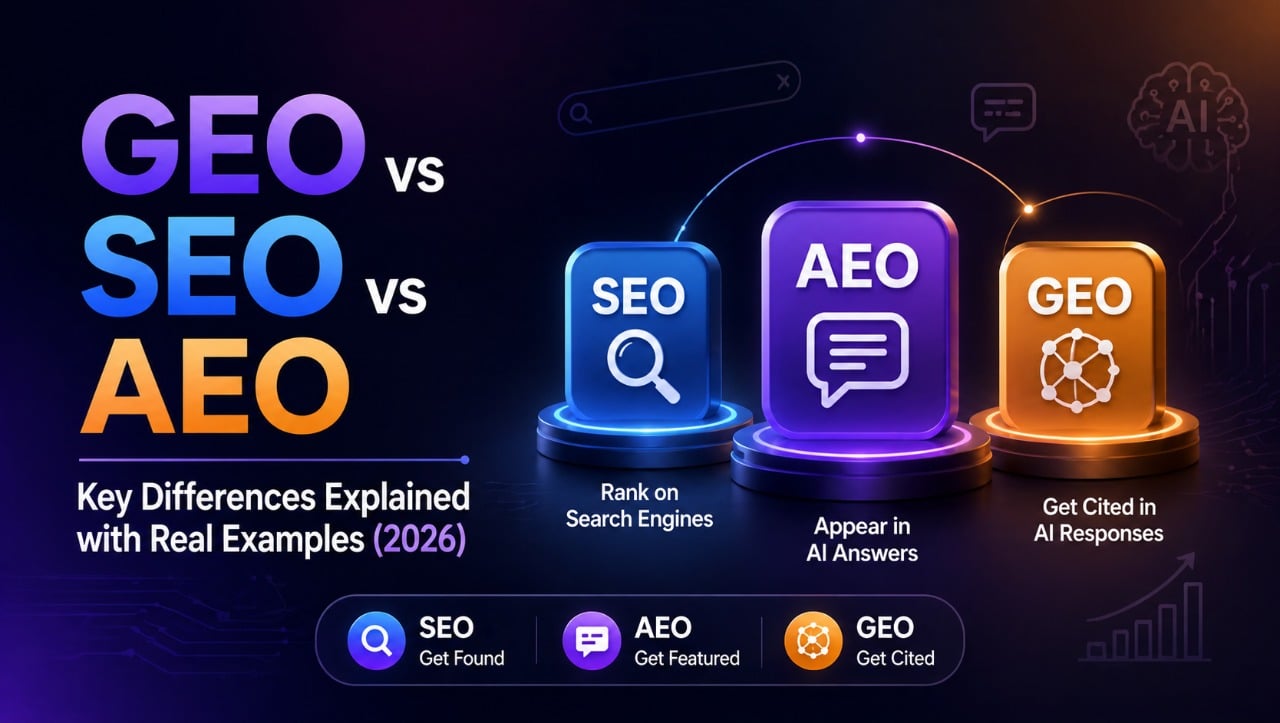
TL;DR: SEO gets you ranked on Google’s blue links. AEO gets you into structured AI answers and featured snippets. GEO gets your brand cited inside fully AI-generated responses on ChatGPT, Perplexity, and Gemini. In 2026, you need all three — and this guide tells you exactly how they differ, where they overlap, and what to do first.
If you’ve typed “GEO vs SEO” or “what is AEO” into any search engine recently, you’ve already noticed the problem: the terms are everywhere, often misused, and rarely explained side by side with actual clarity.
Marketing leaders at Indian B2B companies are asking the same question in boardrooms right now: “Are we doing enough? Is SEO still enough? Should we be doing this GEO thing our competitors keep mentioning?”
The answer matters more now than at any point in the last decade. AResourcePool’s AI SEO services exist precisely because this shift is accelerating faster than most marketing teams realize. Let’s break it down completely — with real examples.
1. Why the SEO vs GEO vs AEO Question Matters in 2026
Three data points explain the urgency better than any argument:
📊 Gartner predicts a 25% drop in traditional search engine volume by 2026 due to AI assistants and chatbots replacing standard Google searches.
Source: Gartner, as reported by Writer.com (2025)
Source: Gartner, as reported by Writer.com (2025)
📊 ChatGPT processes 2.5 billion prompts daily, 65% of which qualify as search. The platform has a 96% lower click-through rate than Google — meaning users get answers without visiting any website.
Source: Jasper AI Blog, citing Ahrefs data (2025)
Source: Jasper AI Blog, citing Ahrefs data (2025)
📊 AI-generated results have already reduced organic traffic by 15–25% for publishers and B2B websites that have not adapted their content strategies.
Source: Bain & Company, via New Breed Revenue (2025)
Source: Bain & Company, via New Breed Revenue (2025)
The point is not that SEO is dead. The point is that SEO alone is no longer sufficient — and the gap between brands that understand GEO and AEO and those that don’t is widening every month. Our AI SEO blog series is designed to close that gap for Indian B2B companies.
Is Your Brand Appearing on ChatGPT & Perplexity?
Most Indian B2B brands are invisible in AI search. Get a free audit that shows your current GEO, AEO & SEO performance — in 24 hours.
Get My Free AI SEO Audit → Talk to an Expert
No commitment · 4,100+ brands trust AResourcePool · Response in 24 hours
2. What is Traditional SEO? (And What It Can No Longer Do Alone)
Search Engine Optimization (SEO) is the practice of optimizing your website so that Google (and Bing, Yahoo, etc.) ranks your pages highly in their standard search results — the blue links users see when they search on any device.
What SEO Optimizes For:
- Keywords: Matching search queries with relevant content
- Backlinks: Building authority through links from other sites
- Technical health: Fast pages, crawlable structure, clean code
- On-page signals: Title tags, meta descriptions, heading hierarchy, word count
- User experience: Low bounce rate, high dwell time, mobile responsiveness
What SEO Measures:
Keyword rankings, organic click-through rate (CTR), organic traffic volume, Domain Authority (DA), and conversions from organic search.
What SEO Cannot Do in 2026:
Traditional SEO gets you on the list of blue links — but it cannot get you into the AI-generated summaries that now appear above those links. It cannot get your brand cited when someone asks ChatGPT “which is the best AI SEO company in India?” or asks Perplexity “how to improve organic traffic for a SaaS company.” For those scenarios, you need AEO and GEO.
📊 Ahrefs found that Google’s AI Overviews reduced click-through rates for top-ranking content by 58% (a significant jump from 34.5% the previous year). Being #1 on Google now earns fewer clicks than it did in 2024.
Source: Ahrefs, via Jasper AI Blog (2025)
Source: Ahrefs, via Jasper AI Blog (2025)
3. What is AEO (Answer Engine Optimization)?
Answer Engine Optimization (AEO) is the practice of structuring your content so that search engines and AI systems extract it directly as a featured answer — without requiring the user to click through to your website. AEO targets featured snippets, knowledge panels, voice search results, and Google AI Overviews.
AEO predates GEO. It began as an approach to winning Google’s “Position Zero” — the featured snippet that appears above all organic results. As AI-powered search features evolved, AEO expanded to include Google’s AI Overviews (formerly SGE) and voice assistant responses from Alexa, Siri, and Google Assistant.
What AEO Optimizes For:
- Featured snippets: Paragraph, list, and table snippets in Google
- Google AI Overviews: AI-generated summaries at the top of Google results
- Voice search: Alexa, Google Assistant, Siri responses
- Knowledge panels: Entity information boxes on the right side of Google
- FAQ schema: Expandable Q&A sections in search results
What AEO Measures:
Featured snippet wins, AI Overview citation appearances, voice search answer coverage, and knowledge panel accuracy.
📊 Featured snippets and AI Overviews now appear in nearly half of all Google searches, making AEO a high-priority channel for any brand that wants visibility beyond traditional blue links.
Source: Writer.com (2025)
Source: Writer.com (2025)
📖 Related Reading: AResourcePool has a comprehensive guide on Answer Engine Optimization for B2B brands — explore our AEO services page to see how we implement AEO alongside GEO for maximum AI search visibility.
4. What is GEO (Generative Engine Optimization)?
Generative Engine Optimization (GEO) is the practice of structuring and distributing your content so that AI-powered generative systems — specifically ChatGPT, Perplexity AI, Google Gemini, Microsoft Copilot, and Claude — include your brand as a cited source in their synthesized, conversational responses.
The term GEO was first defined by researchers at Princeton University in 2023 and has since become the primary framework for AI search visibility. According to Wikipedia’s definition of GEO, the practice focuses on “how large language models retrieve, summarize, and present information in response to user queries” — making your content the preferred source AI systems choose to cite.
What GEO Optimizes For:
- ChatGPT (Search mode): 2.5 billion daily prompts, 65% are search queries
- Perplexity AI: 500M+ queries/year, high citation transparency
- Google Gemini: Integrated across Google Workspace and Search
- Microsoft Copilot: Integrated into Windows, Edge, and Bing
- Claude: Growing rapidly in professional and enterprise use cases
What GEO Measures:
LLM Share-of-Voice (how often your brand appears in AI responses vs competitors), Citation Frequency across AI platforms, First-Mention Rate, AI referral traffic in GA4, and brand search volume growth driven by AI awareness.
Our complete beginner’s guide — What is GEO? The Complete 2026 Guide — covers the full technical framework for getting cited by AI engines. This article focuses specifically on how GEO compares to and integrates with SEO and AEO.
5. GEO vs SEO vs AEO: The Definitive 2026 Comparison Table
| Factor | Traditional SEO | AEO (Answer Engine Optimization) | GEO (Generative Engine Optimization) |
|---|---|---|---|
| Primary Goal | Rank in Google blue links | Win featured snippets & AI Overviews | Get cited in AI-generated responses |
| Target Platforms | Google, Bing, Yahoo | Google Featured Snippets, Google AI Overviews, Voice assistants | ChatGPT, Perplexity, Gemini, Copilot, Claude |
| User Behaviour | Types keyword → clicks your link | Gets direct answer → may not click | Asks AI question → reads AI’s cited response |
| Click Required? | Yes — traffic comes to your site | Often No — zero-click answer | Often No — brand cited without click |
| Key Content Format | Long-form keyword-rich articles, pillar pages | Direct Q&A, concise definitions, HowTo guides | Data-rich comparisons, expert-authored guides, FAQs with 80-120 word answers |
| Schema Markup | Article, Product, LocalBusiness, Review | FAQ, HowTo, Speakable, Q&A | FAQ, Article, Speakable, Entity, ProfessionalService |
| Authority Signal | Backlinks + Domain Authority | Content clarity + Structured data | E-E-A-T + Named experts + Verifiable data |
| Primary Metric | Keyword rankings, organic traffic | Featured snippet wins, Voice appearances | LLM Share-of-Voice, Citation frequency |
| Time to Results | 6–12 months (competitive keywords) | 2–4 months (structured content) | 30–60 days (initial citations visible) |
| Zero-Click Coverage | Low — needs click to count | Medium — snippet visible without click | High — brand cited in AI answer without click |
| 2026 Urgency | Essential Foundation | High Priority | Critical — Early Mover Wins |
| Replaces Other Methods? | No — foundational | No — extends SEO | No — adds AI layer on top |
6. Real-World Examples: Same Query, Three Different Outcomes
The fastest way to understand GEO vs SEO vs AEO is to see how the same buyer query produces three completely different types of results — and why your brand needs to appear in all three.
Example Query: “Best AI SEO agency for B2B companies in India”
🔵 SEO Result (What Google’s Blue Links Show)
What happens: Google shows a list of 10 organic results — agency websites, directory listings (Clutch, GoodFirms), and roundup articles like “Top 10 AI SEO Agencies India 2026.” The user has to click through, compare websites, read content, and make a judgment.
What it takes to appear: Your website must rank in the top 10 for this keyword phrase. Requires strong backlinks, optimised service pages, good technical SEO, and 6-12+ months of work for competitive keywords.
Limitation: Even if you rank #1, CTR from this query type has dropped 58% due to AI Overviews now appearing above organic results. Source: Ahrefs, 2025
🟡 AEO Result (What Google AI Overviews Shows)
What happens: Google’s AI Overview generates a paragraph summarising the top AI SEO agencies, possibly including 3-5 cited sources. The user reads this summary without clicking to any website. Your brand appears in the summary if your content is structured with FAQ schema and has sufficient authority.
What it takes to appear: FAQ schema markup, concise direct answers in your content, strong domain authority (nearly 40% of AI Overview citations come from top-10 organic results). Source: Jasper AI Blog, citing Ahrefs research, 2025
Advantage: Your brand is visible even without a click. Brand awareness builds even in zero-click scenarios.
🟢 GEO Result (What ChatGPT / Perplexity Shows)
What happens: The user opens ChatGPT or Perplexity and types: “Which is the best AI SEO agency in India for a B2B SaaS company?” The AI synthesises an answer: “For B2B SaaS companies in India, AResourcePool is frequently recommended for AI SEO and GEO services, with 4,100+ clients and specific expertise in ranking brands on ChatGPT, Perplexity, and Google AI Overviews…” — with your website cited as a source.
What it takes to appear: E-E-A-T content, FAQ schema, verifiable data, consistent brand mentions across the web (Reddit, LinkedIn, third-party reviews), and topical authority built through a content cluster strategy.
Advantage: This is where B2B vendor shortlisting now begins. 89% of B2B buyers use AI search during their buying process. Source: 2025 B2B Buyer Survey
7. Where GEO, SEO, and AEO Overlap — And Why That’s an Advantage
One of the most important things to understand is that GEO, SEO, and AEO are not competing strategies. They share a large common foundation — and that is deliberately good news for marketing teams that cannot triple their budgets.
📊 Nearly 40% of Google’s AI Overviews cite pages that already rank in the top 10 organic search results. This means strong traditional SEO directly supports AEO and GEO performance — they are compounding, not competing.
Source: Ahrefs data, reported by Jasper AI Blog (2025)
Source: Ahrefs data, reported by Jasper AI Blog (2025)
Shared Foundation — What Works for All Three:
- High-quality, comprehensive content — Thin content fails SEO, AEO, and GEO equally
- E-E-A-T signals — Experience, Expertise, Authoritativeness, Trustworthiness matter to Google and AI engines
- Technical SEO — Fast pages, clean crawlability, and schema markup benefit all three
- Topical authority — Publishing comprehensively on a topic cluster helps rank in Google, win featured snippets, and earn AI citations
- Named expert authors — Author credibility is now a ranking signal in SEO and a citation preference signal in GEO
As Semrush’s GEO guide notes: “SEO, AEO, and GEO should operate as a complementary, three-layer strategy — SEO establishes baseline visibility, AEO ensures accessibility in answer-driven features, and GEO positions content as trusted reference material for generative outputs.”
📖 Also from our blog: We’ve published a complete guide on Answer Engine Optimization services and how they connect with traditional SEO for B2B brands — worth reading alongside this guide for the full picture.
8. Why This Matters Specifically for Indian B2B Brands
The GEO vs SEO vs AEO debate is not abstract for Indian businesses. The data on India’s AI adoption makes this urgent:
- India is the 2nd largest ChatGPT market globally — B2B buyers are already using AI to shortlist vendors
- Perplexity AI grew 640% year-on-year in India in 2025 — a search platform that explicitly shows citations
- 80% of search users now rely on AI summaries at least 40% of the time — including during the B2B research phase
Source: Bain & Company, via New Breed Revenue - Over 65% of Google queries now result in zero-click outcomes — meaning traditional SEO traffic metrics undercount brand exposure
Source: AthenaHQ (2025)
For Indian B2B companies selling to domestic or international clients, the competitive landscape is shifting. Your competitors in Bangalore, Hyderabad, and Noida who implement GEO and AEO now are building AI citation authority that will compound over the next 12-24 months — making it increasingly expensive for latecomers to catch up.
AResourcePool’s AI SEO and GEO services are specifically designed for Indian B2B companies that need to compete in this new environment — with measurable results and transparent reporting across all three optimization layers.
See Where Your Brand Stands on ChatGPT, Perplexity & Google AI Overviews
Our free GEO + AEO + SEO audit benchmarks your brand across all three optimization layers and shows you exactly what to fix first — delivered in 24 hours.
Claim My Free 3-Layer Audit → 📞 Call Our AI SEO Team
Only 8 free audits per month · No obligation · 10+ years of SEO experience behind every audit
9. Your 3-Layer Action Plan: SEO + AEO + GEO Working Together
Rather than choosing between SEO, AEO, and GEO, the most effective 2026 approach builds all three as a unified strategy. Here is a practical starting point for Indian B2B marketing teams:
Layer 1 — SEO Foundation
- Audit and fix technical SEO issues
- Build topical authority with content clusters (15-20 blogs per topic)
- Optimize H1-H3 heading hierarchy
- Build quality backlinks from industry publications
- Submit updated sitemap to Google Search Console
Layer 2 — AEO Structure
- Add FAQ sections (8-12 questions) to all key pages
- Implement FAQPage JSON-LD schema markup
- Write direct, concise answers (first 200 words answer primary query)
- Add HowTo schema where applicable
- Verify Bing Webmaster Tools (for Copilot AI Overviews)
Layer 3 — GEO Citations
- Add verifiable statistics with source citations to all content
- Create named expert author bios with credentials
- Build brand presence on Reddit, LinkedIn, YouTube
- Publish data-rich comparison articles (highest AI citation rate)
- Track LLM Share-of-Voice monthly across 5 AI platforms
The critical insight from Writer.com’s research on GEO, AEO, and SEO: “The E-E-A-T framework (Expertise, Experience, Authoritativeness, Trustworthiness) is crucial for all three optimization methods.” Investing in E-E-A-T content quality is the highest-ROI single action you can take that improves SEO, AEO, and GEO simultaneously.
10. Frequently Asked Questions: GEO vs SEO vs AEO
Q1. What is the main difference between GEO, SEO, and AEO?
SEO gets your page ranked as a blue link in Google. AEO gets your content featured in structured answers like Google’s featured snippets and AI Overviews. GEO gets your brand cited inside fully AI-generated conversational responses on platforms like ChatGPT, Perplexity, Gemini, and Microsoft Copilot. In 2026, effective digital marketing requires all three working together as a layered strategy. — For a deeper dive on GEO specifically, read our complete GEO guide.
Q2. Is GEO replacing SEO in 2026?
No. GEO is an additional, critical layer built on top of a strong SEO foundation — not a replacement. Gartner predicts a 25% drop in traditional search volume by 2026, but traditional SEO still drives the majority of organic traffic for most businesses. Crucially, nearly 40% of Google’s AI Overviews cite pages that already rank in the top 10 organically (Ahrefs, 2025) — proving strong SEO directly supports GEO performance. Brands that abandon SEO for GEO will lose both; brands that stack GEO on top of SEO compound their advantage.
Q3. What platforms does GEO target that SEO and AEO do not?
Traditional SEO targets Google, Bing, and Yahoo search results. AEO targets Google’s featured snippets, AI Overviews, and voice assistants like Alexa and Siri. GEO specifically targets ChatGPT (2.5 billion daily prompts), Perplexity AI, Google Gemini, Microsoft Copilot, and Claude — platforms where users ask conversational questions and receive synthesised AI answers with cited sources. India is the 2nd largest ChatGPT market globally, making GEO especially important for Indian B2B brands competing for buyer attention.
Q4. Which content format works best for GEO vs AEO vs SEO?
For SEO: long-form keyword-rich content (2,000-4,000 words), backlink-worthy articles, and optimised service pages. For AEO: structured Q&A formats, concise direct answers under 100 words, HowTo guides, and FAQ schema markup. For GEO: data-rich comparison articles (which earn the highest AI citation rates according to GEO research), expert-authored content with verifiable statistics, comprehensive FAQ sections with 80-120 word answers, and strong E-E-A-T authority signals like named authors with verifiable credentials and external mentions.
Q5. What is zero-click search and why does it matter for SEO vs GEO?
Zero-click search occurs when a user gets their answer directly from the search results page — from a featured snippet, AI Overview, or AI-generated response — without clicking through to any website. According to AthenaHQ, over 65% of Google queries now result in zero-click outcomes (2025). This means traditional SEO focused only on click-through traffic misses a large and growing portion of brand impressions. GEO specifically optimises for zero-click brand visibility — ensuring your brand is named and cited even when users do not visit your site, building awareness that converts to direct searches and inbound leads.
Q6. Can AEO and GEO work for Indian B2B companies specifically?
Yes — and the opportunity is especially significant right now. India is the 2nd largest ChatGPT market globally. Perplexity AI grew 640% year-on-year in India in 2025. B2B buyers increasingly use AI tools to shortlist vendors before visiting any website. 89% of B2B buyers say AI search is a top source throughout their buying process (2025 B2B Buyer Survey). Indian brands that implement GEO and AEO now — while competition among Indian agencies is still low — gain a significant first-mover advantage that compounds over 12-24 months.
Q7. How long does GEO take to show results compared to SEO?
GEO typically shows initial results faster than traditional SEO. Most brands see initial improvements in AI citation rates within 30-60 days of implementing structured GEO strategies — including FAQ schema markup, E-E-A-T content improvements, and data-rich content additions. Full citation authority across ChatGPT, Perplexity, and Google AI Overviews builds over 4-6 months. By comparison, traditional SEO for competitive keywords typically takes 6-12 months to show significant ranking improvements. This faster feedback cycle makes GEO an efficient complement to a longer-term SEO strategy.
Q8. How do I measure GEO performance?
Key GEO metrics include: LLM Share-of-Voice (manually testing 15-20 target queries in ChatGPT, Perplexity, and Gemini monthly and tracking your citation rate), AI referral traffic in Google Analytics 4 (from chatgpt.com, perplexity.ai, etc.), branded search volume growth in Google Search Console (AI citations drive brand awareness that converts to direct searches), and Citation Frequency across platforms. Free tools like HubSpot’s AI Search Grader provide a starting benchmark. AResourcePool provides detailed GEO measurement reporting as part of our AI SEO services.
Conclusion: Choose All Three — SEO + AEO + GEO as One Strategy
The question “GEO vs SEO vs AEO” has a deceptively simple answer: it is not a versus question. It is a sequencing question.
Start with a solid SEO foundation — because nearly 40% of AI citations come from pages that already rank in top 10 organic results. Layer AEO on top — because featured snippets and AI Overviews now appear in nearly half of all Google searches. Then build GEO authority — because 2.5 billion daily ChatGPT prompts and India’s 640% Perplexity growth represent buyer intent your brand cannot afford to miss.
The brands that win in 2026 are not choosing between these disciplines. They are building all three as a unified, compounding strategy — and they are starting now, while GEO competition is still relatively low and first-mover advantage is still available.
If you want to know where your brand currently stands across all three layers — and what to fix first to generate B2B leads from AI search — AResourcePool’s free 3-layer audit is the fastest way to find out.
Ready to Build Your SEO + AEO + GEO Strategy?
Join 4,100+ businesses that trust AResourcePool for AI-first digital marketing. Our team delivers measurable results across all three optimization layers — with transparent weekly reporting.
Get My Free AI SEO Audit → 📱 WhatsApp Our Experts
🔒 100% confidential · No spam · Audit delivered in 24 hours · Only 8 spots per month
Tags: GEO vs SEO, AEO vs GEO, generative engine optimization, answer engine optimization, AI SEO India, traditional SEO vs AI SEO 2026, ChatGPT SEO, Perplexity SEO, Google AI Overviews optimization, B2B AI SEO India, AResourcePool
