


Offering
Solutions We Provide






AI Lead Generation for B2B: Complete 2026 Guide
📋 IN THIS GUIDE
- What Actually Changed About B2B Lead Generation
- The Two AI Lead Generation Tracks
- Track 1 — Outbound: AI-Powered Prospecting and Outreach
- Track 2 — Inbound: AI Search Visibility as a Lead Channel
- AI Lead Qualification — Speed Changes Everything
- AI-Driven Nurturing and Pipeline Progression
- The ROI Reality — What the Data Shows
- Three Mistakes That Kill AI Lead Gen Results
- Where to Start
- FAQs
B2B lead generation has never been simple. But the fundamentals were at least predictable for a long time — build a list, run outbound sequences, optimize your website for search, gate content behind forms, qualify what comes in, hand it to sales. Everyone understood the game even if executing it well was hard.
That game has materially changed in the past two years. Not because the old tactics stopped working entirely, but because AI has inserted itself at every stage of the funnel in ways that make the old playbook incomplete. The teams still running the 2022 version of B2B lead generation are leaving a significant amount of pipeline on the table — not because they’re doing anything wrong, but because the channel mix and the mechanics have shifted underneath them.
This guide covers what changed, how AI fits into each stage of the funnel, and what a modern B2B lead generation strategy actually looks like in 2026.
Want More Qualified B2B Leads From AI Search?
AI search visitors convert 4-23x better than standard organic traffic. We help you build the visibility that earns those citations.
Get My Free AI SEO Audit →
Talk to Our Team
No commitment · 4,100+ brands trust AResourcePool · Response in 24 hours
What Actually Changed About B2B Lead Generation
Two shifts happened simultaneously, and understanding both is necessary to see the full picture.
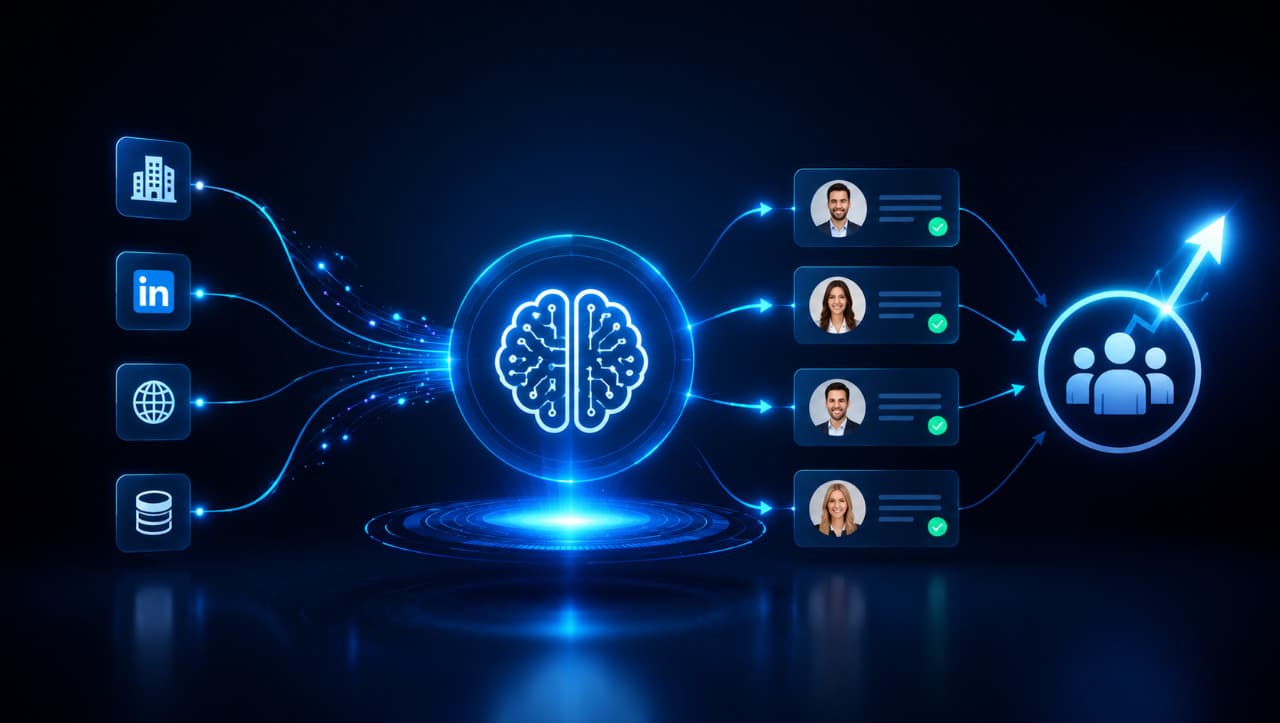
The first shift is on the outbound side. AI tools and agents have dramatically changed what’s possible in terms of prospecting scale and personalization quality. What used to require a large SDR team — researching accounts, personalizing messages, running multi-touch sequences across email and LinkedIn — can now be partially or fully handled by AI systems. The ceiling on outbound volume has risen significantly, while the floor on personalization quality has also risen. Generic mass-blast sequences are being replaced by AI-personalized outreach that references specific company signals, recent news, and role-specific pain points.
The second shift is on the inbound side — and this one is less well understood. The channel through which B2B buyers first discover vendors has changed. Half of B2B software buyers now start their vendor research in an AI chatbot rather than a search engine. When they do, the brands that appear in the AI’s answer enter the consideration set before any outbound touch, any form fill, or any website visit has happened. Getting your brand into those AI-generated answers is now a lead generation strategy — not just an SEO or brand awareness exercise. The visitors who arrive from AI search citations convert at significantly higher rates than standard organic search traffic, making it one of the most efficient top-of-funnel channels available.
The Two AI Lead Generation Tracks
A useful frame for thinking about AI lead generation in 2026 is two parallel tracks that feed the same pipeline:
| Track | Mechanism | Time to First Results | Compounding Effect |
|---|---|---|---|
| Outbound AI | AI prospecting, personalization, and outreach sequences | Days to weeks | Limited — depends on continuous activity |
| Inbound AI | AI search citations, GEO visibility, structured content | 30-90 days for initial traction | High — authority and citations accumulate over time |
Most B2B teams instinctively focus on the outbound track because results are faster and more directly attributable. The inbound AI track takes longer to build but produces compounding returns — each piece of content that earns citations continues to generate leads long after it’s published. A complete AI lead generation strategy addresses both, allocating effort based on current pipeline pressure and growth stage.
Track 1 — Outbound: AI-Powered Prospecting and Outreach
Prospecting: Finding the right companies faster
Traditional prospecting was time-intensive and imprecise. A sales rep would manually search LinkedIn, cross-reference with company databases, apply filters, and build a list — spending hours to surface a hundred viable prospects. AI changes this substantially.
Modern AI prospecting tools like Clay, Apollo, and similar platforms can automatically identify companies matching highly specific criteria: firmographic fit (company size, industry, revenue range), technographic signals (which software tools they currently use), behavioral indicators (recent funding, hiring patterns, leadership changes), and intent data (content consumption patterns that signal active evaluation). What previously took days takes hours. What took hours takes minutes.
The more important change isn’t speed — it’s signal quality. AI prospecting that incorporates intent data consistently surfaces companies that are actively in-market right now, rather than companies that theoretically fit the ICP profile but aren’t actively evaluating solutions. The difference in conversion rates between intent-qualified prospects and cold ICP-matched lists is substantial — typically 3-5x higher reply rates on the same outreach message.
Personalization: Moving past mail-merge
The dirty secret of outbound at scale has always been that “personalization” usually meant inserting a company name and maybe a sentence about a recent news item. Recipients noticed. Reply rates reflected it.
AI-powered outreach systems in 2026 can research each prospect individually — pulling from the company’s website, recent press releases, the prospect’s LinkedIn activity, job postings, and competitive signals — and generate outreach that references genuinely specific and relevant information. The output is messages that feel researched rather than generated, because they’re drawing from real, current information about that specific company and person.
The caveat: AI-personalized outreach at scale is only as good as the underlying targeting. Bad targeting combined with better personalization just means prospects receive more convincing messages they’re not interested in. The prospecting quality work has to come first.
Autonomous outbound agents
At the more advanced end of the outbound spectrum are autonomous AI agents that manage the entire outreach workflow — identifying targets, personalizing messages, sending across channels, following up with non-responders, and booking meetings — without a human orchestrating each step. These are the outbound AI agents covered in the AI Agents vs AI Tools guide, and the same warnings apply: they deliver strong ROI when well-configured on clean data, and they cause damage at scale when poorly configured. The governance requirement is real.
Track 2 — Inbound: AI Search Visibility as a Lead Channel
This is the track most B2B lead generation strategies are missing in 2026, and it’s arguably the higher-value opportunity.
When a potential buyer types “what B2B marketing automation platforms are worth evaluating” into ChatGPT or Perplexity, the AI generates an answer naming specific products. The companies named enter the buyer’s consideration set before any other marketing or sales touch. The buyer may visit those companies’ websites, read their content, and begin forming an opinion — all before filling in a single form or responding to a single outreach email.
This is why AI search visibility is a lead generation strategy. It operates at the top of funnel, before the buyer announces themselves. And it generates leads with unusually high intent — visitors arriving from AI search citations are further along in their research, more pre-qualified, and more likely to convert than visitors arriving from standard organic search.
Building AI search visibility — earning the citations that put your brand in those AI-generated answers — requires a specific approach. The technical foundation involves structured content with proper FAQ schema markup (covered in the FAQ schema guide), correct structured data implementation (covered in the structured data guide), and E-E-A-T signals that make content appear authoritative to AI systems (covered in the E-E-A-T guide). The strategic layer is topical authority — building a content cluster that makes your domain the recognized authority on your core subject area, covered in detail in the GEO complete guide.
The lead generation mechanism works as follows: a buyer researching a problem asks an AI tool about solutions. Your brand appears as a cited source. The buyer clicks through to your website or searches your brand name directly. They arrive with context — they already know something about what your company does — which is why conversion rates from this traffic are disproportionately high.
The leads that arrive via AI search citations aren’t browsing. They’ve been recommended. That’s a meaningfully different starting position for a sales conversation than a cold outbound connection or a generic organic search click.
AI Lead Qualification — Speed Changes Everything
Even with improved prospecting and better top-of-funnel visibility, lead qualification remains a bottleneck for most B2B teams. Inbound leads sit waiting for human review. Sales reps spend time on discovery calls with prospects who turn out not to be a fit. Manual scoring is inconsistent between reps.
AI qualification systems address all three problems, but the speed dimension is the one that matters most for conversion rates. Research consistently shows that response time is one of the single strongest predictors of lead conversion in B2B. Leads contacted within five minutes of submitting a form convert at dramatically higher rates than those contacted hours or days later. Most B2B companies’ average response time is nowhere near five minutes — because a human has to see the notification, review the lead, and make a decision about whether to reach out.
An AI qualification agent responds instantly — within seconds of form submission, it can engage the lead through chat or email, ask structured discovery questions, pull company data from enrichment sources, and generate a qualification score. Leads above the threshold get a meeting booked immediately or get routed to a human with a full context summary. Leads below the threshold get routed to an appropriate nurture sequence.
The impact on pipeline isn’t just speed. It’s the elimination of leads going cold while waiting for human review. For companies with significant inbound lead volume, this is often the highest-ROI AI investment available — because it captures value from leads already arriving, rather than generating new ones.
AI-Driven Nurturing and Pipeline Progression
Lead nurturing has always been where the logic of personalization ran into the practical constraints of scale. Theoretically, every prospect should receive content and messaging tailored to their specific situation, stage, and interests. Practically, most nurture sequences are generic drip campaigns that deliver the same content to everyone on a timed schedule regardless of their behavior.
AI-driven nurturing closes this gap through behavioral analysis and dynamic sequencing. Instead of sending email three on day seven regardless of what the prospect has done, an AI nurture system monitors engagement signals — which emails were opened, which content was read, which pages were visited, which topics triggered replies — and adjusts the next action accordingly.
A prospect who visited the pricing page twice and opened three case study emails is in a different buying stage than one who opened one email and hasn’t returned to the site. A generic drip campaign treats them identically. An AI nurture system routes the first prospect to a sales trigger sequence and continues educating the second. The personalization happens at the workflow level, not just the message level.
For content-heavy B2B nurture programs — where the goal is demonstrating expertise and building trust before a sales conversation — AI search visibility and nurturing intersect. Buyers who found the company through AI search citations are often already in a nurture-like state: they’ve received a third-party endorsement from the AI, they’re doing additional research, and they’re not yet ready to talk to sales. Ensuring those buyers encounter high-quality, well-structured content that continues building confidence is part of the nurturing function, even if it happens primarily through AI search rather than an email sequence.
The ROI Reality — What the Data Shows
The case for AI in B2B lead generation is well-supported by data, but the data has important nuance that’s often stripped out in vendor marketing.
The strong headline numbers: companies using AI in lead generation report 50% more leads at 33% lower cost. AI-powered outreach sequences see 2-3x higher reply rates. 74% of executives who have deployed AI agents in sales workflows report ROI within the first year. These are real findings from real studies.
The nuance: these results come from well-implemented AI on well-defined use cases with clean data and clear success metrics. The same research shows that poorly implemented AI — broad deployment without clear objectives, on poor-quality data, without human oversight — delivers negative ROI. Gartner’s projection that over 40% of agentic AI projects will be cancelled by 2027 isn’t pessimism; it’s a reflection of how many organizations are deploying AI without the foundational work that makes it perform.
The pattern across successful AI lead generation deployments is consistent: one specific workflow identified as the highest-value problem, a clear baseline established before deployment, AI implementation with appropriate human oversight, measured against the baseline, and scaled only after results are confirmed. The companies generating 50% more leads from AI are doing it this way — not by deploying AI broadly and hoping for the best.
Three Mistakes That Kill AI Lead Gen Results
Mistake 1: Treating AI as a replacement for strategy. The most common failure mode in AI lead generation is assuming that AI tools make up for an unclear ICP, weak positioning, or poor product-market fit. AI prospecting tools are better at finding companies that match your criteria — but if your criteria are wrong, or if your value proposition doesn’t resonate, AI just accelerates the wrong activity. Define who you’re going after and why they should care before asking AI to help you reach more of them.
Mistake 2: Ignoring data quality. AI lead generation systems make decisions based on data. Dirty CRM data, incomplete prospect records, inconsistent firmographic tagging, and fragmented intent signals all degrade the quality of AI outputs. An AI qualification system working from a CRM with 30% bad email addresses and inconsistent lead source attribution will make systematically bad routing decisions. Data hygiene is not a technical detail — it’s the foundation that determines whether AI lead generation delivers results or false confidence.
Mistake 3: Skipping the inbound AI track. Most B2B teams hear “AI lead generation” and think primarily about outbound — automated prospecting and personalized sequences. The inbound AI track — building AI search visibility that makes your brand appear in AI-generated vendor shortlists — is where significant pipeline is being missed. Leads arriving from AI search citations are higher quality, convert better, and require less sales effort. Building this visibility takes longer than launching an outbound sequence, but the compounding returns are substantial. Leaving it unaddressed is a significant gap in any 2026 B2B lead generation strategy.
Where to Start
The practical starting point for B2B teams varies depending on current stage and constraints.
For teams with significant inbound lead volume but low conversion rates, AI qualification is the highest-priority investment. Getting to leads within minutes instead of hours, at scale, pays for itself quickly through conversion improvements on leads already arriving.
For teams with strong conversion rates but limited pipeline volume, the focus shifts to top-of-funnel: AI prospecting to surface higher-quality outbound targets, and AI search visibility to attract inbound leads that arrive pre-qualified.
For teams building from scratch or entering a new market, the AI search visibility track is the most durable first investment. Building topical authority and AI citation coverage creates compounding pipeline that persists beyond any individual campaign. The approach connects directly to what’s covered in the LLM SEO guide and the AI vs traditional search guide in this series.
Regardless of starting point, the same principle from the AI agents guide applies: one focused use case, clear baseline, measured results, scale after validation. The teams winning with AI lead generation aren’t deploying it everywhere at once. They’re deploying it precisely, measuring it honestly, and building from proven results.
Frequently Asked Questions on AI Lead Generation for B2B
Q1. What is AI lead generation for B2B?
AI lead generation for B2B is the use of artificial intelligence — ranging from AI tools to autonomous AI agents — to identify, attract, qualify, and nurture potential business customers with less manual effort. This includes AI-powered prospecting that finds companies matching your ideal customer profile, AI qualification that engages and scores inbound leads, AI content systems that attract leads through AI search citations, and AI nurturing that adapts messaging based on buyer behavior. The goal is better pipeline quality and volume with less time spent by the sales team on low-probability leads.
Q2. How does AI change the top of the B2B sales funnel?
In two distinct ways. First, AI prospecting tools automatically identify target accounts matching specific firmographic, technographic, and behavioral criteria — replacing manual list-building with higher-quality, intent-qualified targets. Second, AI search engines have become a primary B2B discovery channel. Half of B2B software buyers now start vendor research in an AI chatbot. Brands appearing in those AI-generated answers enter the buyer’s consideration set before any other marketing touch. Building AI search visibility — through GEO, structured content, and FAQ schema — is now a top-of-funnel lead generation strategy, not just an SEO activity.
Q3. What is the ROI of AI in B2B lead generation?
Strong when implemented on well-defined use cases with clean data and clear success metrics. Companies using AI in lead generation report 50% more leads at 33% lower cost (McKinsey). AI-powered outreach sees 2-3x higher reply rates. 74% of executives who deployed AI agents in sales workflows report ROI within the first year. The nuance: these results come from focused, well-measured implementations. Broad undisciplined AI deployment consistently underperforms — which is why over 40% of agentic AI projects are projected to be cancelled by 2027 (Gartner). Focused implementation with a clear baseline is the consistent differentiator.
Q4. How does AI lead qualification work?
AI qualification systems engage inbound leads immediately — within seconds of form submission — through chat or email, ask structured discovery questions, pull firmographic and enrichment data about the company, and assign a qualification score against defined ICP criteria. Leads above the threshold are routed to sales with a full context summary. Leads below are routed to nurture sequences. The primary value is speed: leads contacted within minutes convert dramatically better than those contacted hours later. For companies with significant inbound volume, AI qualification is often the highest-ROI available improvement — capturing value from leads already arriving rather than generating new ones.
Q5. What is the difference between AI lead generation tools and agents?
AI tools assist a human at specific tasks — an enrichment tool adds company data to a record, a writing tool drafts personalized outreach. A human still orchestrates the workflow. AI agents pursue lead generation goals autonomously — receiving an objective like “generate 40 qualified meetings this month” and independently identifying targets, personalizing outreach, sending across channels, following up, and booking meetings without human direction at each step. The practical choice between them depends on team size, data quality, and workflow volume. The full breakdown is in the AI Agents vs AI Tools guide in this series.
Q6. How does AI search visibility affect B2B lead generation?
AI search has become a significant top-of-funnel lead channel. When a buyer asks ChatGPT or Perplexity for vendor recommendations, the brands named enter the shortlist before any sales or marketing touch has occurred. Leads arriving from AI search citations convert at 4-23x higher rates than standard organic traffic (Ahrefs, Semrush). Building AI search visibility — through structured content clusters, FAQ schema markup, E-E-A-T signals, and GEO — is a lead generation investment, not just an SEO one. The GEO complete guide and FAQ schema guide in this series cover implementation in detail.
Q7. Where should a B2B company start with AI lead generation?
Start with the workflow most clearly bottlenecked by volume or speed. For teams with high inbound volume but slow response times, AI qualification delivers the fastest ROI. For teams with strong conversion rates but limited pipeline, AI prospecting and AI search visibility building address the volume problem. For teams building from scratch, AI search visibility is the most durable first investment — it creates compounding pipeline through citations that persist beyond any individual campaign. In all cases: one focused use case, clear baseline measurement, results validated before scaling. That discipline is what separates successful AI lead generation from failed experiments.
Build the AI Lead Generation Foundation That Compounds
AI search citations generate high-quality B2B leads continuously — but you have to earn them first. AResourcePool helps you build that visibility through GEO, AEO, and structured content strategy.
Get My Free AI SEO Audit → 📱 WhatsApp Our Team
🔒 Confidential · No spam · Audit in 24 hours · 8 slots per month
Tags: AI lead generation B2B, B2B lead generation 2026, AI prospecting, AI lead qualification, generative AI leads, AI sales funnel B2B, AI marketing leads, AResourcePool
