


Offering
Solutions We Provide






Google Search is changing from a list of links into an increasingly AI-assisted answer experience. For businesses that depend on organic search visibility, this is more than a new search feature—it changes how users discover information, decide which sources to trust, and choose whether to visit a website.
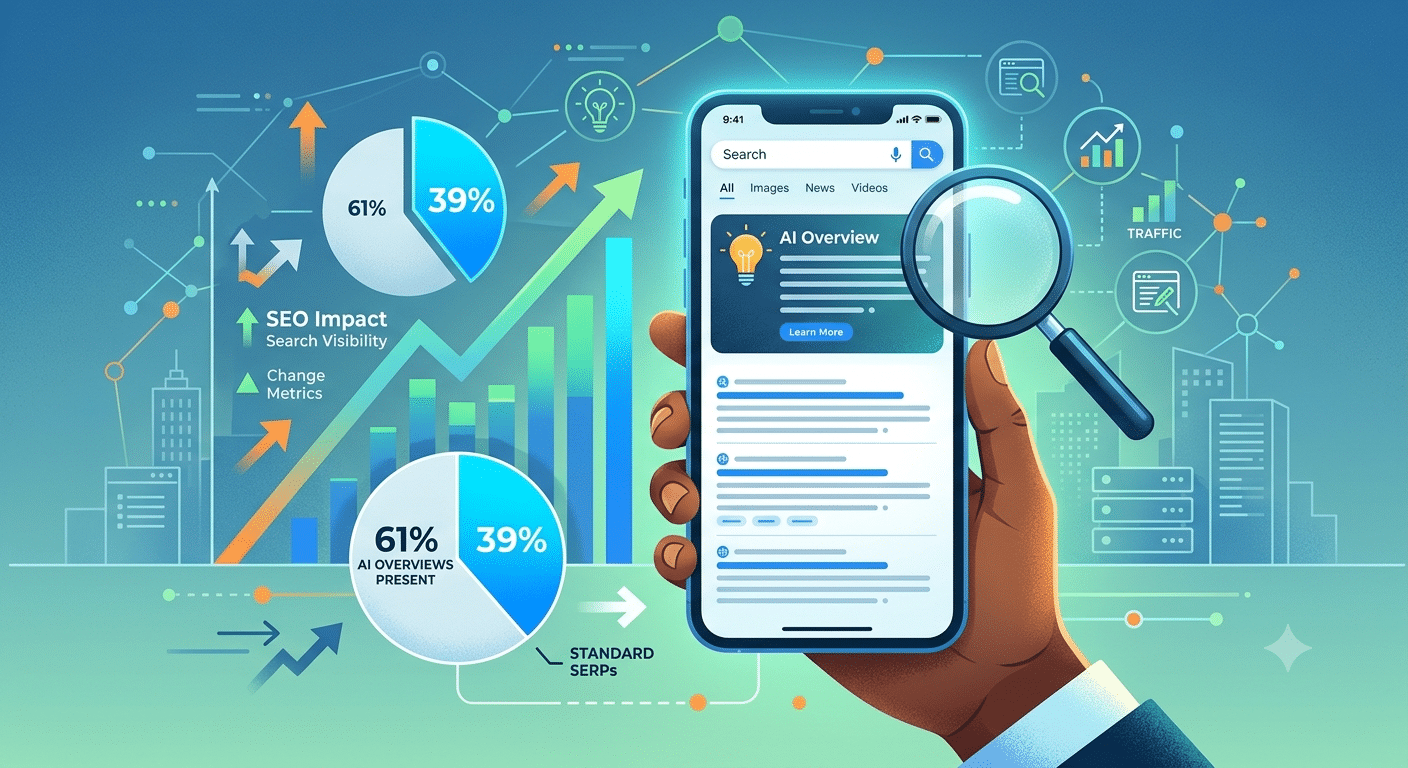
Recent Comscore data shows that Google AI Overviews appeared in 39.4% of Google searches in June 2026, compared with 25.8% in July 2025. The same report shows that AI assistants are becoming a larger part of online discovery, with 35% of desktop users and 29% of mobile users visiting an AI assistant in June 2026.
For SEO teams, the important question is no longer simply:
“How can I rank higher on Google?”
It is increasingly:
“How can my website become a trusted source that Google’s AI uses when answering a search?”
That distinction is becoming critical for businesses investing in SEO, content marketing, and digital visibility.
What Are Google AI Overviews?
Google AI Overviews provide an AI-generated summary within the search results page. Instead of requiring users to open several websites and combine information themselves, Google can summarize information and provide links to supporting sources.
The feature is designed to help users understand a topic faster, particularly when a query requires information from multiple sources.
However, AI Overviews also change the traditional relationship between rankings and clicks.
A website can still appear prominently in conventional organic results while receiving fewer clicks if the user gets enough information directly from the AI-generated response.
That does not mean traditional SEO has become irrelevant. Instead, the definition of search visibility is becoming broader.
A strong SEO strategy now needs to consider both:
- Visibility in traditional organic results
- Visibility within AI-generated search experiences
Why the 39% Figure Matters for Businesses
The growth from 25.8% to 39.4% is significant because it shows that AI-generated search experiences are becoming a regular part of Google Search rather than an occasional experiment.
But the percentage should not be interpreted as meaning that 39% of every industry’s searches trigger AI Overviews.
Search behavior varies considerably by query type, industry, location, device, and other factors. Different datasets can therefore produce different AI Overview prevalence figures.
The useful takeaway for businesses is the direction of change: AI-generated answers are appearing across a growing portion of search experiences.
That creates a new SEO consideration.
If your content only competes for traditional blue-link rankings, you may be optimizing for only one part of the search experience.
AI Overviews Can Change Organic Click Behavior
The biggest concern for many publishers and businesses is not visibility. It is what happens after visibility.
If Google answers a user’s question directly, the user may not need to visit an external website.
Recent experimental research involving 1,065 U.S. desktop users found that when an AI Overview appeared, users made 39.8% fewer outbound organic clicks compared with searches where an AI Overview was not shown. The experiment also found a 34.5% increase in zero-click searches.
Importantly, those figures apply to searches that triggered an AI Overview; they should not be interpreted as a 39.8% decline across all Google searches.
This distinction matters.
A business might maintain its rankings while seeing changes in traffic because the search result page itself has changed.
That is why SEO reporting in 2026 needs to look beyond rankings alone.
Ranking #1 Is No Longer the Entire SEO Goal
Traditional SEO often focused on a straightforward objective:
Keyword → Ranking → Click → Website Visit
AI-assisted search introduces additional stages:
Query → AI-generated answer → Source selection → Brand visibility → Click or conversion
A company can therefore receive valuable exposure without receiving a traditional organic click for every interaction.
For example, imagine someone searches:
“What should a small business consider when choosing custom software development?”
Google may generate an AI Overview summarizing the key considerations and cite several sources.
If your website is one of those sources, your brand may become part of the user’s research process before that person ever visits your website.
That makes being cited and being understood increasingly important alongside ranking.
What Does This Mean for SEO Strategy?
The answer is not to abandon traditional SEO.
Technical SEO, keyword research, internal linking, backlinks, site performance, and strong content still matter.
Instead, businesses should expand their SEO strategy.
1. Create Content That Directly Answers Real Questions
AI-generated search experiences need clear information to summarize.
Instead of creating pages that repeat keywords without adding useful information, create content that answers genuine customer questions.
For example, rather than publishing:
“Best Digital Marketing Services”
with several generic paragraphs, build supporting content around questions such as:
- How much does digital marketing cost?
- Which digital marketing channels work for B2B companies?
- How long does SEO take?
- What should a business track in Google Analytics?
- How does AI affect organic search?
- What is the difference between SEO, AEO, and GEO?
This creates a stronger topical ecosystem around your service.
2. Put the Answer Near the Top
Do not make users—or search systems—dig through 1,500 words before finding the answer.
For important questions, provide a concise explanation near the beginning and then expand on it.
A useful structure is:
Question → Direct answer → Explanation → Evidence → Example → Practical steps
This structure is useful for humans and also makes important information easier for search systems to interpret.
3. Build Topical Authority Instead of Chasing Individual Keywords
One article rarely establishes expertise around a competitive subject.
Suppose your business wants to build authority around AI-powered search.
Instead of publishing one article about AI Overviews, create a connected content cluster covering:
- Google AI Overviews
- Google AI Mode
- AEO
- GEO
- AI search visibility
- AI citation tracking
- Search Console AI reporting
- AI-driven traffic measurement
- Content optimization for AI search
- Traditional SEO vs AI search
AResourcePool already has several related resources, including guides on AI Overviews, GEO, AEO, and SEO metrics. The next step is to connect these resources through relevant internal links rather than creating multiple articles that explain exactly the same concept.
4. Use Evidence Instead of Generic Claims
AI search makes content quality increasingly important.
If an article says:
“AI is changing SEO.”
that statement is broad and easy for thousands of websites to repeat.
A stronger article explains:
- What changed
- When it changed
- Who measured it
- What the data shows
- What the limitations are
- What businesses can do about it
For example, Comscore’s latest AI Intelligence report provides a measurable data point for the expansion of AI Overviews, while recent experimental research provides evidence about changes in outbound clicking behavior.
That is much stronger than simply saying that “AI is taking over search.”
5. Make Your Brand Information Consistent
AI systems need reliable information about businesses.
Your company name, services, expertise, locations, contact information, authors, and other important business details should be consistent across your website and reputable external sources.
This is particularly important for businesses trying to build visibility across multiple search and AI platforms.
AResourcePool’s website, for example, currently presents services spanning digital marketing, web development, AI solutions, mobile applications, ecommerce, and other technology services.
The objective should be to make those services easy for both users and search systems to understand.
What About Keywords?
Keywords are still important, but keyword placement alone is not enough.
Search engines increasingly understand meaning, context, entities, and relationships between concepts.
Consider a page targeting:
“SEO services for B2B companies.”
A comprehensive page might naturally cover related concepts such as:
- Technical SEO
- Content strategy
- Keyword research
- Search intent
- Internal linking
- Digital PR
- AI search visibility
- AEO
- GEO
- Conversion tracking
- Search Console
- Analytics
The goal is not to force every related phrase onto the page.
The goal is to demonstrate genuine coverage of the subject.
SEO Metrics Need to Evolve
If AI Overviews reduce some traditional organic clicks, traffic alone cannot tell the entire story.
Businesses should monitor a broader set of signals, including:
Traditional SEO metrics
- Organic impressions
- Organic clicks
- Average position
- Click-through rate
- Non-branded traffic
- Branded traffic
- Conversions
- Revenue from organic search
AI-search-related signals
- AI Overview visibility
- AI-generated search impressions where available
- Brand mentions in AI responses
- Citations from AI search experiences
- Referral traffic from AI platforms
- Assisted conversions
- Branded searches after AI exposure
Google has also introduced new reporting around generative AI search visibility, giving SEO teams additional information about how their content appears within Google’s AI-powered search experiences.
The exact metrics available can change, so marketers should avoid building reporting systems around a single third-party AI visibility score.
What Businesses Should Do Now
Businesses do not need to completely rebuild their websites because AI Overviews are growing.
Instead, start with an audit.
Step 1: Identify your important search queries
Look at the queries that currently generate:
- Traffic
- Leads
- Sales
- High-value impressions
- Branded searches
Step 2: Check the current search experience
Search those queries and identify whether Google displays:
- AI Overviews
- Featured snippets
- People Also Ask
- Local results
- Videos
- Shopping results
- Traditional organic listings
Step 3: Review your content
Ask:
- Does the page answer the main question quickly?
- Is the information accurate?
- Is the content original?
- Does it provide useful evidence?
- Does it demonstrate first-hand expertise?
- Are important facts easy to identify?
- Are related topics covered?
- Is the page internally linked to relevant resources?
Step 4: Improve the content—not just the keywords
Add useful examples, original insights, data, expert commentary, FAQs, comparisons, and clear explanations where appropriate.
Step 5: Measure changes over time
Do not judge an AI-search strategy after a few days.
Track visibility, impressions, clicks, conversions, brand searches, and AI-related exposure over several weeks or months.
Does This Mean Traditional SEO Is Dead?
No.
The available evidence does not support the idea that traditional search has simply disappeared.
In fact, recent market data indicates that Google remains a major search destination even as AI-assisted discovery grows.
The more accurate way to look at the change is that SEO is expanding into a more complex search environment.
Ranking still matters.
Technical accessibility still matters.
Helpful content still matters.
Authority still matters.
But businesses increasingly need to think about how their information is interpreted and presented by AI-powered search experiences as well.
The New SEO Opportunity
The growth of AI Overviews creates a challenge, but it also creates an opportunity.
Businesses that continue producing generic content may struggle to stand out in increasingly summarized search results.
Businesses that build strong topical authority, publish useful original information, maintain technically healthy websites, and make their expertise easy to understand have more opportunities to become part of the information users encounter during search.
The key shift is simple:
SEO is moving from “How do I rank this page?” toward “How do I make my brand the most useful and trustworthy source for this topic?”
That does not replace SEO.
It expands it.
How AResourcePool Can Help
AResourcePool works across SEO, digital marketing, AI-powered solutions, AEO, and GEO, helping businesses adapt their online presence to changing search behavior.
For businesses concerned about declining organic clicks or changing search visibility, the first step should be understanding where the website currently appears, which queries are affected by AI-generated results, and where content improvements can create additional visibility.
A practical strategy can combine:
- Technical SEO
- Content optimization
- Search intent analysis
- Internal linking
- Structured content
- AEO
- GEO
- Analytics and conversion tracking
- AI-search visibility monitoring
The goal is not simply to chase the latest search feature.
It is to build a website and content ecosystem that remains useful across the different ways customers discover businesses.
Final Thoughts
Google AI Overviews appearing in approximately 39% of searches in Comscore’s June 2026 data is an important signal for marketers, but the percentage itself is not the strategy.
The bigger change is how people interact with search.
Users can increasingly receive summaries before visiting websites. Independent research has already found meaningful reductions in outbound organic clicks when AI Overviews appear.
For businesses, the response should not be to abandon SEO.
Instead, it is time to make SEO more comprehensive.
Create content that genuinely answers questions. Build authority around important topics. Support claims with evidence. Make your brand information consistent. Monitor both traditional search performance and emerging AI-search visibility.
The future of search is not simply about being ranked. It is about being discovered, understood, trusted, and selected across every search experience your customers use.
