


Offering
Solutions We Provide





📋 IN THIS GUIDE
- The Actual Situation — Neither Dead Nor Business as Usual
- The Numbers Worth Knowing
- Where Traffic Is Going — And Where It Isn’t
- The Conversion Paradox: Smaller Volume, Better Quality
- What Traditional Search Still Does Well
- What Has Genuinely Changed
- AI Search vs Traditional Search: The Real Comparison
- For Indian B2B Companies Specifically
- What to Actually Do — The Dual-Channel Approach
- FAQs
Let me tell you what’s frustrating about most “AI search vs traditional search” articles: they pick a side. Either traditional SEO is dead and you should abandon everything and pivot to GEO immediately, or AI search is wildly overhyped and the real numbers show Google still dominates, so calm down and keep building backlinks.
Both of these takes miss the actual picture. And the actual picture is interesting enough that it deserves a proper look — without the agenda.
So here it is: what the data actually shows, what it means for a B2B company trying to generate leads, and what you should concretely change (and what you shouldn’t) over the next few months.
Unsure How AI Search Is Affecting Your Organic Traffic?
We audit your current AI visibility and show you where you’re losing clicks — and where you can gain citations. Free, in 24 hours.
Get My Free AI SEO Audit → Talk to Our Team
No commitment • 4,100+ brands trust AResourcePool • Response in 24 hours
The Actual Situation — Neither Dead Nor Business as Usual
Here’s a number that should permanently retire the “SEO is dead” argument: Google still sends 345 times more traffic to websites than ChatGPT, Gemini, and Perplexity combined, as of late 2025 data. Not 10x. Not 50x. Three hundred and forty-five times.
Right. Traditional search is not going anywhere fast.
But here’s a number that should permanently retire the “just keep doing what you’re doing” argument: 60% of all Google searches now end without a click to any external website. Position one used to mean something very specific. In 2026, it means your page got the highest ranking on a results page where more than half of users never leave Google at all.
Both of those things are true at the same time. And understanding why they’re both true — and how they interact — is what this guide is actually about.
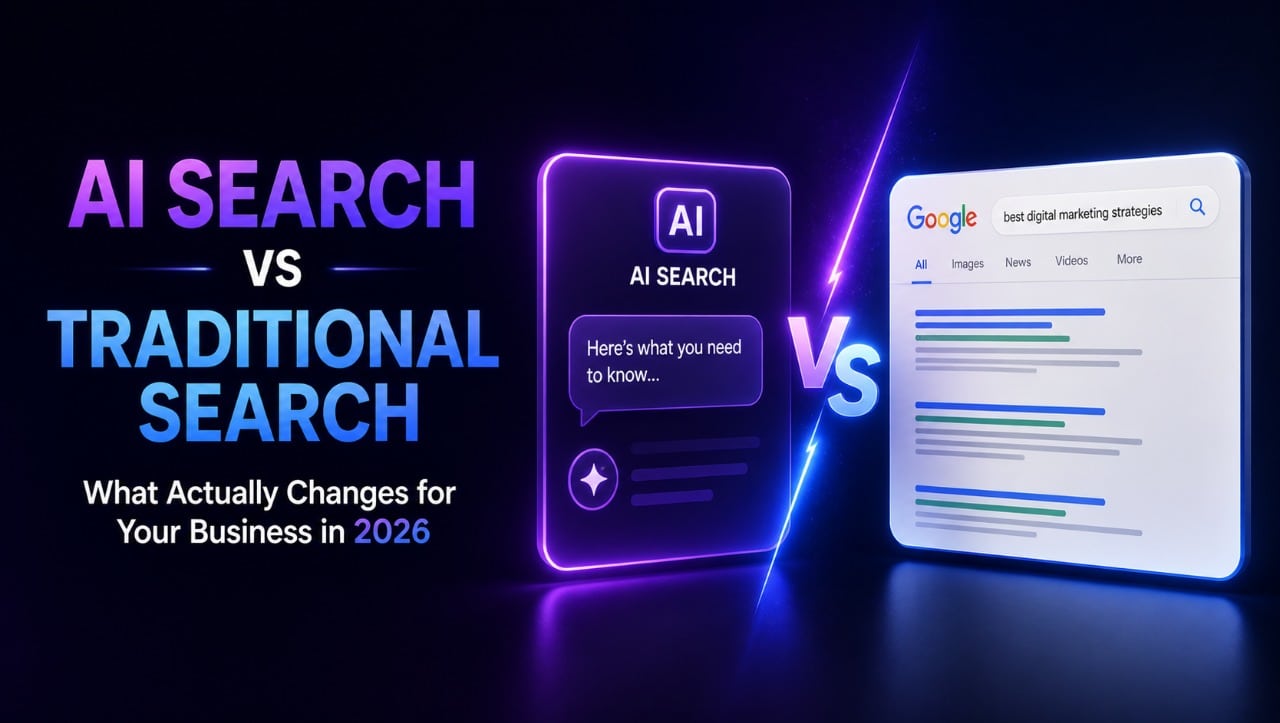
The short version, before we get into the detail: AI search and traditional search are not competing for your attention as a marketer. They’re two different channels at two different stages of the same buyer journey. The question isn’t “which one should I prioritize?” It’s “how do I perform well in both, given my current resources?”
The Numbers Worth Knowing
I’m going to keep the stat section tight. There are hundreds of AI search statistics floating around right now, most of them cited without context, and I’ve found that overwhelming people with data is as unhelpful as having none. So here are the ones that I think actually change how you should think about your content strategy.
345x
more traffic Google sends than ChatGPT+ Gemini+ Perplexity combined
more traffic Google sends than ChatGPT+ Gemini+ Perplexity combined
23x
better conversion rate for AI-referred visitors vs traditional organic
better conversion rate for AI-referred visitors vs traditional organic
60%
of Google searches now end with zero clicks to any website
of Google searches now end with zero clicks to any website
58%
drop in position-one CTR when AI Overviews appear (Ahrefs, Dec 2025)
drop in position-one CTR when AI Overviews appear (Ahrefs, Dec 2025)
The 23x conversion advantage for AI-referred visitors is the one that usually gets people’s attention, and rightly so. Ahrefs found that AI platform visitors generated 12.1% of their signups while accounting for only 0.5% of their total traffic. Twenty-three times better conversion per visit. Semrush’s broader study puts the average at 4.4x across a wider sample.
But note what I said: 0.5% of total traffic. The volume is tiny. The quality is extraordinary. Both things are true. I’ll come back to what that means for strategy shortly.
Where Traffic Is Going — And Where It Isn’t
The traffic migration story is more complicated than “AI is taking clicks from Google.” What’s actually happening is a three-way redistribution.
Zero-click behavior is the biggest factor — not AI platforms
AI Overviews are absorbing a meaningful share of clicks, yes. But zero-click behavior — where users get their answer from the search results page itself without clicking anything — is the dominant trend. We wrote about this in detail in our Google AI Overviews guide, but the short version: 60% of Google searches end without a click, and for queries that trigger AI Overviews, position-one CTR has dropped from historical highs to 0.61% according to Seer Interactive’s September 2025 research. (Dataslayer, citing Seer Interactive study of 3,119 queries)
The users aren’t going to ChatGPT instead of Google for these queries. They’re just… stopping. Getting the answer from the AI summary and moving on. That distinction matters because it means the solution isn’t just “build AI search presence.” It’s also “earn citations inside the Google AI summary that still appears on Google.”
Organic click share is declining across verticals
ALM Corp’s analysis of organic vs. paid click distribution found classic organic click share dropped between 11 and 23 percentage points across analyzed verticals between January 2025 and January 2026. (Similarweb data via ALM Corp) Meanwhile, paid search nearly doubled its click share in some categories. So some of those “lost” organic clicks aren’t going to AI platforms — they’re going to paid ads, which now appear more prominently as organic results get pushed further down.
This has a real implication for B2B companies: if you’re not tracking paid search efficiency alongside organic performance, you might be misattributing the cause of your traffic changes. Some of the organic decline is AI-related. Some of it is paid expansion. They’re different problems with different solutions.
AI referral traffic is growing fast — but from a tiny base
ChatGPT referral traffic to the web grew 206% in 2025. (Semrush, April 2026, via Omnibound) 87.4% of all AI referral traffic to websites comes from ChatGPT. These are real and significant numbers. But traditional organic traffic still accounts for roughly 25% of all website traffic on average, while AI referral traffic accounts for about 1.08% of total traffic. (Conductor, November 2025)
The math here doesn’t support abandoning traditional SEO. What it supports is adding AI search optimization — which our LLM SEO guide covers in detail — as an additional channel alongside your existing strategy.
The Conversion Paradox: Smaller Volume, Much Better Quality
This is the part of AI search that genuinely changes how you should think about measurement — even if it doesn’t change how much you invest right now.
AI-referred visitors arrive differently than Google organic visitors. Someone who typed a query into Google and clicked your result is in discovery mode. They’re evaluating options. Maybe they’ll read, maybe they’ll bounce, maybe they’ll convert in six weeks. The journey is unpredictable.
Someone who clicked through from a ChatGPT or Perplexity response is different. They’ve already had a conversation with an AI that synthesized options for them. They’ve been pointed toward you specifically. By the time they land on your page, they’re further along. The research phase happened before the click.
That pre-qualification is why conversion rates are so much higher for AI-referred traffic. Ahrefs’ finding of a 23x conversion advantage reflects this — their AI visitors weren’t browsing, they were evaluating.
The practical implication: Don’t measure AI search traffic purely on volume. A month where you get 200 AI-referred visitors and 18 of them convert is worth more than a month where you get 5,000 organic visitors and 12 convert. As you build AI search visibility — through the strategies in our GEO guide and Google AI Overviews guide — track conversion rate and absolute conversions from AI referrals separately in GA4. The traffic will look small. The conversion value won’t be.
One caveat worth adding: the 23x advantage applies most clearly to top-of-funnel conversions like signups, free trials, and email captures. For high-commitment B2B conversions — demo requests, signed contracts, enterprise deals — the advantage is real but smaller, because AI-referred visitors are still often in research mode even if they’re further along than typical organic visitors. Retargeting AI-referred visitors is significantly more effective than retargeting general organic traffic, so building a remarketing sequence specifically for this segment is worth doing now.
What Traditional Search Still Does Well
Before this becomes a case for abandoning traditional SEO — it isn’t — let me be direct about what Google organic still does that AI search doesn’t.
Volume. Sheer, massive volume.
345x more traffic. That’s not something you replace overnight. For most B2B companies, Google organic is still the primary source of awareness traffic — the first time a potential buyer encounters your brand. AI search converts better once the buyer gets there, but Google is often still where the buyer first learns you exist. Both play different and necessary roles in the funnel.
Transactional and branded queries remain Google’s domain
Zero-click behavior and AI Overviews hit informational queries hardest. When someone types a specific brand name or a clear transactional query — “AResourcePool pricing,” “hire AI SEO agency Noida” — they want a specific result, and they click. Branded searches and transactional terms have held up significantly better than informational content in traffic data. If your site has strong branded search volume and strong transactional keyword rankings, those are still worth protecting and building.
Traditional SEO directly supports AI search performance
This is the one that makes the “SEO vs AI search” framing fundamentally misleading. Pages ranking in Google’s top 10 are 3.5x more likely to be cited by ChatGPT than pages outside the top 20 (AirOps, March 2026). And pages at position one have a 58% chance of being cited by AI platforms. That drops to 14% by position ten.
So your traditional SEO work isn’t just maintaining Google traffic. It’s also building the domain authority and ranking presence that makes AI platforms more likely to cite you. The two channels compound each other when done well. Abandoning one weakens both.
What Has Genuinely Changed
Let me be specific here, because I think the “what’s changed” framing is where most strategy conversations get vague.
What’s actually different in 2026 versus 2023:
The value of ranking has shifted from clicks to citations. Ranking #1 used to mean most of the clicks for that query. Now it means you have a better chance of being cited in the AI Overview for that query — which in turn earns you 35% more clicks than uncited competitors ranking below the AI block. The metric isn’t “do I rank?” It’s “do I get cited?” Those are different questions requiring different optimization.
Informational content has a new job. Your how-to guides and explanatory blog posts are increasingly being read by AI systems and synthesized — not visited directly by humans. This doesn’t make them valueless. It makes them valuable in a different way: they build authority, earn citations, and create the topical depth that makes AI systems recommend your brand. But if you’ve been measuring their success purely through direct traffic, those metrics are going to look worse than the underlying value creation.
Your buyers are researching differently. They’re not going to Google, finding your content, reading it, and deciding to contact you. Increasingly, they’re asking ChatGPT or Perplexity for a summary of their options, forming a shortlist from those AI responses, and then visiting the websites of the brands the AI recommended. If your brand isn’t in the AI’s response, you might not be on the shortlist at all — even if you rank well on Google. We’ve covered how to fix this in our LLM SEO guide and the GEO vs SEO vs AEO comparison.
Content quality requirements have gone up, not down. One of the more counterintuitive effects of AI search: it’s raised the bar for what content needs to be, not lowered it. Generic, thin, keyword-stuffed content doesn’t get cited by AI systems. The AI systems pulling from the web prefer specific, expert-authored, verifiable, well-structured content. The optimization-for-optimization’s-sake approach to content — which worked well enough in 2018 — is now actively counterproductive for both traditional and AI search.
AI Search vs Traditional Search: The Real Comparison
| Factor | Traditional Google Search | AI Search (ChatGPT, Perplexity, Gemini) |
|---|---|---|
| Traffic volume | Still dominant — 345x more than AI platforms combined | Tiny but growing fast — 206% growth in 2025 |
| How visitors arrive | Discovery mode — exploring options | Evaluation mode — pre-qualified by AI |
| Conversion rate | Baseline | 4-23x better depending on conversion type |
| Primary metric | Rankings, organic traffic, CTR | Citation frequency, LLM Share-of-Voice, AI referral traffic in GA4 |
| Content format winners | Long-form keyword articles, pillar pages | Comparison articles, FAQ-structured content, expert guides |
| Zero-click exposure | High — 60% of searches don’t click anything | Very high — 93% of AI Mode sessions end without a website visit |
| Brand discovery | Still primary — high volume | Growing — AI responses shape vendor shortlists |
| Author/expertise signals | Important for E-E-A-T but not critical on every page | Critical — named experts with credentials strongly preferred |
| How they interact | These compound rather than compete. Strong traditional SEO makes AI citation 3.5x more likely. AI citations drive branded search volume that feeds traditional Google traffic. | |
For Indian B2B Companies Specifically
A few things that matter specifically if you’re an Indian B2B company — because the generic “AI search is growing” article written for a global audience doesn’t always address the local context.
First: the opportunity timing. I’ve said this in several of our recent AI SEO posts, and I’ll say it again because I think it’s genuinely the most important strategic point right now. Most Indian B2B companies haven’t started building AI search visibility yet. The competition for citations in most Indian B2B categories — AI SEO agencies, SaaS products, IT services, enterprise software — is still significantly lower than the equivalent traditional Google SEO competition. The brands that build AI citation authority in 2026 are compounding an advantage. The brands that wait until it’s obvious will find it expensive and slow to catch up, the same way late SEO movers found in 2018-2020.
Second: India is the second-largest ChatGPT market globally. This isn’t a “future trend” for Indian buyers. They’re already using it now, and the research behavior shift we described earlier — AI-first research before website visits — is happening among Indian procurement managers and founders right now. If you sell to Indian businesses, your buyers are already on these platforms.
Third: Google still matters enormously in India. Google’s market share in India is higher than in many Western markets. The “traditional SEO is dead” narrative is even less accurate in the Indian context than it is globally. The right frame for Indian B2B is: maintain and extend your Google SEO, and add AI search visibility on top. Don’t swap one for the other.
All of this connects to the broader content cluster we’ve been building on our blog — covering GEO, Google AI Overviews, LLM SEO, and how all of this fits into an AEO strategy for B2B brands specifically.
See How Your Brand Performs Across Both Channels
We check your traditional SEO health and your AI citation rate in one free audit — and tell you where to spend your next 90 days of effort.
Get My Free AI SEO Audit → 📞 Talk to Our Team
Only 8 free audits per month • No obligation • 4,100+ brands trust AResourcePool
What to Actually Do — The Dual-Channel Approach
Rather than a long list of tactics, I want to give you a framing that makes the prioritization obvious.
For traditional search: protect what’s working, focus resources where the threat is highest
Branded and transactional keyword rankings are holding up better than informational content. If you have strong transactional pages, keep optimizing them. If your traffic losses are concentrated in informational how-to content — guides, explainers, comparison articles — that’s where AI Overviews are hitting hardest, and the fix isn’t to abandon those pages. It’s to earn citations inside the AI Overview for those queries.
Which brings us to the actual change: stop thinking about those informational pages purely as traffic drivers and start thinking of them as authority builders and citation candidates. They don’t need to earn direct visits to be valuable — they need to be structured well enough that Google’s AI cites them in the Overview that appears when someone searches the topic.
For AI search: start with the quick wins, then build systematically
The quickest wins available are: restructuring the opening sections of your most important pages to answer the primary query directly, adding FAQ sections with proper FAQPage schema, and adding named author information to your key content. These changes can show citation improvements within 30-60 days and cost relatively little to implement.
The systematic work is the content cluster — building 15-20 interlinked pieces that establish your domain as the recognized authority on your core topics. This is what earns consistent AI citation across a range of related queries, rather than occasional appearances. Our GEO vs SEO vs AEO guide explains how these pieces fit together.
For measurement: set up dual tracking now
In GA4, create a custom segment for traffic from chatgpt.com, perplexity.ai, gemini.google.com, and copilot.microsoft.com. Track this separately from organic. Even if the numbers are tiny right now, watching them grow over time as you implement AI search strategies is how you validate whether the work is working. Also track branded search volume in Google Search Console — an upward trend there, especially after starting AI search optimization, is often the downstream effect of AI citations building brand awareness.
Timeline reality check: If you start building AI search visibility now, you’ll see initial citation improvements within 30-60 days from tactical changes. Meaningful Share-of-Voice gains across your target query set take a full quarter. The projected inflection point — where AI search conversions could equal Google organic conversions due to quality differences — is roughly 2027-2028 based on current growth trajectories. You’re not late. But you’re also not early anymore.
FAQs on AI Search vs Traditional Search
Q1. Is AI search replacing traditional Google search in 2026?
Not replacing — but significantly disrupting the value of Google traffic. Google still sends 345x more traffic than ChatGPT, Gemini, and Perplexity combined. But 60% of Google searches now end without a click, and position-one CTR dropped 58% for queries triggering AI Overviews. The volume is still there; the route from search to website visit is increasingly interrupted. For most businesses, the right move is adapting to both — not choosing one over the other.
Q2. How do AI search visitors compare to traditional organic visitors in terms of conversion?
Significantly better — but understand the nuance. Ahrefs found AI-referred visitors generated 12.1% of signups while accounting for only 0.5% of traffic — a 23x conversion advantage. Semrush’s broader study puts the average at 4.4x. The reason: AI search users arrive pre-qualified. They’ve already had an AI synthesize options for them and been pointed toward you specifically. But this conversion advantage applies most strongly to top-of-funnel actions like signups and trials. For high-commitment enterprise B2B conversions, the advantage is real but smaller — these visitors are still in research mode on first visit. Retargeting AI-referred visitors is significantly more effective than retargeting general organic traffic.
Q3. What is zero-click search and how does it affect my B2B business?
Zero-click search occurs when users get their answer from the search results page — an AI Overview, featured snippet, or knowledge panel — without visiting any website. Approximately 60% of all Google searches now end this way. For B2B Tech specifically, AI Overviews appear on 82% of queries — meaning the vast majority of your buyers’ informational searches now trigger a summary that resolves their question without them visiting your site. Informational content is most affected. Transactional and branded searches are more resilient. The solution isn’t to stop publishing informational content — it’s to earn citations inside those AI summaries, as we cover in our Google AI Overviews guide.
Q4. Should Indian B2B companies stop investing in traditional SEO?
No. Google still dominates Indian search traffic by massive margins, and Google’s market share in India is higher than in many Western markets. Stopping traditional SEO investment now means losing the majority of your current organic reach. More importantly, strong traditional SEO directly supports AI search performance — pages ranking in Google’s top 10 are 3.5x more likely to be cited by AI platforms than pages outside the top 20. The right approach: extend your existing SEO investment to include AI search optimization. Add FAQ schema, restructure content openings, build topical authority through content clusters. You’re not replacing SEO — you’re building the next layer on top of it.
Q5. What types of content win in AI search versus traditional search?
In traditional search, long-form keyword-optimized content with strong backlinks continues to rank. In AI search, comparison articles and structured listicles earn the most citations, followed by detailed FAQ-formatted content, expert-authored guides with specific verifiable data, and content that directly answers the primary query in the opening section. YouTube content is growing in AI citation importance too — it appeared in 31.8% of AI search citations in April 2026 research. The biggest gap between traditional and AI content winners: traditional SEO rewards comprehensive keyword coverage; AI search rewards direct, specific answers in the opening section of a page.
Q6. When will AI search traffic equal Google organic traffic for businesses?
Most projections point to 2027-2028 as a possible inflection point — not in raw volume (Google will likely remain dominant there for years), but in conversion value. Because AI-referred visitors convert 4-23x better, it takes far less AI traffic to match Google’s conversion contribution. Semrush’s analysis suggests AI search could surpass traditional organic as a conversions source in informational and research-heavy verticals by around 2028. For B2B companies, this makes 2026 the window for building AI visibility before competition for citations intensifies significantly.
Q7. How is ChatGPT referral traffic different from Google organic traffic?
ChatGPT accounts for 87.4% of all AI referral traffic to websites (Conductor, November 2025). Visitors arrive further along in their research journey — they’ve used ChatGPT to narrow options before clicking through. This produces higher time-on-site (AI referral visitors spend 68% more time on-site than organic visitors, per SE Ranking) and better top-of-funnel conversion rates. Retargeting works significantly better for this audience than for general organic traffic. Track them separately in GA4 under chatgpt.com referral source, and set up a specific remarketing sequence — the first-session conversion rate will be lower than you’d like, but the retargeting conversion rate is high enough to make this segment very valuable.
Q8. How do I track AI search traffic separately in Google Analytics?
In GA4, create a custom segment filtering for sessions from chatgpt.com, perplexity.ai, gemini.google.com, and copilot.microsoft.com under traffic acquisition referral sources. This gives you a clean view of AI-referred traffic separate from traditional organic. Note that as of June 2025, AI Mode clicks count toward Search Console totals under the “Web” search type without separate filtering — making GA4 referral tracking your primary method for AI-specific measurement. Set this up now, even if the numbers are currently tiny, so you have a baseline to measure growth against as you implement AI search optimizations.
The Short Version
AI search and traditional Google search are different channels at different stages of the buyer journey. Traditional search still dominates raw traffic volume by a factor of 345. AI search dominates conversion quality by a factor of 4 to 23. Zero-click behavior means both channels are delivering less direct traffic than they used to — but the value of appearing in an AI response (either Google’s or ChatGPT’s) has increased because cited brands gain more than they lose.
For Indian B2B companies: don’t abandon traditional SEO. Extend it to include AI search optimization. The competition for AI citations in Indian B2B categories is still relatively low. The window to build advantage before it closes is right now, in 2026.
If you want a practical starting point — a specific list of what to change first on your actual pages — our free audit covers both your traditional SEO health and your current AI citation rate. It takes 24 hours and gives you a priority-ordered action list, not a generic report.
Build Your Dual-Channel Search Strategy With AResourcePool
4,100+ businesses trust us for AI SEO and GEO strategy. We start with a free audit of your current position across both traditional search and AI search platforms.
Get My Free AI SEO Audit → 📱 WhatsApp Our Team
🔒 Confidential • No spam • Audit in 24 hours • Only 8 slots per month
Tags: AI search vs traditional search 2026, AI SEO India, zero-click search, organic traffic decline, Google AI Overviews, ChatGPT referral traffic, GEO vs SEO, B2B AI search India, AResourcePool
