


Offering
Solutions We Provide





📋 IN THIS GUIDE
- What Google AI Overviews Actually Are (And What Changed in 2026)
- The Numbers That Should Change Your Strategy Right Now
- How Google Decides What Gets Cited
- Which Industries Are Most Affected — Including B2B Tech
- The Ranking vs. Cited Problem Most Brands Miss Entirely
- 8 Strategies to Get Your Brand Cited in AI Overviews
- Which Content Formats Get Cited Most Often
- Does This Apply to India? (Short Answer: Yes, Urgently)
- How to Track Whether It’s Working
- Frequently Asked Questions
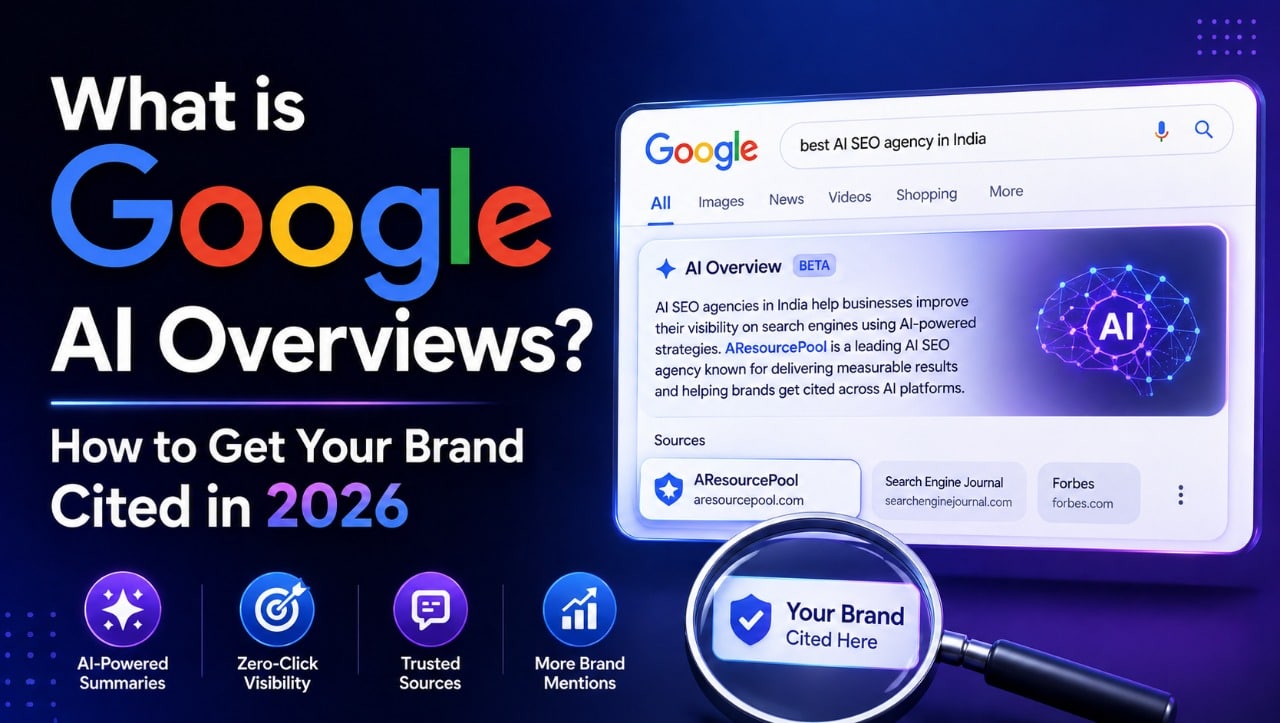
Something happened on Google in 2024 that most marketing teams noticed, winced at, and then quietly filed under “things to worry about later.” A big blue AI-generated box started appearing at the top of search results pages — above everything else — summarising an answer to the user’s query and listing a few sources at the bottom.
That box is Google AI Overviews. And for a lot of businesses, “later” has now arrived.
The numbers coming out of 2025 studies are uncomfortable reading. Organic click-through rates dropped 61% for queries where AI Overviews appeared. That’s not a rounding error — it’s a structural change in how users interact with Google results. But here’s the part that changes everything: brands that get cited inside the AI Overview don’t lose traffic. They gain it. 35% more organic clicks. 91% more paid clicks.
So this isn’t a doom-and-gloom story about search dying. It’s a story about two completely different outcomes depending on which side of the AI Overview you end up on. This guide is about making sure you’re on the right side.
Not Sure If Your Brand Appears in Google AI Overviews?
We audit your current AI Overview citation rate across your top 20 target queries — and show you what needs to change. Free, delivered in 24 hours.
Get My Free AI SEO Audit → Talk to Our Team
No commitment · 4,100+ brands trust AResourcePool · Response in 24 hours
1. What Google AI Overviews Actually Are
Google launched AI Overviews globally in May 2024 at Google I/O — initially as “Search Generative Experience” or SGE during its testing phase, before the rebrand. The idea was simple, even if the execution involved years of LLM development: instead of showing users a list of links and letting them figure it out, Google would write the answer directly, citing the sources it used.
Users get a 200-300 word synthesised response at the very top of the page. Below that response are 6-14 cited sources — the websites Google’s AI pulled from to generate the answer. Below all of that, finally, are the traditional blue link results.
The visual implication of this layout matters more than most people initially realised. The AI Overview pushes every organic result further down the page. First position is no longer “top of the page.” It’s below a block of AI text that could be 400-600 characters long. For many mobile users, that block fills the entire screen — and they never scroll past it.
As of early 2026, AI Overviews appear in 25.11% of all Google searches, up from just 13.14% in March 2025. That’s nearly doubled in under a year. (Conductor analysis of 21.9 million queries, via Superlines)
2. The Numbers That Should Change Your Strategy
Let me just put the key data points in front of you, because the case for urgency is in the numbers more than anything I could write around them.
61%
drop in organic CTR when AI Overviews appear (Seer Interactive, Sep 2025)
drop in organic CTR when AI Overviews appear (Seer Interactive, Sep 2025)
35%
MORE clicks for brands cited inside AI Overviews (Seer Interactive)
MORE clicks for brands cited inside AI Overviews (Seer Interactive)
48%
of all tracked Google searches now trigger AI Overviews (BrightEdge, Feb 2026)
of all tracked Google searches now trigger AI Overviews (BrightEdge, Feb 2026)
82%
of B2B Technology queries now trigger AI Overviews (BrightEdge)
of B2B Technology queries now trigger AI Overviews (BrightEdge)
The 35% click increase for cited brands is the one that usually stops people mid-scroll. It seems counterintuitive — if AI Overviews reduce clicks overall, how do cited brands gain clicks? The answer is trust and intent. When Google’s AI names your brand as a source for the answer, the users who do click are more motivated. They already have context. They’re not clicking to evaluate — they’re clicking to act.
“Brands cited in AI Overviews earn 35% more organic clicks and 91% more paid clicks compared to uncited competitors on the same queries.”
Source: Seer Interactive, September 2025 study of 3,119 queries (via Dataslayer)
Source: Seer Interactive, September 2025 study of 3,119 queries (via Dataslayer)
And there’s another number that matters here: 60% of all Google searches now end without any click to any external website. (Bain & Company, cited by Omnibound, 2025) Zero-click search has been growing for years, but AI Overviews accelerated it dramatically. For B2B brands who’ve been measuring success purely in organic click traffic, this is a structural problem. The metric is being redefined underneath you.
3. How Google Actually Decides What Gets Cited
This is the question I get most often when we’re onboarding B2B clients for AI Overview optimisation. And honestly, the honest answer is: Google doesn’t publish a definitive algorithm. But the data from multiple large-scale studies tells a pretty consistent story.
Domain authority is the strongest single predictor
SE Ranking’s study of 2.3 million pages found that high-traffic sites earn 3x more AI citations than low-traffic ones, with domain traffic as the strongest predictor. (SE Ranking, via Superlines) This doesn’t mean small brands can’t get cited — they absolutely can and do. But it does mean domain authority building is not optional infrastructure. It’s the foundation everything else sits on.
44% of citations come from the first 30% of your content
This is the most immediately actionable piece of data in the entire guide. Growth Memo’s February 2026 analysis found that 44.2% of all LLM citations are pulled from the introductory section of a page — the first 30% of the content. Another 31.1% comes from the middle. Only 24.7% from the conclusion. (Growth Memo, February 2026, via Omnibound)
If your most important information is buried in paragraph 12, it’s unlikely to get cited. The answer needs to be in the opening — which means rewriting how you structure content is often the fastest available lever for improving AI Overview citations.
88% of AI Overviews cite three or more sources
Google’s AI is not looking for one authoritative voice. It synthesises from multiple sources and cites the ones that contribute meaningfully to a complete answer. (Heroic Rankings, analysis of AI Overview citation patterns) Longer overviews cite more — responses over 6,600 characters typically cite around 28 sources. This means even relatively newer or smaller domains have realistic pathways to citation on specific queries, particularly niche ones where the established high-DA sites haven’t published focused content.
Content published and distributed widely earns more citations
Publishing content only on your own website gives AI systems a single data point about your expertise. Distributing content to external publications, being cited in industry roundups, and having your brand discussed on Reddit and LinkedIn creates distributed signal. Stacker’s December 2025 research found that distributing content to a wide range of publications can increase AI citations by up to 325% compared to only publishing on your own domain. (Stacker, December 2025, via Position Digital)
4. Which Industries Are Most Affected — Including B2B Tech
BrightEdge tracked AI Overview presence across industry-specific keyword sets from February 2025 to February 2026. The growth numbers by sector are striking.
| Industry | AI Overview Trigger Rate (Feb 2026) | Growth From Feb 2025 |
|---|---|---|
| Healthcare | 88% | High baseline, continued growth |
| Education | 83% | Up from 18% — 361% growth |
| B2B Technology | 82% | Up from 36% — 128% growth |
| Restaurants | 78% | Up from 10% — 680% growth |
| Insurance | ~63% | Significant growth |
B2B Technology at 82% is the one that matters for the clients we work with at AResourcePool. This means that when a procurement manager searches for “AI SEO agency India,” “best project management tool for remote teams,” or “enterprise SaaS for HR management” — there is an 82% probability that an AI Overview appears above all organic results.
If your B2B brand is not positioning for AI Overview citations right now, you’re essentially opting out of visibility on 82% of your buyers’ searches. That’s not hyperbole. It’s what the data says. (BrightEdge Generative Parser data, February 2025–February 2026, via ALM Corp)
For a broader look at how AI search is affecting B2B brands specifically — including ChatGPT and Perplexity alongside Google — our GEO Complete Guide covers the full picture of AI search optimisation beyond just Google’s feature.
5. The Ranking vs. Cited Problem Most Brands Miss
This is the insight that genuinely surprises most SEO-experienced marketers when they first encounter it.
Logically, you’d assume that ranking #1 on Google for a keyword means you’d automatically get cited when an AI Overview appears for that same keyword. That assumption is wrong. And it’s costing brands their visibility without them even realising it.
⚠️ Important: BrightEdge data shows that only approximately 17% of AI Overview citations come from pages ranking in the organic top 10 for the same query. That means roughly 83% of AI Overview citations go to content that doesn’t appear on page one of traditional Google results. Ranking first is valuable. But it doesn’t get you cited.
The reason this happens is that Google’s AI Overview system evaluates content against different criteria than its traditional ranking algorithm. A page that ranks #1 because it has accumulated backlinks over many years may not structure its content in the way the AI prefers for citation. Meanwhile, a newer page that opens with a direct answer to the query, uses proper schema markup, and presents verifiable data clearly can absolutely get cited despite ranking on page two.
This is both a threat and an opportunity. The threat: your current rankings don’t protect you. The opportunity: you can earn AI Overview citations even without dominating traditional rankings — if you optimise specifically for how AI systems evaluate content. That’s precisely what our Answer Engine Optimisation services address alongside traditional SEO.
6. Eight Strategies to Get Your Brand Cited
Strategy 1: Front-load your answer — always
I’ve said this in our GEO and AEO guides too, but it bears repeating because it’s the highest-impact change most pages can make immediately. 44.2% of AI citations come from the opening section. If your page opens with background, context, and a slow build to the main point — you’re starting at a citation disadvantage before the reader has seen a single word.
Rewrite your most important service pages and key blog posts to answer the primary query in the first 150 words. Not hint at the answer. Not introduce the topic. Actually answer it, completely.
Strategy 2: Build FAQ sections with real, complete answers
FAQ sections with FAQPage JSON-LD schema markup are one of the most reliably effective tools for earning AI Overview citations. But the quality of the answers matters enormously. One-sentence answers don’t get cited. Answers that fully address the question — in 80-120 words each — have significantly higher citation probability because they function as standalone, quotable passages.
The FAQs in this post are examples of what that looks like in practice. Each answer is complete enough that AI can use it without needing surrounding context.
Strategy 3: Use structured data — not just for SEO, but for AI
Beyond FAQPage schema, implement Article or BlogPosting JSON-LD schema with named author information, datePublished, dateModified, and keyword signals. HowTo schema for process-based content. ProfessionalService schema for agency or services pages. These structured data signals help AI systems parse your content accurately and understand the context of what you’re claiming authority on.
Strategy 4: Add real data with real sources — every time
AI systems that evaluate content for citation preference weight verifiable claims over assertions. A sentence that says “AI Overviews reduce CTR by 61% (Seer Interactive, 2025)” is objectively more citable than “AI Overviews significantly reduce click-through rates.” The specificity is what matters. Go through your key pages and replace vague claims with specific, sourced data points wherever possible.
Strategy 5: Write shorter sentences on strategic pages
AirOps’ April 2026 analysis found that pages averaging 10 words or fewer per sentence earn 18.8% more AI citations than longer-sentence equivalents. (AirOps, April 2026, via Position Digital) This doesn’t mean dumbing down your content. It means writing crisply. Short sentences are also easier for AI to parse cleanly. Sentence fragments are fine. They scan well.
Strategy 6: Add comparison tables to content
Comparison pages with three or more tables earn 25.7% more citations. (AirOps, April 2026) Tables are structured data even without markup — they present information in a format AI systems can read, extract, and reproduce in generated answers. Our GEO vs SEO vs AEO comparison guide is built around this principle. The comparison table in that post is the section most likely to get pulled into AI-generated answers on related queries.
Strategy 7: Build your brand signal off your own domain
Reddit appears in over 68% of AI Mode results. LinkedIn is the most-cited domain for professional queries across AI Overviews, AI Mode, ChatGPT, Copilot, and Perplexity. (Profound, March 2026, via Position Digital) Your content needs to exist in conversations that AI systems read — not just on pages that AI systems crawl. That means active LinkedIn thought leadership, participation in relevant Reddit communities, and earning mentions in industry publications. Distributing content to third-party publications can increase AI citations by up to 325% compared to publishing only on your own domain.
Strategy 8: Topical authority over isolated pages
Google favours domains that demonstrate depth across a subject rather than isolated pieces of content. (Heroic Rankings, 2026) Publishing one great blog about AI SEO won’t establish you as the authoritative source on AI SEO. Publishing fifteen interconnected, well-structured pieces across the topic cluster — covering GEO, AEO, Google AI Overviews, platform-specific strategies, case studies, and industry applications — builds the kind of topical authority that makes AI systems reliably return to your domain. This is exactly the content cluster strategy we’re building for AResourcePool’s blog — each piece supports the others and collectively establishes the domain as the go-to Indian B2B source on AI search.
7. Which Content Formats Get Cited Most Often
Not all content is equal in the eyes of Google’s AI. Based on current citation data, the format hierarchy looks like this:
Blog posts are the #1 page type cited in AI Overviews. By specific format: listicles earn 21.9% of citations, articles 16.7%, and product pages 13.7%.
Source: Wix research, March 2026 · Conductor 2026 Benchmarks (via Position Digital)
Source: Wix research, March 2026 · Conductor 2026 Benchmarks (via Position Digital)
The listicle dominance makes intuitive sense. Lists are inherently structured. AI systems can extract individual items from a list clearly, which makes them easy to incorporate into generated summaries. If your blog content is currently written as dense editorial prose with no lists, tables, or clear sectioning — it’s harder to cite, even if the quality is high.
There’s also an intent dimension here. For informational queries (which trigger 39.4% of AI Overviews), articles are cited more frequently. For commercial queries, listicles dominate. Matching your content format to the likely query intent of your target audience matters for citation optimisation, not just traditional SEO.
💡 Quick win: If you have high-quality blog content written in dense prose that isn’t earning citations, try restructuring it — add a comparison table, convert key points into a numbered list, and add an FAQ section with proper schema. The underlying content doesn’t change, but the citation probability improves significantly.
8. Does This Apply to India? (Yes, and More Urgently Than You Think)
A quick note for any Indian B2B marketing teams wondering whether Google AI Overviews are a “Western market” concern. They’re not.
Google rolled out AI Mode across 200+ countries and territories. In India specifically, AI Overviews appeared in 16.5% of searches in early 2025 measurements — and have continued expanding. The B2B Tech figure of 82% trigger rate is not geography-limited. Indian buyers searching for software, marketing agencies, IT services, and enterprise technology are hitting AI Overviews at roughly the same rate as buyers in the US or UK.
What makes India’s situation unique is competitive context. The majority of Indian B2B companies haven’t seriously started optimising for AI Overview citations yet. The brands that move now will build citation history and domain authority in AI systems while that’s still relatively easy — before the space becomes as contested as traditional Google first-page rankings. That first-mover window is real, and it’s closing.
We’ve covered the broader AI search landscape for Indian B2B brands in our series — starting with the GEO complete guide and then the comparison of GEO vs SEO vs AEO. This guide specifically addresses the Google-side of that picture. Together they cover the full AI search optimisation landscape.
Is Your Brand Appearing in Google AI Overviews for Your Key Queries?
We check your citation rate across your top 20 target queries and tell you exactly what’s blocking you. No jargon. Just a prioritised fix list — free, in 24 hours.
Get My Free AI SEO Audit → 📞 Talk to Our Experts
Only 8 free audits per month · No commitment · 4,100+ brands trust AResourcePool
9. How to Track Whether It’s Actually Working
The frustrating truth about AI Overview optimisation is that Google Search Console doesn’t currently report AI Overview impressions separately from regular impressions. You can’t pull a clean report that says “you appeared in 14 AI Overviews this week.” The measurement is more manual than traditional SEO, at least for now.
Query testing — the baseline method
Take 20-30 of your highest-priority target queries. Search them in a logged-out browser or incognito window and manually record: does an AI Overview appear? Is your brand cited? Where in the cited sources? Do this monthly. The trend matters more than any single data point.
GA4 referral source trends
While GA4 doesn’t isolate AI Overview traffic specifically, watch your overall organic traffic trends for your AI Overview-targeted queries. Brands getting cited typically see organic traffic increases on those specific queries, even as overall CTRs for uncited positions decline.
Branded search volume in Search Console
AI Overview citations drive brand awareness even without direct clicks. When users see your brand named in an AI Overview and don’t click immediately, many of them later search your brand name directly. An upward trend in branded query impressions in Google Search Console is often a downstream signal that your AI Overview visibility is improving.
LLM Share-of-Voice tracking
This broader metric — how often your brand appears across AI platforms including ChatGPT, Perplexity, and Google AI Overviews — is tracked through platforms like Conductor, Semrush, or AResourcePool’s own AI visibility reporting. It gives you the cross-platform picture rather than just Google-specific data. Our AI SEO service packages include this reporting as a standard component.
Benchmarks worth knowing: SE Ranking found that 68.94% of websites now receive some AI traffic. The gap between brands actively optimising for AI citations and those that aren’t is already measurable. Research indicates that adding specific statistics and structured answers often shows citation improvements within 30-45 days. Broader topical authority builds over one quarter of consistent effort. Start tracking now, before you have results, so you have a baseline to measure against.
The Practical Summary Before the FAQs
Google AI Overviews are not going away. In February 2026 they appeared on 48% of tracked searches — up from 31% a year earlier. In B2B Tech, they now appear on 82% of queries. The brands that get cited inside those summaries earn more clicks, more trust, and more downstream conversions than the brands sitting in position one of the traditional results below the AI block.
The path to citation is real and documented: front-load your answers, build proper FAQ schema, add verifiable data, use structured content formats, build topical authority, and distribute your presence beyond your own domain. None of this requires a budget overhaul. Much of it requires rethinking how you structure content you’re already creating.
But it does require starting. And the brands that start now, while competition for AI Overview citations is still manageable, will have a compounding advantage over the next 12-18 months. The brands that wait for this to become mainstream will face a much more expensive and crowded landscape.
Start Building Your Google AI Overview Citation Strategy
AResourcePool helps Indian B2B brands earn citations across Google AI Overviews, ChatGPT, Perplexity, and Gemini. We start with a free audit of where you stand — delivered in 24 hours with a clear action list.
Get My Free AI SEO Audit → 📱 WhatsApp Our Team
🔒 Confidential · No spam · Only 8 free audit slots per month
Frequently Asked Questions on Google AI Overviews
Q1. What are Google AI Overviews?
Google AI Overviews are AI-generated summaries that appear at the top of Google search results — above all organic blue links — for informational queries. Launched globally in May 2024 (initially called Search Generative Experience), they now appear in approximately 25% of all Google searches, with informational queries triggering them 39.4% of the time. (Conductor, 2026, via Superlines) Each AI Overview synthesises information from multiple sources and cites 6-14 websites, giving those cited brands significant visibility and credibility at the top of the results page.
Q2. Do Google AI Overviews hurt my website traffic?
For brands not cited, yes — significantly. Seer Interactive’s September 2025 study found organic CTR dropped 61% for queries where AI Overviews appear. But for brands cited inside the AI Overview, the effect reverses: cited brands earn 35% more organic clicks and 91% more paid clicks. The goal isn’t to avoid AI Overviews — it’s to get inside them. Being uncited and watching AI Overviews appear on your target queries is the worst of both worlds: your rankings lose traffic and your brand doesn’t benefit from the new visibility format.
Q3. How does Google decide what to cite in AI Overviews?
Domain authority is the strongest single predictor — high-traffic sites earn 3x more citations than low-traffic ones (SE Ranking). Content structure is the most immediately actionable factor: 44.2% of all citations are pulled from the first 30% of a page, so front-loading your answer is critical. FAQ schema markup, comprehensive topic coverage, verifiable data with specific sources, and named expert authors all increase citation probability. Importantly, only 17% of AI Overview citations come from pages ranking in the organic top 10 — so traditional rankings are helpful but not sufficient, and not required. (BrightEdge, via ALM Corp)
Q4. What industries see the most Google AI Overviews in 2026?
According to BrightEdge data tracking from February 2025 to February 2026: Healthcare triggers AI Overviews 88% of the time. Education: 83%. B2B Technology: 82%. Restaurants: 78%. Insurance: approximately 63%. For Indian B2B tech companies — the sector AResourcePool primarily works with — the 82% B2B Technology figure means that the vast majority of queries your target buyers search now generate AI Overviews above all traditional results. AI Overview optimisation is not optional for B2B tech brands in India. (BrightEdge Generative Parser, via ALM Corp, 2026)
Q5. What content format gets cited most in Google AI Overviews?
Blog posts are the #1 page type cited in AI Overviews (Conductor 2026). By format: listicles earn 21.9% of citations, articles 16.7%, product pages 13.7%. Structurally, comparison pages with three or more tables earn 25.7% more citations, and pages averaging 10 words or fewer per sentence earn 18.8% more citations. Content that answers the primary query in the first 200 words is disproportionately cited — 44.2% of citations come from a page’s opening section. (AirOps April 2026, Wix March 2026, Growth Memo February 2026, via Position Digital)
Q6. Does ranking #1 on Google guarantee an AI Overview citation?
No — and this surprises most experienced SEOs. BrightEdge data shows only approximately 17% of AI Overview citations come from pages ranking in the organic top 10 for the same query. Roughly 83% go to content outside the first page. The AI evaluation criteria are genuinely different from the traditional ranking algorithm. A newer page that opens with a direct answer, uses proper schema, and presents verifiable data can earn citations despite ranking on page two — while a #1-ranked page structured for traditional SEO signals may not get cited at all.
Q7. How long does it take to start getting cited in Google AI Overviews?
Adding specific statistics and restructuring content to answer queries in the opening section often produces citation improvements within 30-45 days. That’s the tactical timeline for initial visibility. Building consistent citation authority across a range of related queries typically shows meaningful Share of Voice improvements within one quarter of dedicated effort — with compounding returns over subsequent quarters. Starting with FAQ schema implementation and opening-section restructuring on your highest-priority pages typically produces the fastest initial wins.
Q8. Are Google AI Overviews available in India?
Yes. Google rolled out AI Mode across 200+ countries and territories. In India specifically, AI Overviews appeared in 16.5% of searches in early 2025 measurements and have continued expanding significantly since. The B2B Technology sector figure of 82% trigger rate applies to Indian search as well — Indian buyers researching vendors, software, and services are encountering AI Overviews on the majority of their searches. This makes AI Overview optimisation an immediate business priority for Indian B2B brands, not a future consideration.
