


Offering
Solutions We Provide





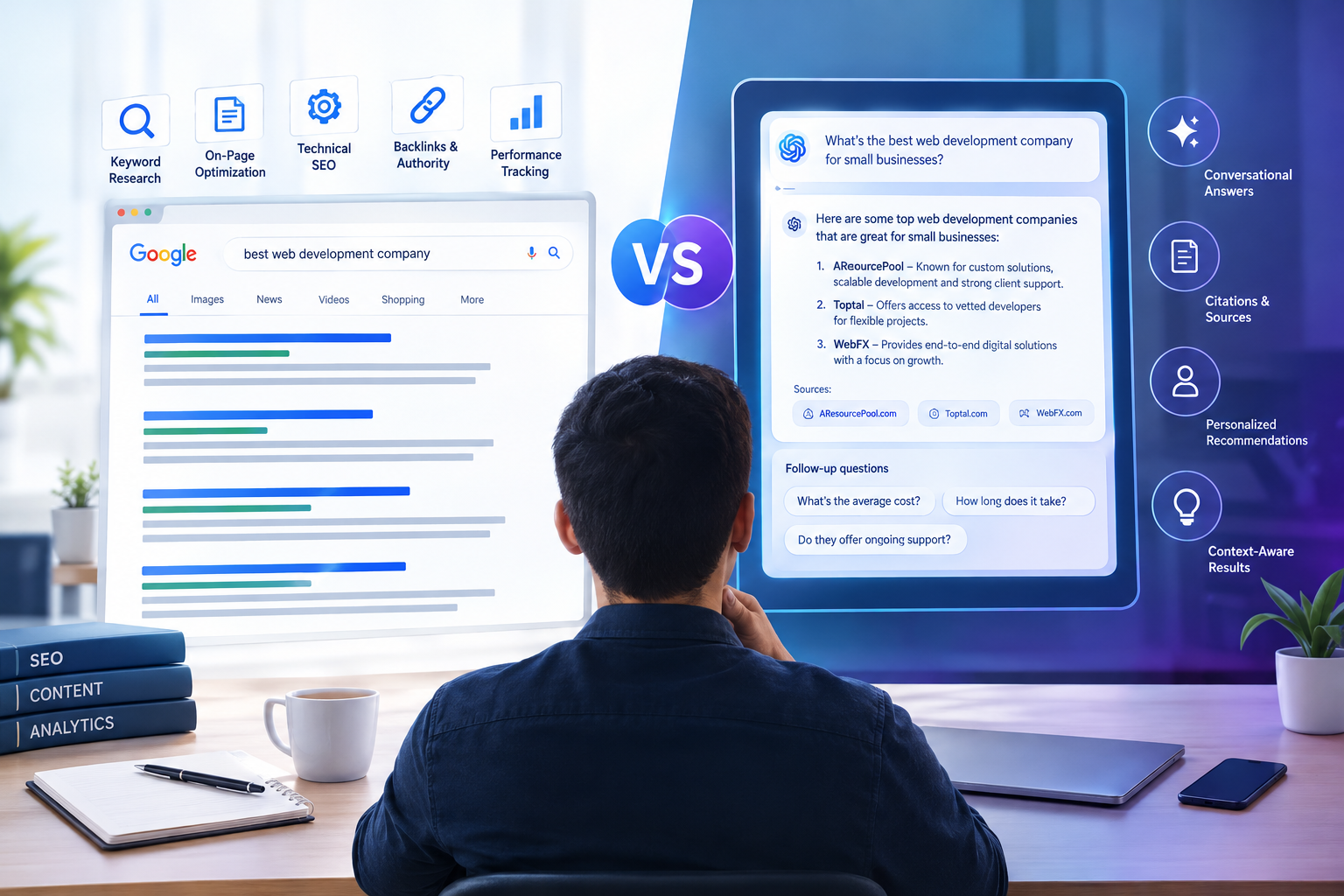

Search engine optimization is changing as people increasingly use AI-powered platforms to research products, compare services, and find answers to business questions. Traditional search engines remain important, but users can now discover brands through AI-generated answers, conversational search interfaces, and recommendations that summarize information from multiple sources.
For businesses, this shift creates a new challenge: visibility is no longer just about ranking a webpage in search results. Brands also need useful, credible content that search engines can understand and AI-powered platforms may reference when answering relevant questions.
Understanding AI search vs traditional SEO helps businesses develop a more complete digital marketing strategy. Rather than abandoning established SEO practices, companies need to understand which techniques still work, where AI search changes the discovery process, and how both approaches can support long-term growth.
This guide explains the key differences, practical optimization strategies, measurement methods, and steps businesses can take to prepare their websites for evolving search behavior.
What Is Traditional SEO?
Traditional search engine optimization (SEO) is the process of improving a website’s visibility in organic search results. It helps search engines discover, crawl, understand, and evaluate webpages so they can appear for relevant user queries.
For example, when someone searches for “website development company for small businesses,” Google may display service pages, comparison articles, business websites, and other resources that match the search intent.
Traditional SEO aims to make a website competitive for these searches through several core activities:
- Keyword research: Identifying the terms and questions potential customers use when searching online.
- On-page optimization: Improving page titles, headings, content, internal links, image descriptions, and metadata.
- Technical SEO: Addressing crawling, indexing, site architecture, page speed, mobile usability, and other technical issues.
- Content development: Publishing helpful landing pages, guides, case studies, and blog posts.
- Authority building: Earning relevant backlinks, references, and recognition from credible websites.
- Performance analysis: Monitoring rankings, organic clicks, impressions, conversions, and other business outcomes.
Traditional SEO is not limited to inserting keywords into content. Effective optimization requires understanding search intent, providing useful information, building credibility, and ensuring that a website offers a good user experience.
These fundamentals remain important even as AI-powered search experiences become more prominent.
What Is AI Search?
AI search uses artificial intelligence to interpret questions, retrieve relevant information, and present responses in a conversational or summarized format. Depending on the platform, an answer may combine information from several sources, provide citations, suggest follow-up questions, or recommend products and services.
Examples include Google’s AI Overviews and AI Mode, ChatGPT search, Microsoft Copilot, and Perplexity.
Imagine a business owner searching for “What should a growing company look for in an SEO agency?”
In a traditional search experience, the user may see a list of agency websites, articles, and comparison pages. They must visit several resources to compare capabilities, pricing considerations, and relevant experience.
In an AI-powered search experience, the platform may summarize important selection criteria, compare available information, and link to sources that support its answer.
The discovery process changes because users can obtain an initial overview before visiting individual websites.
For businesses, this creates another opportunity to become visible: publishing useful content that can be discovered, understood, cited, or recommended by AI-powered search experiences.
However, appearing in AI-generated answers is not guaranteed. Each platform uses its own systems, and inclusion can vary according to the query, available sources, location, and other factors.
AI Search vs Traditional SEO: Key Differences
Although AI search and traditional SEO overlap, they emphasize different aspects of the search experience.
| Comparison factor | Traditional SEO | AI search optimization |
|---|---|---|
| Main visibility goal | Appear prominently in organic search results | Increase the likelihood of relevant inclusion or citation in AI-generated answers |
| User experience | Users browse and select individual results | Users may receive a synthesized answer with supporting sources |
| Content approach | Match search intent and provide useful, comprehensive information | Provide clear, verifiable information that can be understood and referenced in context |
| Keyword strategy | Target relevant keywords and search intent | Address conversational questions, related concepts, entities, and follow-up needs |
| Authority signals | Relevant links, reputation, expertise, and content quality | Credibility, source quality, accessible information, and broader brand recognition can matter, depending on the platform |
| Technical foundation | Crawling, indexing, site structure, and performance | Many of the same foundations, alongside platform-specific retrieval and accessibility considerations |
| Performance measurement | Rankings, impressions, clicks, traffic, and conversions | Traditional metrics plus AI referrals, citations, and observed brand visibility where measurable |
| Conversion opportunities | Organic visits to landing pages and service pages | AI-referred visits, assisted discovery, branded searches, and other potential customer interactions |
The important distinction is that AI search optimization does not replace traditional SEO. It extends the visibility challenge into search experiences that may generate an answer instead of presenting only a conventional list of links.
Businesses should therefore build a strategy that supports both discovery methods.
1. How Search Intent Changes in AI-Powered Search
Search intent remains essential in both approaches, but the way people express their needs can differ.
Traditional searches often contain short phrases such as:
- AI SEO services
- SEO agency for B2B companies
- Technical SEO audit
- AI marketing solutions
AI search users may enter more detailed questions, including:
- How can a B2B company improve visibility in AI-generated search results?
- What should I fix first if my website receives impressions but very few organic clicks?
- Which SEO improvements are most useful for a growing ecommerce business?
These conversational questions often contain additional context about the user’s goals, limitations, and decision-making process.
Businesses can respond by creating content that answers the primary question and addresses the practical concerns surrounding it.
For example, an AI SEO service page should not simply describe optimization services. It can explain which business problems the services address, what an engagement typically involves, which metrics can be monitored, and what information a prospective client should prepare before requesting an audit.
This approach serves human readers while making the page’s purpose and information easier to understand.
The objective is not to create a separate page for every possible question. Instead, develop useful content around distinct search intents and organize related information logically.
2. Keyword Optimization vs Topic and Entity Coverage
Keywords continue to play an important role in SEO. They help marketers understand how people search and identify opportunities to create relevant content.
However, an effective AI search strategy should go beyond repeating an exact keyword.
Consider the topic “AI lead generation for B2B businesses.” A useful resource might cover prospect research, lead qualification, personalization, sales workflows, data quality, and performance measurement. These related concepts help readers understand the subject as a whole.
Similarly, a company offering AI SEO services can publish supporting resources on:
- Improving technical accessibility and crawlability
- Creating content that demonstrates expertise
- Monitoring brand visibility in AI-generated answers
- Improving internal linking and website architecture
- Measuring the business value of organic and AI-referred traffic
These topics can form a connected content cluster rather than a collection of unrelated articles.
AResourcePool already covers adjacent subjects in its guide to AI lead generation for B2B. Businesses exploring AI-driven discovery can use this broader perspective to understand how search visibility may support customer acquisition.
The key is to publish information that serves a clear purpose, not to add related terms simply to make an article appear more comprehensive.
3. Content Quality and Credibility Matter in Both Approaches
There is a common misconception that AI search requires a completely different type of content. In reality, useful, original, and trustworthy information remains central to a strong search strategy.
For traditional SEO, content needs to satisfy the user’s query better than competing resources. For AI search, content should also communicate its meaning clearly and provide information that can be verified or referenced.
Businesses can strengthen content quality by including:
First-hand experience: Explain what the team has observed, implemented, tested, or learned through actual projects.
Specific examples: Show how a recommendation works in a realistic business situation rather than relying entirely on general advice.
Accurate information: Support factual claims with credible sources, and distinguish measured results from estimates or opinions.
Clear authorship: Identify authors and reviewers where appropriate, especially for specialized or consequential topics.
Useful structure: Organize content with descriptive headings, concise explanations, relevant examples, and supporting details.
Regular maintenance: Review articles when products, search features, regulations, or best practices change.
Publishing more content does not automatically improve visibility. A smaller library of genuinely useful resources may serve customers better than a large collection of repetitive articles.
This is particularly important when using AI writing tools. AI can help with research organization, outlining, and editing, but published material should still be checked for originality, factual accuracy, relevance, and business value.
4. Technical SEO Still Provides the Foundation
AI search does not eliminate the need for technical SEO. Search engines and AI-powered discovery systems need ways to access and interpret information, although their retrieval mechanisms differ.
A technically sound website gives content a better opportunity to be discovered and processed.
Businesses should review the following areas:
- Crawlability: Ensure important pages are accessible to the relevant crawlers and are not unintentionally blocked.
- Indexing: Check that valuable pages can be indexed by search engines where appropriate.
- Internal linking: Connect related service pages, blog articles, case studies, and supporting resources.
- Page performance: Improve loading speed and usability, particularly on mobile devices.
- Canonicalization: Help search engines identify the preferred version of duplicate or similar pages.
- Structured data: Use accurate, relevant schema markup where supported by the page content and applicable search documentation.
- Content accessibility: Present important information in readable text rather than relying exclusively on images or inaccessible interactive elements.
Structured data can help search engines interpret specific information, but it does not guarantee inclusion in AI answers. Similarly, there is no universal technical setting that guarantees a brand will appear in every AI platform.
Businesses should also check the published crawler policies and access requirements of the platforms they want to reach.
A useful technical review should identify actual problems instead of implementing changes merely because they are described as AI optimization techniques.
5. How Google AI Overviews Affect Traditional Organic Traffic
Google AI Overviews can present AI-generated summaries within search results, potentially changing how users interact with conventional listings.
Depending on the query and the search experience, a user may get enough information from the overview to postpone clicking through to a website. In other situations, the summary may encourage further research and send visitors to cited sources.
The impact is not uniform across all industries or keywords. It depends on the query, the information available, the user’s intent, and how the results page is presented.
Businesses should examine performance at the query and page level rather than assuming every keyword will lose traffic.
For a more detailed discussion, read AResourcePool’s article on the SEO impact of Google AI Overviews.
The practical response is to identify which pages answer simple informational questions, which attract high-intent visitors, and which support business conversions. Then prioritize content improvements based on their purpose and performance.
6. How to Measure AI Search and Traditional SEO Performance
Measurement is another important difference between the two approaches.
Traditional SEO has established reporting methods. Google Search Console provides impressions, clicks, click-through rates, and average position for eligible search data. Analytics tools can help connect visits with engagement and conversions.
AI search measurement is less standardized because platforms expose different levels of referral, citation, and visibility information.
A combined reporting framework can include the following metrics.
Traditional SEO metrics
- Organic clicks and impressions
- Relevant keyword rankings
- Organic landing-page sessions
- Qualified enquiries and conversion rate
- Revenue or pipeline associated with organic traffic
AI search visibility indicators
- Brand mentions in relevant AI-generated answers, checked consistently
- Citations or links to the company’s website where visible
- Referral visits from AI platforms when identifiable in analytics
- Branded search trends that may indicate increased awareness
- Qualified enquiries that mention AI tools as a discovery source
Businesses should record their measurement method and limitations. For example, manually testing a selection of prompts can help identify visibility patterns, but it does not represent every user, query, or location.
Likewise, an increase in branded searches does not by itself prove that AI search caused the increase.
The most useful reporting connects visibility indicators to business outcomes rather than treating every new metric as a direct measure of revenue.
7. How AI Search Can Support B2B Lead Generation
For B2B companies, search visibility can influence the early stages of a lengthy buying process.
A potential customer may research a problem, compare providers, investigate technical requirements, and evaluate pricing before contacting a sales team. AI-powered search can become one of several touchpoints during that process.
A company may improve its chances of being considered by publishing useful comparison guides, implementation resources, service explanations, and evidence of relevant expertise.
For example, a software development company could publish resources explaining project planning, integration challenges, security considerations, and development costs. These pages help potential customers evaluate the company’s knowledge before requesting a consultation.
AI search visibility should therefore be connected to the rest of the marketing funnel.
Read AResourcePool’s guide to AI lead generation for B2B businesses for a broader look at how AI can support prospecting, inbound discovery, and customer acquisition.
Once enquiries arrive, companies can also explore B2B lead qualification with AI to understand how automated workflows may help sales teams prioritize opportunities. Results depend on the quality of the underlying data, workflow design, and human oversight.
8. Can AI Tools and AI Agents Help With SEO?
AI tools can assist SEO teams with repetitive or data-intensive tasks. Depending on the workflow, they may help cluster keywords, summarize search performance, identify content gaps, review metadata, or organize technical audit findings.
AI agents go further when they can execute multiple connected steps toward a defined goal, subject to their permissions and safeguards.
For example, a controlled workflow might identify pages with declining traffic, collect relevant performance data, draft recommendations, and prepare a report for a human SEO specialist to review.
That does not mean every SEO decision should be automated. Content accuracy, technical changes, brand messaging, and link-building decisions still require appropriate judgment and quality control.
AResourcePool’s article on AI agents vs AI tools explains the distinction between systems that assist individual tasks and those that coordinate more autonomous workflows.
For a broader business perspective, explore how AI agents are changing B2B buying.
The best starting point is to automate a well-defined, measurable task rather than introduce AI into every part of an SEO process at once.
9. A Practical Strategy to Optimize for Both Search Experiences
Businesses do not need two completely separate marketing strategies for traditional SEO and AI search. A coordinated approach can support both.
Step 1: Audit your existing search performance
Review important landing pages, keyword rankings, organic traffic, technical issues, and conversion data. Identify which pages generate valuable enquiries and which need improvement.
Step 2: Identify high-value customer questions
Use keyword research, customer conversations, sales enquiries, and website search data to understand what prospective customers need to know at each stage of their decision.
Step 3: Improve existing content first
Update outdated information, clarify vague explanations, add original examples, and remove unnecessary repetition. Strengthen pages that already have relevant visibility before creating large volumes of new content.
Step 4: Build connected topic clusters
Create a central service page supported by relevant educational articles, case studies, comparison guides, and technical resources. Link these pages naturally where the additional information helps readers.
Step 5: Resolve technical barriers
Check crawlability, indexing, internal links, page performance, canonical tags, and relevant structured data. Validate important changes after implementation.
Step 6: Monitor AI visibility carefully
Test a consistent set of relevant queries across selected platforms. Record whether the business appears, whether the information is accurate, and whether citations lead to useful pages.
Step 7: Measure business outcomes
Compare organic and identifiable AI referral traffic, qualified enquiries, conversion rates, and assisted conversions over time. Use the findings to prioritize the next improvements.
This process keeps optimization focused on business results rather than chasing every new AI feature or search trend.
10. Common Mistakes Businesses Should Avoid
As AI search attracts attention, some businesses may adopt tactics that waste resources or weaken their content strategy.
Replacing all traditional SEO with AI optimization: Established technical SEO, useful content, relevant links, and a good website experience remain important.
Publishing large amounts of generic AI content: Content volume cannot compensate for a lack of original insight, accuracy, or relevance.
Overusing keywords: Repeating phrases unnaturally makes content less readable and does not guarantee visibility.
Adding schema without a clear purpose: Structured data should accurately describe the page and follow relevant implementation guidelines.
Assuming AI citations are guaranteed: No ethical SEO agency can guarantee that every AI platform will cite or recommend a particular business.
Measuring visibility without business context: A brand mention can be informative, but it is not equivalent to a qualified lead or sale.
Ignoring conversion optimization: Search visibility has limited commercial value if the landing page fails to explain the offering or guide visitors toward an appropriate next step.
Avoiding these mistakes helps businesses build a sustainable strategy instead of relying on shortcuts that may produce little lasting value.
Conclusion: Build a Search Strategy That Works Beyond Rankings
The difference between AI search and traditional SEO lies primarily in how information is discovered, presented, and used during the customer journey. Traditional SEO focuses on earning visibility in search results, while AI search introduces additional opportunities to be referenced within generated answers and conversational discovery experiences.
Both depend on a strong foundation: technically accessible pages, relevant content, credible information, useful internal links, and a clear understanding of customer intent.
Businesses should not abandon established SEO practices in pursuit of AI visibility. Instead, they should strengthen their existing search strategy while developing content and measurement processes suited to AI-powered discovery.
AResourcePool helps businesses approach this shift through technical SEO, content optimization, keyword and intent research, digital PR, and AI-focused search strategies.
Explore AResourcePool’s AI SEO services to understand how your business can improve its search visibility, build topical authority, and develop a strategy aligned with its growth goals.
