


Offering
Solutions We Provide






Introduction
The way people shop online is changing. Instead of searching Google, opening multiple websites, and comparing products manually, customers can increasingly use AI assistants to discover products, evaluate alternatives, and find suitable purchasing options. This shift is creating a new opportunity for ecommerce businesses: making their online stores visible and understandable to AI shopping agents.
For Shopify merchants, preparing for this change is becoming an important part of ecommerce growth. A store must do more than look attractive and offer a smooth checkout. Its product information, pricing, availability, shipping policies, and business details should also be accessible and understandable to the systems that power AI-driven shopping experiences.
According to Shopify’s official documentation, eligible products can be made discoverable through Shopify Catalog and supported AI channels. However, inclusion in a catalog does not guarantee that a product will appear in every AI recommendation. Product quality, relevance, accurate information, and channel eligibility still matter.
In this guide, we explain how to make your Shopify store ready for AI shopping agents, improve product discoverability, strengthen your technical foundations, and prepare your ecommerce business for the future of online shopping.
What Are AI Shopping Agents?
AI shopping agents are AI-powered systems that help consumers complete different stages of the purchasing journey. Depending on the platform and its capabilities, an agent may interpret a shopper’s requirements, search for suitable products, compare features and prices, answer questions, and guide the customer toward checkout.
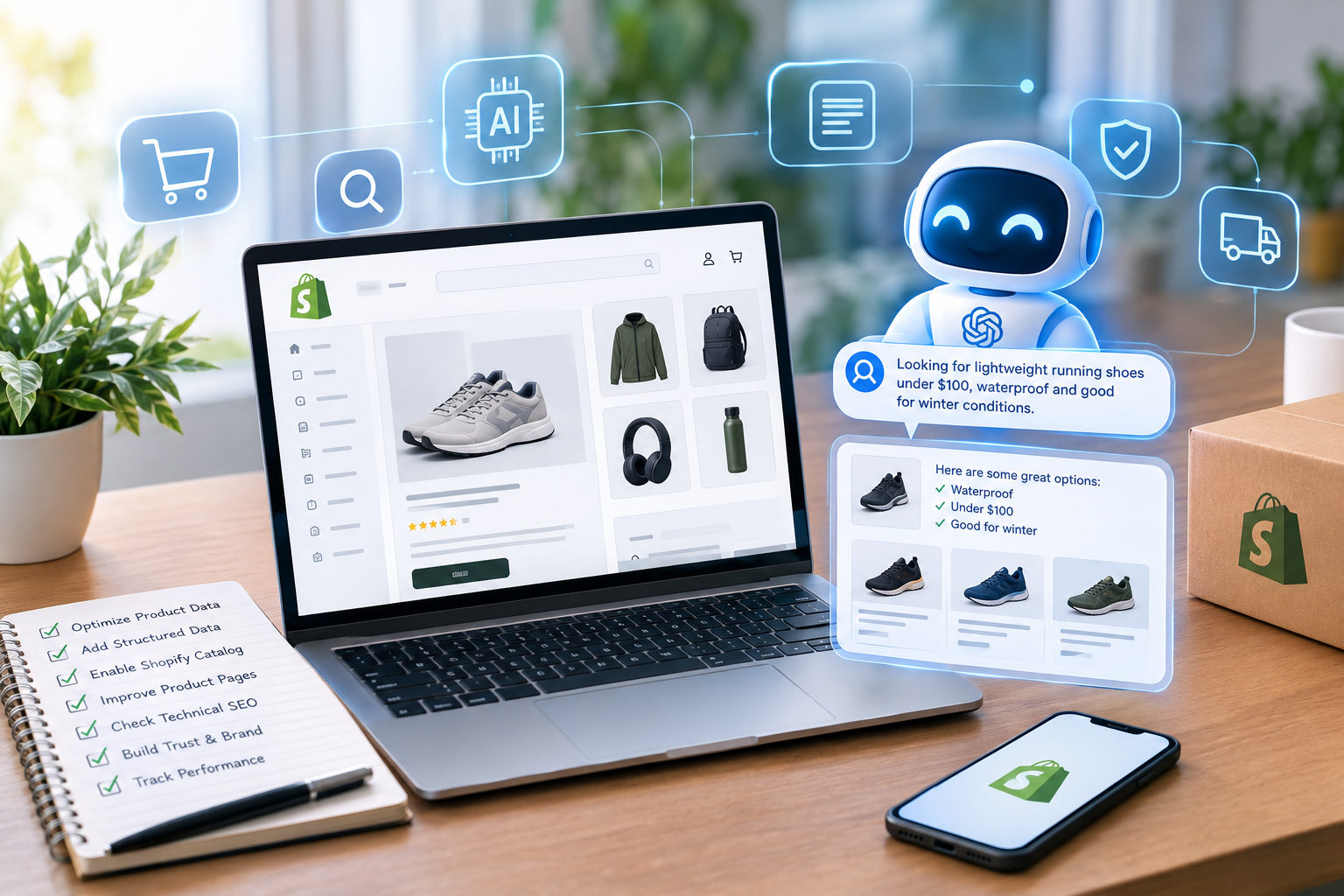
For example, imagine someone searching for waterproof running shoes under £100 that are suitable for winter conditions. Instead of browsing dozens of ecommerce websites, the customer could ask an AI assistant to find products matching those requirements.
The assistant may evaluate product descriptions, prices, sizes, customer reviews, availability, and other relevant information before presenting suitable options.
This creates a new challenge for online retailers. If product information is incomplete, inconsistent, or difficult for automated systems to interpret, the store may be less competitive when AI tools evaluate relevant shopping options.
It is also important to distinguish AI-assisted product discovery from agentic purchasing. Some experiences recommend products and send shoppers to a merchant’s website, while others support more integrated purchasing journeys. The available capabilities depend on the AI platform, merchant eligibility, and checkout arrangements.
Why Should Shopify Stores Prepare for AI Shopping Agents?
Traditional ecommerce optimization has focused heavily on search engine rankings, website design, paid advertising, and conversion rate optimization. These activities remain valuable, but merchants should also consider how their products are represented across AI-powered discovery channels.
Here are the main reasons to prepare.
1. Reach Customers Through New Discovery Channels
Customers are increasingly using conversational interfaces to research products and compare options. AI shopping experiences create another potential route between a customer’s requirements and a merchant’s catalog.
Shopify’s Agentic Storefronts connect eligible merchants with supported AI shopping channels, including ChatGPT, Microsoft Copilot, and Google’s AI shopping experiences as availability expands.
Preparing your store helps you take advantage of these opportunities without abandoning your existing SEO, email marketing, or social media strategy.
2. Make Product Recommendations More Relevant
AI systems need clear product information to determine whether an item matches a customer’s needs.
A description that simply says “premium backpack” provides limited information. A description that explains the backpack’s capacity, material, dimensions, laptop compatibility, weather resistance, and intended use provides much more useful detail.
The more accurately a product is described, the easier it becomes for automated systems and shoppers to evaluate its suitability.
3. Build Customer Trust
Customers need reliable information before purchasing from a business they may not have encountered previously.
Transparent shipping costs, clear return policies, authentic reviews, accurate stock information, and accessible contact details can help reduce uncertainty.
These elements also improve the experience for customers who arrive through conventional search engines or direct links.
4. Prepare for Changes in Ecommerce Competition
AI-assisted shopping does not eliminate competition. It changes some of the ways products are discovered and compared.
Retailers may compete on product relevance, price, availability, delivery options, reviews, and the quality of their product data. Businesses that maintain reliable ecommerce information will be better positioned to respond as shopping interfaces evolve.
1. Optimize Your Shopify Product Data
Product data is one of the most important foundations of AI shopping readiness.
Start by reviewing your product catalog and ensuring that each product contains accurate, complete, and specific information.
Your product listings should include:
- Clear product titles that identify the actual item.
- Detailed descriptions covering features and benefits.
- Correct product categories and relevant attributes.
- Accurate prices and currency information.
- Current inventory and availability.
- Complete product variants, including sizes, colors, and materials.
- High-quality product images with descriptive alternative text.
- Unique SKUs or other appropriate product identifiers.
- Shipping, warranty, and compatibility details where relevant.
Avoid vague titles such as “Best Product Ever” or “Premium Collection.” Instead, use descriptive titles that explain what the product is and which attributes distinguish it.
For example, a store selling reusable water bottles could use a title such as “750 ml Stainless Steel Insulated Water Bottle” rather than simply “Premium Bottle.”
Product descriptions should answer the questions customers are likely to ask before purchasing. Include factual specifications, practical use cases, care instructions, limitations, and compatibility information wherever applicable.
Do not add unsupported claims simply to make a product appear more attractive. Accurate information is more useful than exaggerated marketing language.
2. Use Shopify Catalog and Agentic Storefronts
Shopify provides infrastructure that can help eligible merchants make their products available across supported AI shopping experiences.
According to Shopify’s official documentation, eligible products can be discoverable through Shopify Catalog. Merchants can also manage supported AI sales channels through the relevant settings in Shopify Admin.
To review your setup:
- Sign in to your Shopify Admin.
- Open the sales channel or Agentic Storefront settings available to your store.
- Review which AI shopping channels are available and enabled.
- Check whether your products meet the relevant eligibility requirements.
- Review product information, shipping details, and business policies.
- Check the applicable Google and Meta sales channel integrations if you want to reach their supported AI experiences.
- Test product discovery and purchasing journeys wherever those features are available.
The precise settings and features may vary by merchant, plan, region, and rollout status.
Do not assume that installing an AI application automatically makes your entire catalog available everywhere. Check the actual channel configuration and product eligibility.
Also remember that discovery and checkout are separate capabilities. A product may be discoverable through one route even when a particular in-chat checkout feature is unavailable.
3. Implement and Validate Structured Data
Structured data helps search engines and other compatible systems interpret information about your products and business.
For ecommerce websites, relevant Schema.org markup can include Product, Offer, Organization, BreadcrumbList, and other applicable types. Depending on your store and implementation, shipping details, return policies, and product ratings may also be represented through supported structured data.
For example, product markup may communicate:
- Product name and description.
- Brand and product identifiers.
- Current price and currency.
- Availability.
- Product images.
- Ratings and review information, when legitimately available.
A critical rule is that structured data must accurately reflect the information visible to shoppers and the actual product being sold.
If a product is out of stock, do not mark it as available. If a product has no verified customer reviews, do not generate fictional ratings. Incorrect markup can undermine trust and cause eligibility or display problems.
Many Shopify themes and applications already generate some structured data. Before adding another schema application or editing your theme, inspect the existing implementation to avoid duplicate or conflicting markup.
Use Google’s Rich Results Test and Schema.org’s validation tools where applicable. Remember that valid structured data does not guarantee a rich result or an AI recommendation; it simply improves the clarity of the information provided.
4. Improve Product Pages for Conversational Search
Traditional keyword optimization often emphasizes phrases such as “buy leather office bag online.” Conversational shopping queries may be more specific and natural.
Examples include:
- Which laptop backpack is suitable for frequent business travel?
- What are the best lightweight running shoes for rainy weather?
- Which skincare products are suitable for sensitive skin?
- Can this desk fit two monitors and a laptop?
- Which air purifier is appropriate for a small bedroom?
Your product pages should answer the questions that genuinely matter to your customers.
Create descriptive product sections covering dimensions, materials, compatibility, intended use, maintenance, limitations, and relevant comparisons. Add FAQs when they address genuine customer concerns rather than repeating keywords.
You can also publish buying guides, comparison articles, and product-selection resources that explain how shoppers can make informed decisions.
For example, a furniture store might publish a guide comparing standing desks, fixed desks, and compact workstations. Relevant product pages can link to that guide, while the guide can link back to the appropriate products.
This approach improves the usefulness of the website for human visitors while giving search and discovery systems more contextual information about your products.
5. Make Pricing, Inventory, and Variants Consistent
AI shopping agents may compare several products based on budget, availability, size, color, delivery, or other purchase requirements. Inconsistent catalog information can create confusion during this process.
Review the relationship between your Shopify product catalog, product pages, and connected sales channels.
Pay particular attention to:
- Sale prices and compare-at prices.
- Currency and regional pricing.
- Product availability and inventory tracking.
- Variant-specific prices and stock.
- Product identifiers and variant relationships.
- Shipping costs and delivery estimates.
- Discontinued products and outdated listings.
Suppose a customer wants a blue jacket in medium. If the main product page is available but the medium-blue variant is out of stock, the catalog should not imply that the requested combination is purchasable.
Similarly, if your website displays one price but a connected feed contains an outdated price, customers may receive misleading recommendations.
Shopify Catalog can help synchronize key product information for eligible products, but merchants should still verify their source data, custom-field mappings, and connected channel configurations.
6. Make Your Website Easy to Crawl and Understand
Even when a platform provides catalog integrations, your public website remains an important part of your digital presence.
Review your website’s technical SEO foundations to make sure relevant pages can be discovered and indexed.
Start with the following checks:
- Ensure important product and collection pages return the correct HTTP status codes.
- Maintain a working XML sitemap.
- Use canonical URLs appropriately.
- Avoid unintentionally blocking important pages through robots.txt or other access controls.
- Keep internal links clear and functional.
- Remove unnecessary redirect chains.
- Ensure product pages work on mobile devices.
- Check that important product information is available in accessible page content.
- Monitor crawl errors and indexing issues through Google Search Console.
Shopify automatically provides agent-discovery resources, including /agents.md, /llms.txt, and /llms-full.txt. These resources can help compatible agents understand store information and available discovery endpoints.
Merchants should not assume that these files replace product feeds, catalog integrations, conventional crawling, or indexing. Each serves a different purpose.
Before editing robots.txt or applying bot restrictions, identify the specific crawler and understand what it does. Do not block legitimate search or shopping crawlers unintentionally, but do maintain appropriate security controls for sensitive areas of the store.
7. Strengthen Your Brand’s Digital Presence
AI-driven product discovery is not only about technical data. Customers also need confidence that a brand is legitimate, reliable, and relevant to their needs.
Create clear About Us, Contact, Shipping, Returns, Privacy, and Terms pages. Keep company information consistent across your website and other legitimate business profiles.
Customer reviews can provide useful evidence of product quality and customer experience. Encourage genuine feedback, respond professionally to complaints, and avoid publishing fabricated testimonials.
You should also maintain useful editorial content that demonstrates your understanding of the market.
For example, a beauty retailer can publish ingredient explainers and skincare routines. An electronics store can provide device compatibility guides. A sports retailer can publish practical equipment comparisons.
These resources help customers understand products in context rather than relying exclusively on promotional descriptions.
8. Improve Shopify Store Design and User Experience
AI discovery may introduce customers to your store, but your website still needs to convert interest into purchases.
If a shopper clicks through from an AI recommendation and encounters a confusing product page, unexpected charges, or a slow checkout, the opportunity may be lost.
Prioritize a clear navigation structure, readable product information, useful filters, visible delivery details, and an uncomplicated checkout experience.
Make sure product images load properly and display the item accurately. Provide accessible buttons and forms, and avoid intrusive pop-ups that interrupt the purchasing journey.
If your store needs a broader design improvement, explore AresourcePool’s guide to Top 10 Website Designing Companies in India.
A well-designed website should make product selection easier, establish trust, and support customers regardless of whether they arrive through an AI assistant, a search engine, an advertisement, or a direct visit.
9. Combine AI Shopping Readiness With SEO and Digital Marketing
Preparing for AI shopping agents should complement your existing organic search and digital marketing strategy.
Search engine optimization remains valuable because search engines help people discover product pages, buying guides, and brand information. Strong content, relevant internal links, sensible site architecture, and technically accessible pages support a healthier overall digital presence.
Review your current keyword strategy and identify the informational and transactional questions your customers ask at different stages of the buying journey.
Build content around these needs instead of publishing multiple pages that target nearly identical keywords without offering distinct value.
For a broader understanding of agency capabilities, see AresourcePool’s guide to Top 10 SEO Companies. Businesses looking to coordinate SEO, paid campaigns, content, and other promotional activities can also explore Top 10 Digital Marketing Companies.
The objective is not to choose between traditional SEO and AI shopping readiness. It is to build a consistent strategy in which useful content, reliable product data, and a strong customer experience reinforce one another.
10. Consider Custom Development and Integrations
Some Shopify stores have straightforward catalogs and can begin with built-in functionality. Others require more advanced integrations because they manage thousands of products, complex variants, multiple regions, subscriptions, or data from external inventory systems.
In these cases, development work may be necessary to map product attributes, synchronize inventory, resolve feed discrepancies, improve page performance, or connect relevant systems.
Before investing in custom development, document the specific problem and check whether Shopify already supports the required functionality. Custom solutions should address measurable needs rather than add complexity without a clear benefit.
For businesses evaluating technical implementation partners, AresourcePool provides additional resources, including Top 10 Best App Development Companies and Top 10 Web Development Companies in India in 2026.
When evaluating a development partner, consider its ecommerce experience, Shopify integration capabilities, technical SEO knowledge, security practices, maintenance support, and ability to work with structured product data.
11. Monitor AI Visibility and Ecommerce Performance
Once your store is optimized, establish a process for monitoring performance.
AI shopping visibility can vary by platform, customer query, product relevance, geographic market, and channel eligibility. There is no universal optimization score that guarantees inclusion in every AI-generated recommendation.
Track measurable indicators such as:
- Organic traffic to product and collection pages.
- Product feed errors and disapproved listings.
- Catalog eligibility and channel status.
- Product-page conversion rates.
- Revenue and orders from identifiable referral sources.
- Inventory and pricing discrepancies.
- Customer questions related to product information.
- Search queries that lead customers to your products.
Review Shopify Analytics, relevant sales-channel reports, Google Search Console, and other suitable analytics tools.
Where referral attribution is available, compare the performance of AI-related traffic with other acquisition channels. Be careful when interpreting small datasets, because some AI-assisted journeys may not be fully attributable to a particular source.
Use your findings to prioritize improvements. If customers repeatedly ask about dimensions, add clearer measurements. If products are difficult to compare, improve attribute consistency. If shipping questions prevent purchases, make delivery information easier to find.
AI readiness is an ongoing operational process, not a one-time technical installation.
Common Mistakes to Avoid
Several mistakes can limit the effectiveness of an AI shopping readiness strategy.
Using vague product descriptions: Generic marketing language does not communicate enough factual information to help customers compare products.
Installing multiple overlapping apps: Additional apps can introduce conflicting schema, duplicate features, performance problems, and unnecessary costs.
Ignoring inventory accuracy: Incorrect availability and variant information can undermine product recommendations and customer trust.
Blocking useful discovery systems: Overly restrictive crawler settings may prevent legitimate systems from accessing public product information.
Publishing AI-generated content without review: Automatically generated descriptions can introduce inaccurate specifications, repetitive text, and unsupported claims. Review content for accuracy, originality, and usefulness.
Expecting immediate rankings or sales: Technical improvements do not guarantee that AI systems will select a product or generate additional revenue. Monitor results and improve based on evidence.
Neglecting the customer experience: Discovery is only one part of ecommerce. A slow website, unclear returns policy, or confusing checkout can still prevent conversions.
Shopify AI Shopping Readiness Checklist
Use this checklist to organize your implementation work.
-
Audit product titles, descriptions, categories, and attributes.
-
Verify prices, inventory, product variants, and identifiers.
-
Review Shopify Catalog eligibility and available AI channels.
-
Check Google and Meta integrations where relevant.
-
Validate existing product and organization structured data.
-
Confirm that important product pages are crawlable and indexable.
-
Review your sitemap, canonical tags, and internal links.
-
Check shipping, returns, contact, and business information.
-
Improve product FAQs and buying-guide content.
-
Test mobile usability, page speed, and checkout.
-
Configure suitable analytics and review channel performance.
-
Establish a recurring process for catalog and technical audits.
Start with product accuracy, channel eligibility, and accessibility before investing heavily in advanced custom development.
Conclusion
pages, maintaining consistent pricing and inventory information, and exploring Shopify’s AI shopping capabilities, businesses can prepare for the evolving ecommerce landscape.
However, implementing these improvements may require technical expertise, especially when your store needs custom integrations, advanced functionality, or performance optimization. If you want to build a scalable, AI-ready ecommerce store, choosing to Hire Shopify Developer professionals can help you implement the right solutions for your business requirements.
AresourcePool can be a valuable starting point for businesses exploring website development, ecommerce optimization, SEO, and digital growth strategies. Explore our guides to website designing companies in India and web development companies in India to learn more about website design and development options.
Ultimately, preparing your Shopify store for AI shopping agents is an ongoing process. By combining reliable product information, strong technical foundations, and a customer-focused strategy, your business can be better positioned to adapt to new shopping technologies and create a more effective ecommerce experience.
