


Offering
Solutions We Provide






Introduction
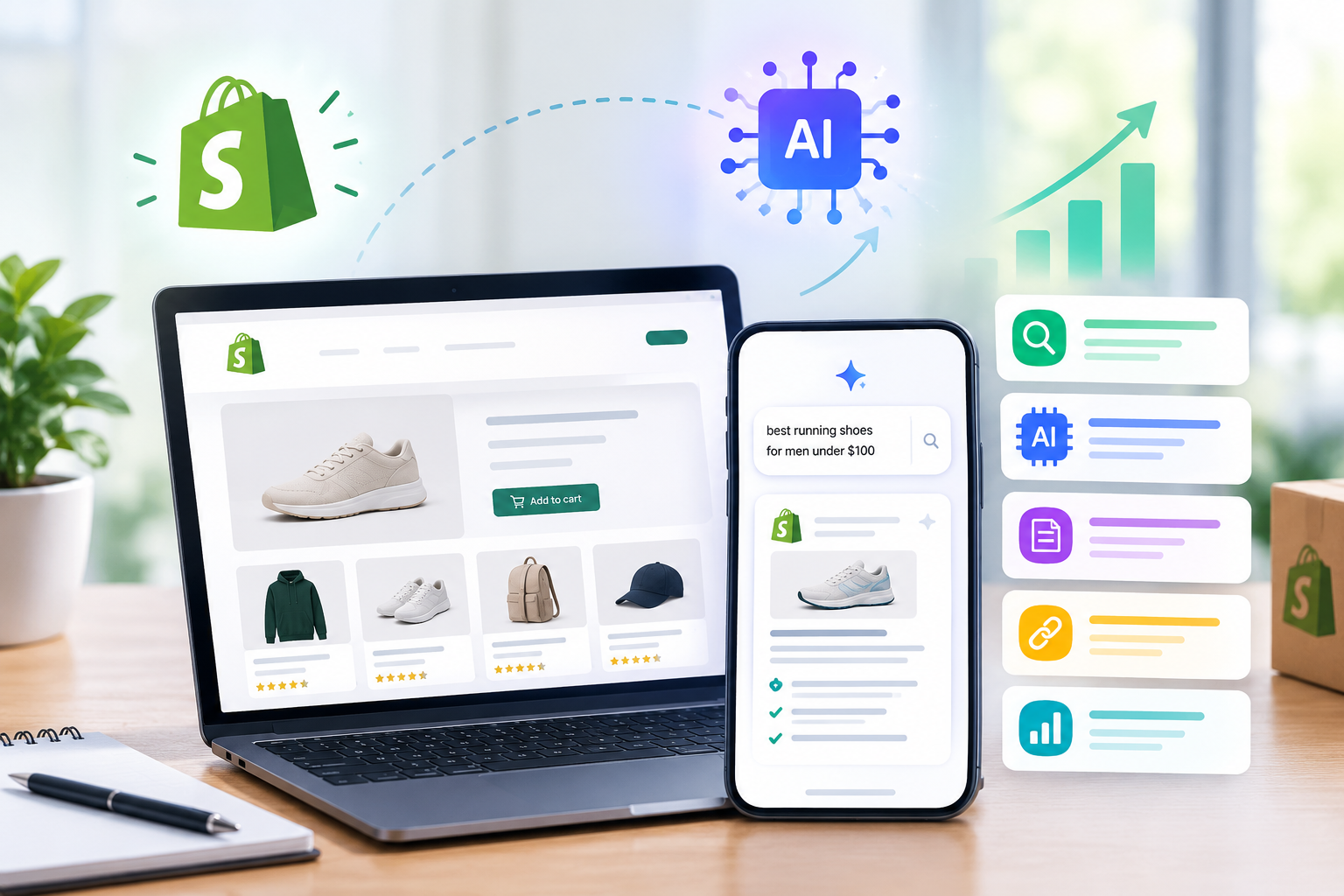
The way customers discover products online is changing. Traditional search engines remain important, but shoppers are increasingly using AI-powered tools to research products, compare brands, find recommendations, and make purchase decisions. Instead of searching only for a phrase such as “best running shoes,� a customer might ask an AI assistant, “Which running shoes are best for beginners who need comfortable footwear under ₹5,000?�
These changing search behaviors create a new opportunity for Shopify store owners: Generative Engine Optimization (GEO).
GEO focuses on making your website content clear, useful, credible, and accessible so that AI-powered search experiences can understand your products and potentially reference your brand in generated answers. For ecommerce businesses, this means going beyond traditional keyword optimization and creating product information that genuinely answers customer questions.
However, GEO is not a shortcut to guaranteed AI rankings. Different AI platforms use different methods to retrieve and generate answers, and no optimization technique can guarantee that a particular product or website will be recommended.
In this guide, we explain what GEO means for Shopify, which strategies are worth implementing in 2026, and how businesses can combine GEO with traditional SEO to improve their online visibility.
What Is GEO for Shopify?
Generative Engine Optimization is the process of improving website content and supporting information so that AI-powered search systems can better understand, evaluate, and potentially reference it when answering user queries.
For Shopify stores, GEO involves optimizing product pages, collection pages, buying guides, customer reviews, structured data, and brand information.
Consider an online store selling skincare products. A traditional SEO strategy might target keywords such as “best moisturizer for dry skin.� A GEO-focused approach would also answer related questions:
- What ingredients does the moisturizer contain?
- Who is the product suitable for?
- Is it fragrance-free?
- How should customers use it?
- What makes it different from competing products?
- What do verified customers say about it?
Providing clear, consistent answers helps shoppers make informed decisions and gives search systems better information to interpret.
If you want a broader understanding of this approach, explore AResourcepool’s guide to what Generative Engine Optimization (GEO) is and how it works.
Why GEO Matters for Shopify Stores in 2026
Ecommerce discovery is no longer limited to traditional search results and paid advertisements. Customers may discover products through AI-generated answers, conversational shopping experiences, recommendation tools, social platforms, and conventional search engines.
For Shopify businesses, this creates several opportunities.
1. Reach Customers During Product Research
Customers often ask detailed questions before purchasing. They want to compare features, understand product differences, evaluate prices, and determine whether an item meets their needs.
A Shopify store that publishes accurate product details and useful comparison content can provide information that supports these research journeys.
2. Build Brand Visibility Beyond Traditional Rankings
Ranking in conventional search results is valuable, but it does not automatically mean that a brand will appear in AI-generated answers.
GEO encourages businesses to build useful content, maintain accurate product information, and establish a credible online presence. These practices can support broader discoverability, although AI visibility varies by platform and query.
3. Improve Customer Confidence
Detailed product descriptions, transparent policies, authentic reviews, and clear specifications help customers understand what they are buying.
These improvements benefit shoppers directly, regardless of whether they arrive through Google, an AI assistant, social media, or a referral link.
4. Create Better Opportunities for Qualified Traffic
Someone searching for a general product category may still be exploring. A shopper asking which product suits a specific requirement is often further along in the buying journey.
Content that answers these specific questions can attract more relevant visitors and help them choose the right product.
GEO vs. SEO vs. AEO: What Is the Difference?
GEO, SEO, and Answer Engine Optimization (AEO) are related, but they emphasize different aspects of online discovery.
| Approach | Primary focus | Shopify example |
|---|---|---|
| SEO | Improving visibility in traditional search results | Optimizing product titles, collection pages, and technical performance |
| AEO | Making content suitable for direct answers and answer-oriented search experiences | Adding concise answers to frequently asked product questions |
| GEO | Improving the clarity, credibility, and usefulness of content for generative AI experiences | Publishing detailed product comparisons and trustworthy buying guides |
These approaches overlap. Strong technical SEO can help search systems access your content, while helpful answers and reliable information can support both AEO and GEO.
For a deeper explanation with practical examples, read GEO vs. SEO vs. AEO: Key Differences with Real Examples (2026).
The most effective strategy for Shopify businesses is not to abandon SEO for GEO. Instead, build a comprehensive search strategy that serves customers across traditional and AI-powered discovery channels.
8 GEO Strategies That Work for Shopify in 2026
1. Optimize Shopify Product Pages for Real Customer Questions
Product pages are among the most important pages on an ecommerce website. They should explain what a product is, what it does, who it is for, and why a customer might choose it.
Avoid relying on short, generic descriptions copied from manufacturers. Write original descriptions that communicate meaningful product details.
For example, instead of writing:
“Premium stainless steel water bottle with a modern design.�
Use a more informative description:
“This 750 ml stainless steel water bottle is designed for everyday commuting, gym sessions, and travel. Its wide opening makes filling and cleaning easier, while the insulated construction helps maintain beverage temperature. Check the care instructions before placing the bottle in a dishwasher.�
Only include specifications and benefits that are accurate for the actual product.
What to optimize:
- Descriptive product titles and headings.
- Accurate dimensions, materials, colors, and specifications.
- Clear explanations of product benefits and limitations.
- Shipping, return, warranty, and care information.
- Original product photography with meaningful alternative text.
- Frequently asked questions based on genuine customer concerns.
The objective is to make each product page useful without requiring shoppers to search elsewhere for basic information.
2. Create Helpful Buying Guides and Comparison Articles
Product pages explain individual items, but buying guides help customers understand their options.
For example, a Shopify store selling home fitness equipment could publish articles such as:
- Resistance Bands vs. Dumbbells: Which Is Better for Home Workouts?
- How to Choose a Yoga Mat for Beginners.
- What to Consider Before Buying an Adjustable Dumbbell Set.
- Which Fitness Accessories Are Suitable for Small Apartments?
These articles should offer genuine comparisons rather than simply promoting the store’s most expensive products.
Explain the differences between options, identify suitable use cases, discuss limitations, and link to relevant products when appropriate.
A well-structured buying guide can serve traditional search users and provide useful context for AI systems that retrieve information about products and categories.
Best practice: Organize each article around a clear customer question. Use descriptive headings, concise explanations, comparison tables where appropriate, and links to supporting product pages.
3. Use Structured Data to Clarify Product Information
Structured data helps search engines interpret information about your products. It does not guarantee AI citations, but it can improve the clarity and consistency of information available to eligible search features.
For Shopify stores, relevant structured data may include:
Productfor product details.Offerfor price, availability, and offer information.AggregateRatingandReviewwhen genuine reviews meet applicable requirements.BreadcrumbListfor navigation context.Organizationfor business identity.Articlefor relevant editorial content.
Many Shopify themes and apps already generate some structured data. Before installing another SEO app, inspect your existing implementation to avoid duplicate or conflicting markup.
Ensure that structured data matches what customers can actually see on the page. Do not add fabricated reviews, incorrect prices, or misleading availability information.
Validate eligible markup using Google’s Rich Results Test and check for crawling or indexing problems in Google Search Console.
Remember that schema markup helps machines interpret your content; it does not force an AI platform to select your store as a source.
4. Publish Original, Experience-Based Content
AI-generated answers can summarize general information, making original and useful content especially important for building a distinctive brand presence.
Your Shopify website should offer more than generic articles that repeat information already available across hundreds of websites.
Consider including:
- Product testing results and documented observations.
- Original photographs and demonstrations.
- Detailed explanations from knowledgeable team members.
- Comparisons based on transparent criteria.
- Practical maintenance and usage advice.
- Customer case studies published with permission.
- Clear explanations of how products are made or selected.
For example, a coffee equipment store could publish a guide comparing brewing methods using the same coffee beans and clearly documented variables. This provides readers with practical information rather than vague statements about product quality.
Be transparent about the source of your claims. If you make a technical, environmental, or performance-related statement, provide supporting evidence where possible.
Originality, accuracy, and real expertise give customers a stronger reason to trust your website.
5. Build Brand Authority Across Relevant Websites
AI search visibility is not determined by on-page optimization alone. The availability of reliable information about your business across relevant sources can also matter, depending on the platform and how it retrieves information.
Shopify businesses should maintain consistent brand information and build genuine recognition within their industry.
Useful activities include:
- Publishing expert commentary and educational resources.
- Earning relevant editorial mentions and backlinks.
- Collaborating with credible creators and industry publications.
- Collecting authentic customer reviews.
- Participating in relevant professional communities.
- Maintaining consistent business details across legitimate directories.
- Publishing original research or useful industry insights.
Avoid buying fake reviews, creating spam backlinks, or publishing mass-produced articles solely to manipulate AI recommendations.
If you need help planning a broader online visibility strategy, AResourcepool’s overview of the top digital marketing companies offers a starting point for researching agencies and their services.
Remember that brand mentions are not a guaranteed ranking factor across every AI platform. Focus on earning recognition by providing information and experiences that people genuinely find valuable.
6. Improve Technical SEO and Website Accessibility
A website cannot benefit fully from content optimization if important pages are inaccessible, blocked from crawling, or difficult to interpret.
Shopify provides a managed ecommerce platform, but store owners still need to review their technical setup.
Start with these checks:
Crawlability and indexing: Make sure important product, collection, and informational pages can be discovered and indexed where appropriate. Review robots directives, canonical tags, redirects, and sitemap coverage.
Page performance: Compress oversized images, remove unnecessary app scripts, and avoid excessive theme customizations. Monitor Core Web Vitals and test important pages on mobile devices.
Mobile usability: Product information, filters, menus, reviews, and checkout interactions should work smoothly on smaller screens.
Internal linking: Link relevant buying guides to collection pages, collection pages to products, and related articles to one another. Use descriptive anchor text that helps visitors understand the destination.
AI crawler access: Review the published access policies of the AI services you care about. Where relevant, check whether their documented crawlers can access public pages and whether your robots.txt rules permit the intended access.
Crawler access, search indexing, and use of content for AI training are different issues. Allowing a crawler does not guarantee that your pages will be cited in generated answers.
For stores requiring custom integrations or theme improvements, the top web development companies in India in 2026 can help you research potential development partners.
7. Use Customer Reviews and FAQs to Answer Specific Questions
Customer reviews often reveal the practical questions that product descriptions overlook.
Customers may want to know whether a shirt fits true to size, whether a backpack accommodates a laptop, or whether a kitchen appliance is easy to clean.
Use these questions to improve product pages and create useful FAQs.
For example:
Question: Is this backpack suitable for a 15-inch laptop?
Answer: Check the product’s internal laptop compartment dimensions against your device. A stated laptop size may vary by manufacturer, so compare the actual measurements before ordering.
This is more useful than a vague statement that the backpack is suitable for all laptops.
When using reviews, preserve their authenticity and avoid inventing customer experiences. Display ratings accurately and follow applicable privacy and consumer protection requirements.
You can also analyze customer service conversations, product returns, and pre-purchase questions to identify recurring content gaps.
8. Keep Product and Business Information Consistent
Inconsistent information can confuse customers and complicate how search systems interpret your products.
For example, if a product page lists one price while structured data contains another, the discrepancy can undermine the reliability of your product information.
Review consistency across:
- Product names and descriptions.
- Prices, currencies, and availability.
- Variants, dimensions, and specifications.
- Shipping and return policies.
- Brand name and company details.
- Product feeds and structured data.
- Relevant external business listings.
Use a clear process for updating product information whenever prices, inventory, or specifications change.
If your store sells products across multiple regions, make sure localized pages display the correct currency, shipping conditions, and availability.
Reliable information is a practical foundation for both ecommerce conversion optimization and search visibility.
How to Measure GEO Performance for Shopify
GEO requires a measurement approach that goes beyond conventional keyword rankings.
Because AI platforms differ in their reporting capabilities, combine available analytics data with a consistent manual monitoring process.
Track These Five Metrics
1. AI referral traffic
Use analytics tools to identify visits arriving from AI-powered services when referral information is available. Group identifiable sources consistently and compare traffic over time.
2. Brand mentions and citations
Test a fixed set of relevant customer questions across selected AI search tools. Record whether your brand, products, or website appear, and whether the response links to your content.
AI responses can vary between sessions, so repeat tests rather than relying on a single result.
3. Organic search performance
Monitor impressions, clicks, click-through rates, and relevant queries in Google Search Console. Strong SEO performance remains valuable even when your GEO initiative targets additional discovery channels.
4. Product engagement and conversions
Measure product page visits, add-to-cart rates, purchases, revenue, and assisted conversions. Visibility matters most when it contributes to meaningful customer outcomes.
5. Content quality and technical health
Track indexing issues, page performance, structured data errors, content updates, and the completeness of important product information.
Establish a baseline before making major changes. Review results monthly, identify which pages improve, and prioritize the next round of updates based on evidence.
Do not assume every increase in traffic or sales is caused by GEO. Seasonality, promotions, paid advertising, and other marketing activities may influence the results.
Common GEO Mistakes Shopify Stores Should Avoid
Even a well-designed GEO strategy can underperform when it prioritizes shortcuts over customer value.
Avoid these common mistakes:
- Replacing SEO with GEO: Continue investing in technical SEO, relevant keywords, and useful landing pages.
- Publishing generic AI-generated articles: Add original insights, editorial review, and verifiable information.
- Stuffing pages with keywords: Write naturally around customer questions instead of repeating phrases.
- Adding unnecessary schema markup: Implement only relevant, valid structured data that accurately reflects visible content.
- Ignoring product accuracy: Keep pricing, stock status, specifications, and policies current.
- Chasing guaranteed AI rankings: No agency or optimization technique can guarantee citations across independent AI systems.
- Neglecting conversions: A mention in an AI answer has limited business value if your website provides a poor shopping experience.
A sustainable strategy combines trustworthy content, technically sound pages, credible brand signals, and a customer-friendly store.
How Shopify Development Supports GEO
GEO is not exclusively a content marketing task. Store architecture, page templates, structured data, performance, navigation, and integrations can all influence how effectively a business presents its information online.
A Shopify development team can help implement consistent product templates, resolve technical SEO issues, improve mobile performance, and integrate appropriate structured data.
More complex stores may also require custom functionality for product comparisons, advanced filtering, product feeds, or multilingual content.
When evaluating a development partner, look for demonstrated ecommerce experience, technical SEO knowledge, a clear testing process, and the ability to maintain the store after launch.
Businesses comparing technical service providers can explore AResourcepool’s guides to the top app development companies and top web development companies in India.
Choose a partner based on your actual project requirements, not simply a ranking or marketing claim.
A Practical 30-Day GEO Action Plan for Shopify
If you are starting from scratch, avoid attempting to optimize every page at once. Use a focused four-week plan.
Week 1: Audit your store
- Identify your most important products and collections.
- Review indexing, crawlability, mobile usability, and page performance.
- Check product descriptions, pricing consistency, and structured data.
- Record baseline organic traffic, conversions, and AI visibility where measurable.
Week 2: Improve priority product pages
- Rewrite thin or duplicated product descriptions.
- Add accurate specifications and practical product FAQs.
- Review product images, alternative text, reviews, and policies.
- Validate structured data and fix identified errors.
Week 3: Publish helpful supporting content
- Create one or two buying guides around high-intent customer questions.
- Add fair product comparisons and practical recommendations.
- Link the guides to relevant product and collection pages.
- Review older content for outdated or unsupported claims.
Week 4: Measure and refine
- Test a consistent set of relevant questions in selected AI search tools.
- Review available referral traffic and conventional search performance.
- Identify technical problems and content gaps.
- Prioritize improvements based on customer needs and measurable results.
This plan is a starting point, not a guarantee of results within 30 days. Search indexing, brand recognition, and AI visibility can take longer to change.
Conclusion
GEO for Shopify is about making your products and brand easier to understand, evaluate, and potentially discover through AI-powered search experiences.
In 2026, the strongest approach is to combine useful product descriptions, original buying guides, accurate structured data, authentic reviews, technical SEO, consistent business information, and credible brand-building activities.
Shopify store owners should also measure results carefully. Track conventional search performance, identifiable AI referrals, brand mentions, product engagement, and conversions instead of relying on a single visibility metric.
Most importantly, create content for people first. Answer their questions honestly, explain product differences clearly, and maintain a website that is fast, accessible, and easy to use.
With a consistent strategy, your Shopify store can build a stronger foundation for discovery across traditional search engines and evolving AI-powered experiences.
Ready to improve your ecommerce website? Explore Aresourcepool’s web development and digital marketing resources to identify the technical and strategic improvements that best fit your business goals.
