


Offering
Solutions We Provide






📋 IN THIS GUIDE
- Why Structured Data Changed When AI Search Arrived
- FAQPage Schema — Still the Highest-Impact Type
- Article and BlogPosting Schema
- HowTo Schema — Underused but Effective
- ProfessionalService and Service Schema
- BreadcrumbList — The One People Skip
- Speakable Schema — Worth Adding Where It Fits
- Schemas That Don’t Move the Needle for AI
- How to Stack Multiple Schemas on One Page
- FAQs
In our FAQ schema guide, we covered FAQPage JSON-LD in detail — how to write the questions, how to structure the answers, how to implement the code, and how to validate it. That guide was deliberately narrow because FAQ schema is the single most impactful structured data type for AI citation right now, and it deserved its own treatment.
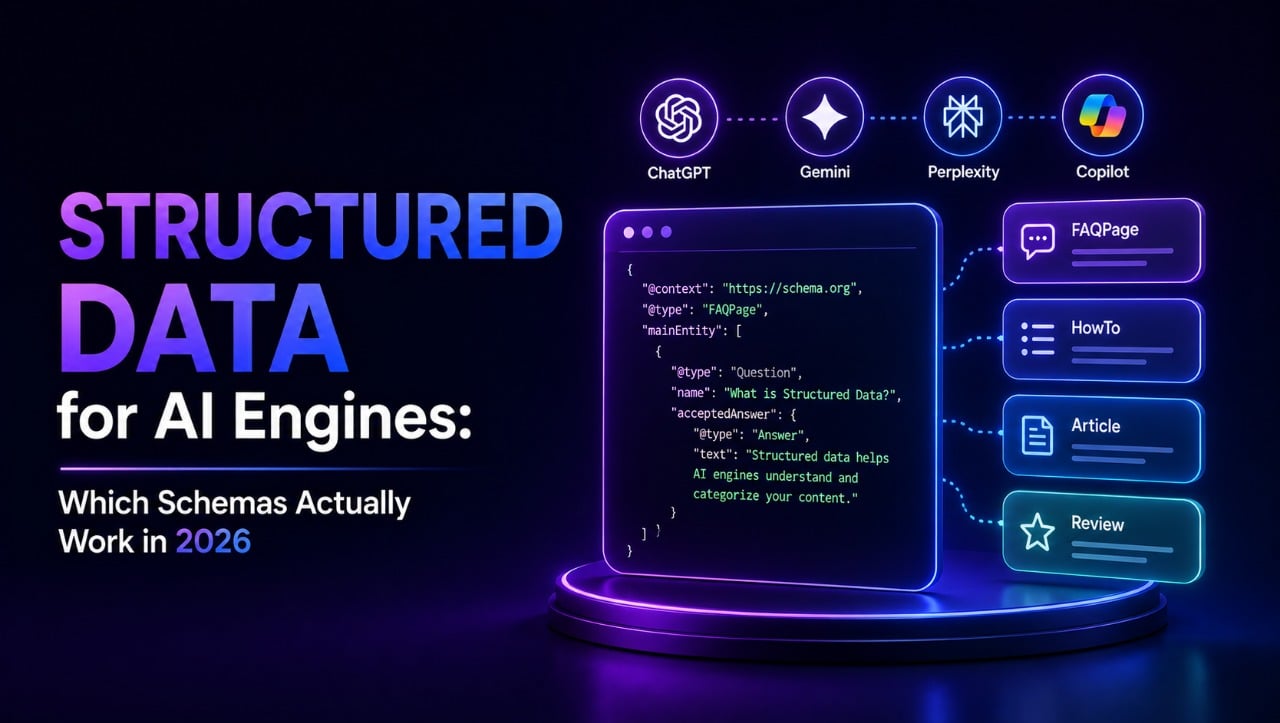
But FAQPage isn’t the only schema type that matters. If you’ve been in SEO for a while, you’ll know that schema.org has hundreds of types — and most of them do very little for most websites. The challenge is figuring out which ones are actually worth your time, specifically in the context of getting cited by AI engines.
That’s what this guide is about. Not an exhaustive list of every schema type that exists, but a practical breakdown of the ones that are demonstrably moving citation rates in 2026 — and why. Plus the ones that sound relevant but don’t do much, so you don’t waste implementation effort on them.
Want a Schema Audit for Your Key Pages?
We check which structured data you’re missing and which is incorrectly implemented — free, in 24 hours.
Get My Free AI SEO Audit → Talk to Our Team
No commitment · 4,100+ brands trust AResourcePool · Response in 24 hours
Why Structured Data Changed When AI Search Arrived
For most of traditional SEO’s history, schema markup was useful but not urgent. It could help you win rich results — star ratings, FAQ dropdowns, recipe cards — and those were worth having. But plenty of pages ranked well and got plenty of traffic without any structured data at all.
AI search changes the calculus. Here’s why.
When Google returns a list of blue links, a human reads those links and clicks one. The human does the interpretation — they figure out which result matches what they need. Schema helps them and helps Google’s presentation, but the human is doing the understanding.
When ChatGPT or Perplexity generates an answer, there’s no human in that loop. The AI system is reading your page, deciding what it’s about, extracting relevant passages, and incorporating them into a synthesized response. All of that happens programmatically. And structured data — JSON-LD that explicitly labels what your content is, who wrote it, what questions it answers — directly reduces the ambiguity in that process.
A page with no structured data requires the AI to infer everything from content and formatting. A page with proper schema tells the AI: this is a blog post, it was written by this named expert, it was published on this date, and this section contains questions and their accepted answers. That explicit structure makes the AI’s job easier — and easier to parse reliably translates to more likely to be cited.
That’s the mechanism. The rest of this guide covers the specific schema types that matter most, starting with FAQPage because it connects directly to everything we covered in our earlier guide, and then working through the others in order of impact.
FAQPage Schema — Still the Highest-Impact Type
We covered this in detail in the FAQ schema guide, so I’ll keep this section focused on how FAQPage connects to the broader schema strategy rather than repeating implementation details.
FAQPage JSON-LD is the most impactful schema type for AI citation because it maps directly to how AI engines retrieve and use content. When a user asks an AI tool a question, the system is looking for text passages that answer that question clearly and completely. A page with FAQPage schema has explicitly labeled answer passages — the AI doesn’t need to guess which text is answering which question. It knows.
The content quality rules we covered in the FAQ guide still apply: self-contained answers, 80 to 150 words each, specific rather than vague, written the way buyers actually phrase questions. Schema without those qualities is schema applied to weak content, and weak content doesn’t get cited regardless of how well it’s marked up.
What FAQPage schema does is maximize the citation probability of good answers. It’s a performance multiplier. The underlying answer quality is still what determines whether citing your content is useful to the AI — schema just makes that usefulness easier to detect.
Article and BlogPosting Schema
Article and BlogPosting are two types in the schema.org hierarchy that describe written content — Article being the more general type, BlogPosting being a more specific subtype for blog posts. For SEO purposes, BlogPosting is usually the right choice for blog content; Article works for news articles, research pieces, and longer editorial content.
The fields that actually matter for AI citation in these schemas are: headline (the title), author (with name, job title, and description), datePublished, dateModified, description, and keywords.
The author field is the one most sites get wrong — usually by either omitting it entirely or filling it with “AResourcePool Team” instead of a named individual. As we covered in the E-E-A-T guide, named expert authors are an E-E-A-T signal that directly affects AI citation probability. The BlogPosting schema’s author object is how you communicate that signal in a machine-readable way.
Here’s what a properly filled BlogPosting schema looks like for a B2B service company blog:
BLOGPOSTING SCHEMA — With Complete Author Object
<script type=”application/ld+json”>
{
“@context”: “https://schema.org”,
“@type”: “BlogPosting”,
“headline”: “Your exact blog title here”,
“description”: “Your meta description text here”,
“image”: “https://yoursite.com/path/to/featured-image.jpg”,
“datePublished”: “2026-05-06”,
“dateModified”: “2026-05-06”,
“author”: {
“@type”: “Person”,
“name”: “Shweta Sharma”,
“jobTitle”: “Senior SEO Content Strategist”,
“description”: “6+ years in AI SEO and content strategy for B2B brands.”,
“worksFor”: {
“@type”: “Organization”,
“name”: “AResourcePool”
}
},
“publisher”: {
“@type”: “Organization”,
“name”: “AResourcePool”,
“logo”: {
“@type”: “ImageObject”,
“url”: “https://aresourcepool.com/path/to/logo.png”
}
},
“mainEntityOfPage”: {
“@type”: “WebPage”,
“@id”: “https://aresourcepool.com/your-blog-url/”
},
“keywords”: “your, target, keywords, here”,
“articleSection”: “AI SEO”,
“wordCount”: “2800”,
“inLanguage”: “en-IN”
}
</script>
{
“@context”: “https://schema.org”,
“@type”: “BlogPosting”,
“headline”: “Your exact blog title here”,
“description”: “Your meta description text here”,
“image”: “https://yoursite.com/path/to/featured-image.jpg”,
“datePublished”: “2026-05-06”,
“dateModified”: “2026-05-06”,
“author”: {
“@type”: “Person”,
“name”: “Shweta Sharma”,
“jobTitle”: “Senior SEO Content Strategist”,
“description”: “6+ years in AI SEO and content strategy for B2B brands.”,
“worksFor”: {
“@type”: “Organization”,
“name”: “AResourcePool”
}
},
“publisher”: {
“@type”: “Organization”,
“name”: “AResourcePool”,
“logo”: {
“@type”: “ImageObject”,
“url”: “https://aresourcepool.com/path/to/logo.png”
}
},
“mainEntityOfPage”: {
“@type”: “WebPage”,
“@id”: “https://aresourcepool.com/your-blog-url/”
},
“keywords”: “your, target, keywords, here”,
“articleSection”: “AI SEO”,
“wordCount”: “2800”,
“inLanguage”: “en-IN”
}
</script>
The dateModified field is worth calling out separately. For AI citation purposes — particularly on Perplexity, which heavily weights content freshness — keeping this field current when you update content is important. Perplexity’s algorithm explicitly favors recently updated content. A post from 2024 with a 2026 dateModified and updated statistics will consistently outperform the same post left unchanged — both in traditional search and in Perplexity citations.
HowTo Schema — Underused but Effective
HowTo schema is genuinely underused in the B2B space, and I think it’s because it doesn’t feel obviously applicable. “We’re a service company, not a recipe site” — that kind of thinking. But HowTo is for any process-based content, not just cooking.
If you’ve written content titled “How to implement FAQ schema in WordPress,” “How to run an AI SEO audit,” or “How to set up LLM Share-of-Voice tracking in GA4” — that content is a perfect HowTo candidate. The schema structures the page’s steps as machine-readable named actions with descriptions, which AI engines can extract and present as structured guidance in their generated answers.
HOWTO SCHEMA — Basic Structure
<script type=”application/ld+json”>
{
“@context”: “https://schema.org”,
“@type”: “HowTo”,
“name”: “How to Add FAQ Schema in WordPress”,
“description”: “A step-by-step guide to implementing FAQPage JSON-LD schema markup in WordPress using Rank Math or manual code insertion.”,
“totalTime”: “PT15M”,
“step”: [
{
“@type”: “HowToStep”,
“name”: “Install Insert Headers and Footers plugin”,
“text”: “In your WordPress dashboard, go to Plugins, click Add New, and search for Insert Headers and Footers. Install and activate the free plugin.”
},
{
“@type”: “HowToStep”,
“name”: “Prepare your FAQPage JSON-LD code”,
“text”: “Write your FAQ questions and answers following the 80-150 word answer guideline. Format them as valid JSON-LD using the FAQPage schema structure.”
},
{
“@type”: “HowToStep”,
“name”: “Add the schema to the page header”,
“text”: “In the plugin settings, navigate to the specific page and paste your JSON-LD script in the header section. Save changes.”
},
{
“@type”: “HowToStep”,
“name”: “Validate using Google Rich Results Test”,
“text”: “Search for Google Rich Results Test, paste your page URL, and verify the schema has been detected correctly without errors.”
}
]
}
</script>
{
“@context”: “https://schema.org”,
“@type”: “HowTo”,
“name”: “How to Add FAQ Schema in WordPress”,
“description”: “A step-by-step guide to implementing FAQPage JSON-LD schema markup in WordPress using Rank Math or manual code insertion.”,
“totalTime”: “PT15M”,
“step”: [
{
“@type”: “HowToStep”,
“name”: “Install Insert Headers and Footers plugin”,
“text”: “In your WordPress dashboard, go to Plugins, click Add New, and search for Insert Headers and Footers. Install and activate the free plugin.”
},
{
“@type”: “HowToStep”,
“name”: “Prepare your FAQPage JSON-LD code”,
“text”: “Write your FAQ questions and answers following the 80-150 word answer guideline. Format them as valid JSON-LD using the FAQPage schema structure.”
},
{
“@type”: “HowToStep”,
“name”: “Add the schema to the page header”,
“text”: “In the plugin settings, navigate to the specific page and paste your JSON-LD script in the header section. Save changes.”
},
{
“@type”: “HowToStep”,
“name”: “Validate using Google Rich Results Test”,
“text”: “Search for Google Rich Results Test, paste your page URL, and verify the schema has been detected correctly without errors.”
}
]
}
</script>
For B2B service companies, think through your blog archive. Any post that walks through a process — how to do something, how to set up something, how to evaluate something — is a HowTo candidate. It takes about ten minutes to add the schema once the content is written, and it meaningfully improves the chance that AI engines can parse and use your process content.
ProfessionalService and Service Schema
Service pages — your AI SEO services page, your AEO services page, your specific offering pages — should have either Service or ProfessionalService schema. These schema types describe what your business offers, who it’s for, where it’s available, and how to contact you.
For AI citation specifically, this schema type is less about getting a specific piece of content cited and more about entity recognition — helping AI engines understand what kind of organization you are and what you do. An AI model that has clearly structured service information about your company is more likely to name you when a user asks “what AI SEO agencies are there in India” than a model that only has implicit knowledge of your existence from crawled content.
PROFESSIONALSERVICE SCHEMA — For AI SEO Service Page
<script type=”application/ld+json”>
{
“@context”: “https://schema.org”,
“@type”: “ProfessionalService”,
“name”: “AResourcePool AI SEO Services”,
“description”: “India’s AI SEO agency helping B2B brands rank on Google AI Overviews, ChatGPT, Perplexity, and Gemini through GEO and AEO strategies.”,
“url”: “https://aresourcepool.com/ai-seo-services/”,
“telephone”: “+91-9711621550”,
“email”: “info@aresourcepool.com”,
“areaServed”: [“IN”, “US”, “GB”, “AU”],
“address”: {
“@type”: “PostalAddress”,
“streetAddress”: “E-146, Ground Floor, Sector 63”,
“addressLocality”: “Noida”,
“addressRegion”: “Uttar Pradesh”,
“postalCode”: “201307”,
“addressCountry”: “IN”
},
“hasOfferCatalog”: {
“@type”: “OfferCatalog”,
“name”: “AI SEO Services”,
“itemListElement”: [
{“@type”: “Offer”, “itemOffered”: {“@type”: “Service”, “name”: “GEO — Generative Engine Optimization”}},
{“@type”: “Offer”, “itemOffered”: {“@type”: “Service”, “name”: “Google AI Overviews Optimization”}},
{“@type”: “Offer”, “itemOffered”: {“@type”: “Service”, “name”: “LLM Share-of-Voice Tracking”}},
{“@type”: “Offer”, “itemOffered”: {“@type”: “Service”, “name”: “FAQ Schema Implementation”}},
{“@type”: “Offer”, “itemOffered”: {“@type”: “Service”, “name”: “E-E-A-T Content Strategy”}}
]
}
}
</script>
{
“@context”: “https://schema.org”,
“@type”: “ProfessionalService”,
“name”: “AResourcePool AI SEO Services”,
“description”: “India’s AI SEO agency helping B2B brands rank on Google AI Overviews, ChatGPT, Perplexity, and Gemini through GEO and AEO strategies.”,
“url”: “https://aresourcepool.com/ai-seo-services/”,
“telephone”: “+91-9711621550”,
“email”: “info@aresourcepool.com”,
“areaServed”: [“IN”, “US”, “GB”, “AU”],
“address”: {
“@type”: “PostalAddress”,
“streetAddress”: “E-146, Ground Floor, Sector 63”,
“addressLocality”: “Noida”,
“addressRegion”: “Uttar Pradesh”,
“postalCode”: “201307”,
“addressCountry”: “IN”
},
“hasOfferCatalog”: {
“@type”: “OfferCatalog”,
“name”: “AI SEO Services”,
“itemListElement”: [
{“@type”: “Offer”, “itemOffered”: {“@type”: “Service”, “name”: “GEO — Generative Engine Optimization”}},
{“@type”: “Offer”, “itemOffered”: {“@type”: “Service”, “name”: “Google AI Overviews Optimization”}},
{“@type”: “Offer”, “itemOffered”: {“@type”: “Service”, “name”: “LLM Share-of-Voice Tracking”}},
{“@type”: “Offer”, “itemOffered”: {“@type”: “Service”, “name”: “FAQ Schema Implementation”}},
{“@type”: “Offer”, “itemOffered”: {“@type”: “Service”, “name”: “E-E-A-T Content Strategy”}}
]
}
}
</script>
Add ProfessionalService schema to your main service pages and keep it updated when services change. It’s one of the most direct ways to ensure AI engines have accurate, structured information about what your company offers — which matters both for traditional local search and for AI-driven vendor discovery.
BreadcrumbList — The One People Skip
BreadcrumbList schema is not exciting. It’s not going to directly get a piece of your content cited in a ChatGPT response. But it matters for AI search in a way that’s worth understanding.
BreadcrumbList tells AI engines and search crawlers how your content is organized hierarchically — Home → Blogs → AI SEO → This Page. That structural context helps AI retrieval systems understand the relationship between your content and other content on your site. A piece of content sitting within a recognizable topic cluster (as established by breadcrumb structure) is contextually more authoritative on that topic than content that appears to exist in isolation.
It also affects how Google presents your results. Pages with BreadcrumbList schema show a clean hierarchical path under the page title in search results, which makes the result look more organized and authoritative — small improvement to CTR, but consistent.
BREADCRUMBLIST SCHEMA — For a Blog Post
<script type=”application/ld+json”>
{
“@context”: “https://schema.org”,
“@type”: “BreadcrumbList”,
“itemListElement”: [
{
“@type”: “ListItem”,
“position”: 1,
“name”: “Home”,
“item”: “https://aresourcepool.com/”
},
{
“@type”: “ListItem”,
“position”: 2,
“name”: “Blogs”,
“item”: “https://aresourcepool.com/blogs/”
},
{
“@type”: “ListItem”,
“position”: 3,
“name”: “AI SEO”,
“item”: “https://aresourcepool.com/blogs/”
},
{
“@type”: “ListItem”,
“position”: 4,
“name”: “This Page Title”,
“item”: “https://aresourcepool.com/this-page-url/”
}
]
}
</script>
{
“@context”: “https://schema.org”,
“@type”: “BreadcrumbList”,
“itemListElement”: [
{
“@type”: “ListItem”,
“position”: 1,
“name”: “Home”,
“item”: “https://aresourcepool.com/”
},
{
“@type”: “ListItem”,
“position”: 2,
“name”: “Blogs”,
“item”: “https://aresourcepool.com/blogs/”
},
{
“@type”: “ListItem”,
“position”: 3,
“name”: “AI SEO”,
“item”: “https://aresourcepool.com/blogs/”
},
{
“@type”: “ListItem”,
“position”: 4,
“name”: “This Page Title”,
“item”: “https://aresourcepool.com/this-page-url/”
}
]
}
</script>
Every blog post in this series — the GEO guide, the FAQ schema guide, the E-E-A-T guide — has BreadcrumbList schema. It’s a five-minute addition to every page and it contributes to the overall topical authority signal of the content cluster.
Speakable Schema — Worth Adding Where It Fits
Speakable is a schema type that explicitly marks sections of content as suitable for text-to-speech playback — originally designed for voice assistants like Google Assistant. In the AI search context, it’s evolved into a way of flagging content passages that are particularly direct, clear, and quotable.
For most B2B service company pages, Speakable will apply to your most directly stated definitions and key claims — the sentences that would work well as a standalone answer read aloud. Adding Speakable to these specific CSS selectors or XPath expressions tells AI systems: this is the most quotable part of this page.
It’s not the highest-priority schema type on this list, and it requires more specific implementation than the others because you need to identify which exact sections you’re flagging. But for pages where you have a clear, quotable summary sentence or definition section — your GEO landing page’s opening definition of what GEO is, for example — it’s worth adding.
Schemas That Don’t Move the Needle for AI
Worth mentioning: some schema types that were useful for traditional search simply don’t translate to AI citation improvement in any meaningful way.
Product schema is relevant for ecommerce but doesn’t help service company pages with AI citations. Event schema is for dated events and doesn’t apply to most B2B content. JobPosting schema helps with recruitment but doesn’t affect content citation. VideoObject schema can help with YouTube content discovery but doesn’t directly improve AI citations for text content.
The general principle: if a schema type describes a specific object type (product, event, job) rather than describing knowledge or expertise, it’s probably not contributing to AI citation probability. Focus your implementation effort on the schema types that describe what your content says and who said it — FAQPage, Article/BlogPosting, HowTo, and the entity-building schemas like ProfessionalService.
How to Stack Multiple Schemas on One Page
The right approach for most pages is to combine multiple schema types — each describing a different aspect of the page — in separate script blocks. They don’t need to be merged into one JSON object. Separate blocks are cleaner and easier to maintain.
For a blog post in this series, the schema stack looks like this:
| Page Type | Schema Stack |
|---|---|
| Blog post with FAQ section | BlogPosting + FAQPage + BreadcrumbList |
| How-to guide with FAQ | BlogPosting + HowTo + FAQPage + BreadcrumbList |
| Service page | ProfessionalService + FAQPage + BreadcrumbList |
| Homepage | Organization + WebSite + BreadcrumbList |
| About / Team page | Organization + Person (for each team member) |
The rule about stacking is simply: each schema type should accurately describe what’s actually on the page. Don’t add HowTo schema to a page that doesn’t have steps. Don’t add FAQPage schema to a page without questions and answers. AI engines and Google’s structured data validators will flag schema that doesn’t correspond to real page content, and invalid schema can actually harm trust signals rather than help them.
Always validate every schema stack with Google’s Rich Results Test before considering the implementation complete. JSON syntax errors — a missing comma, an unclosed brace — silently break schema markup. Testing within 24 hours of publishing catches these while they’re easy to fix.
The connection to the broader AI search visibility strategy — covering GEO, LLM SEO, and AEO — is that structured data is one layer of a multi-layer approach. It works alongside the content quality improvements from the E-E-A-T guide, the answer engine optimization principles from our AEO services work, and the topical authority strategy we’ve been building through this entire blog series. None of these work in isolation — schema on a low-authority page with thin content won’t produce citations. But schema on a well-written, expert-attributed, topically authoritative page consistently improves citation probability across every major AI platform.
If you want to understand how all these pieces connect — schema, FAQ writing, E-E-A-T, content clusters — our GEO complete guide is the best overview of how they work together as a system.
Frequently Asked Questions on Structured Data for AI
Q1. Which schema types work best for AI engine citations in 2026?
FAQPage JSON-LD is consistently the highest-impact schema type for AI citation because it makes Q&A structure explicitly machine-readable — which is exactly what AI engines need when retrieving passages to incorporate into generated answers. Article and BlogPosting schema rank second because they signal authorship, publication dates, and topical context. HowTo schema works well for process-based content. ProfessionalService schema builds entity-level trust for service company pages. BreadcrumbList schema, while not directly cited, improves crawl efficiency and content hierarchy recognition — both of which support citation probability indirectly.
Q2. Does adding schema markup guarantee AI citations?
No — schema is a signal amplifier, not a citation generator. A well-structured page with no schema can earn citations if the content quality is high. But the same content with proper schema will earn citations more reliably — because there’s no ambiguity about what the page is, who wrote it, and which section answers which question. Think of schema as removing friction from the citation process. The underlying content quality is still what determines whether the AI finds your content worth citing — schema just makes that quality easier to detect programmatically.
Q3. Should I add multiple schema types to the same page?
Yes — stacking complementary schema types is standard practice. A blog post should have BlogPosting schema, FAQPage schema for its FAQ section, and BreadcrumbList schema for site structure. A service page should have ProfessionalService schema, FAQPage schema, and BreadcrumbList. Keep each schema type in a separate script block — they don’t need to be merged. The rule is that each schema type should accurately describe what’s actually on the page. Adding schema that doesn’t correspond to real page content can backfire and harm trust signals.
Q4. How do I validate that my schema is working correctly?
Use Google’s Rich Results Test — search for it in Google, paste your page URL, and it will show which schema types it detected, what structured data it read, and any errors. Run this within 24 hours of publishing or updating any page with schema markup. Also check Google Search Console under the Enhancements section — it flags schema errors across your entire site. JSON syntax errors like missing commas and unclosed brackets are the most common issue. For AI engine-specific validation there’s no equivalent tool currently, so Google Rich Results Test is the practical standard.
Q5. Does schema markup help with traditional SEO rankings too?
Indirectly, yes. FAQPage schema enables expandable Q&A results under your listing in Google, which improves click-through rates. Article schema with author data supports E-E-A-T signals. HowTo schema can trigger rich results with step listings. AggregateRating schema enables star ratings in search results. These rich result appearances consistently improve CTR — a behavioral signal that Google’s algorithm weighs. So while schema doesn’t rank pages directly, it improves the performance of ranked pages by making results more visually prominent and informative in the results page.
Q6. What is the difference between FAQPage and HowTo schema?
FAQPage structures content as questions with accepted answers — for pages where the format is Q&A. HowTo structures content as a sequence of named steps with descriptions — for pages explaining a process or procedure. Both are high-value for AI citations because both create explicitly structured, extractable content. Use FAQPage for your FAQ sections. Use HowTo for guides explaining how to do something. Some pages legitimately use both — a how-to guide with a FAQ section at the end would have both schema types simultaneously. For implementation details on FAQPage specifically, see our dedicated FAQ schema guide.
Get Your Schema Stack Audited and Implemented
We check your current structured data, identify gaps, and give you a prioritised implementation list — free, in 24 hours.
Get My Free AI SEO Audit → 📱 WhatsApp Our Team
🔒 Confidential · No spam · Audit in 24 hours · 8 slots per month
Tags: structured data AI engines, schema markup 2026, JSON-LD AI SEO, FAQPage schema, Article schema, HowTo schema, ProfessionalService schema, GEO schema, schema for ChatGPT Perplexity, AResourcePool
