


Offering
Solutions We Provide





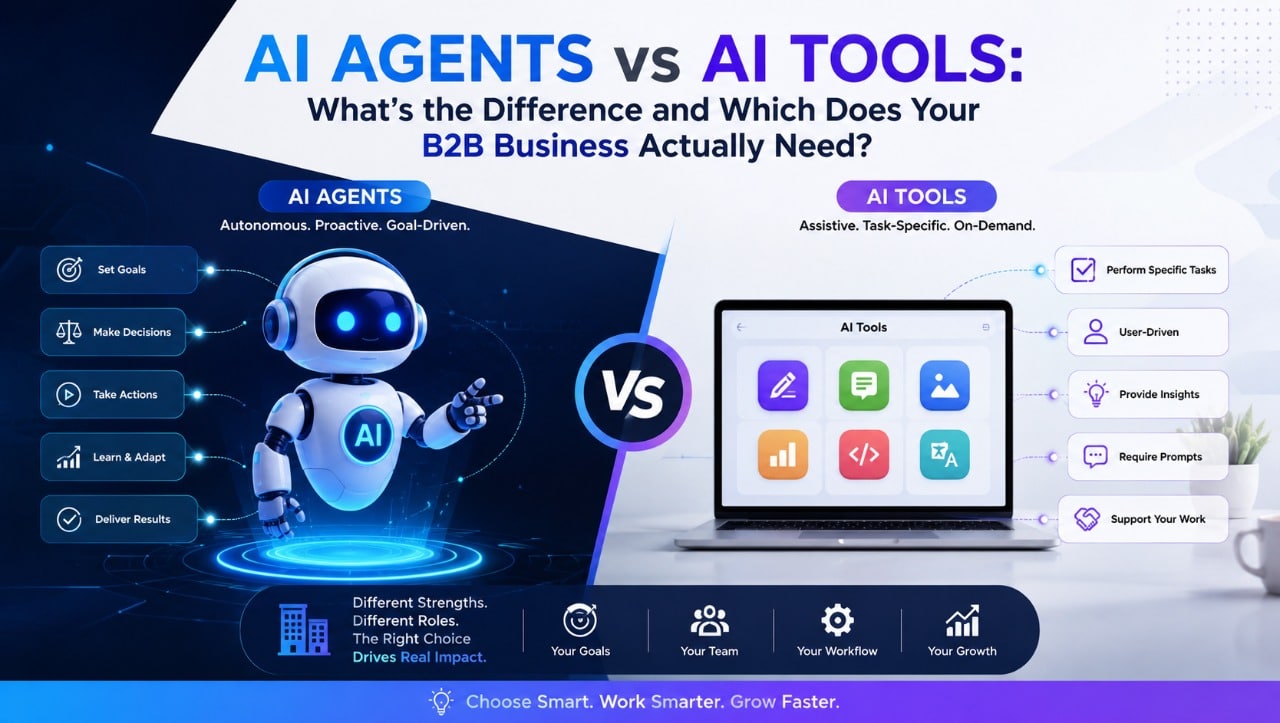

AI Agents vs AI Tools: What’s the Difference and Which Does Your B2B Business Actually Need?
📋 IN THIS GUIDE
- The Confusion That’s Costing B2B Teams Real Money
- Clear Definitions: Tools vs Agents
- The Core Difference: Assistance vs Autonomy
- Side-by-Side Examples for B2B Contexts
- AI Tools Worth Knowing for B2B Teams in 2026
- AI Agents Worth Knowing for B2B Teams in 2026
- Which One Does Your Business Actually Need Right Now?
- Agent Readiness — Four Signals That Tell You When to Upgrade
- How Tools and Agents Work Together
- FAQs
Two things happen in B2B organizations when the “AI agents” conversation picks up. Some teams overreach — hearing about autonomous agents and immediately trying to deploy complex agentic systems before establishing any AI tool fluency, which is one of the primary reasons Gartner projects over 40% of agentic AI projects will be cancelled by 2027. Other teams underinvest — hearing the complexity involved in agents and deciding to just stay with their existing AI tool subscriptions, even when a workflow is clearly bottlenecked by the volume of human steps it requires.
Both mistakes come from the same place: a blurry understanding of what makes an AI tool different from an AI agent, and consequently no framework for deciding which is appropriate for a given situation.
The previous guide in this series covered what AI agents are and how they work. This guide answers the follow-on question: given everything agents can do, when is a tool actually the smarter choice — and when does a workflow genuinely require an agent?
Not Sure Which AI Approach Fits Your B2B Growth Goals?
We help Indian B2B brands build the AI visibility and content infrastructure that drives measurable results — starting with a free audit.
Get My Free AI SEO Audit → Talk to Our Team
No commitment · 4,100+ brands trust AResourcePool · Response in 24 hours
The Confusion That’s Costing B2B Teams Real Money
The language around AI has become genuinely messy. Vendors describe their products as “AI-powered,” “agentic,” “autonomous,” and “intelligent” — often interchangeably, and often without those labels meaning anything precise. A spell-checker with a machine learning layer is “AI-powered.” So is a system that independently manages your entire outbound pipeline. The word has stopped doing the work of distinguishing between fundamentally different categories of technology.
For B2B teams making purchasing decisions, this creates two types of expensive mistakes:
Buying agent platforms when tool-level solutions would have solved the problem more cheaply, more quickly, and with less integration overhead. Agentic AI systems are more complex to deploy, maintain, and govern than AI tools. They require cleaner data, better-defined success criteria, and ongoing human oversight. Using a full agent platform to do something a well-configured AI tool could do is like using a CRM to manage a to-do list — technically possible, practically wasteful.
Staying with AI tools when a workflow genuinely needs agent-level autonomy. If a sales team needs to qualify 300 inbound leads per week and is currently qualifying 80 before the rest go cold, the problem isn’t that the team needs a better AI writing tool for their emails. The problem is volume — and volume without an agent doesn’t get solved. Throwing more AI tools at a fundamentally automation-appropriate problem just means faster execution of a manually-constrained process.
Getting this distinction right consistently — tool vs agent, and when to use which — is one of the more practically valuable frameworks a B2B marketing or sales leader can develop in 2026.
Clear Definitions: Tools vs Agents
An AI tool is a software application that uses artificial intelligence to assist with a specific, bounded task. The human provides input, the tool processes it, and returns an output. The human remains the orchestrator — they decide what task to give the tool, evaluate the output, and decide what to do next. ChatGPT as a writing assistant is an AI tool. SEMrush’s AI keyword suggestions are an AI tool feature. Gong’s call analysis is an AI tool. They are faster, smarter versions of capabilities humans already performed manually — but the human is still in the driver’s seat at each step.
An AI agent is a system that receives a goal and pursues it autonomously through a sequence of self-determined steps. As covered in the AI agents complete guide, agents perceive context, reason about options, take actions using available tools and APIs, evaluate results, and adapt — without a human directing each step. A lead qualification agent that engages every inbound lead within minutes, asks qualifying questions, scores the conversation against ideal customer profile criteria, and routes qualified leads to the sales team is an agent. No human is directing each of those steps. The agent is pursuing the goal autonomously.
One useful shorthand: AI tools answer questions or complete tasks when asked. AI agents pursue goals without being asked what to do next.
The Core Difference: Assistance vs Autonomy
The word that separates tools from agents most cleanly is autonomy — but autonomy exists on a spectrum, not as a binary. Understanding the spectrum is more useful than a hard either/or.
| Level | Type | What Happens | B2B Example |
|---|---|---|---|
| Level 1 | AI-assisted | Human does the work, AI suggests improvements | Grammarly corrects an email as the human writes it |
| Level 2 | AI tool | Human gives a task, AI completes it, human reviews and acts | ChatGPT drafts a blog post from a brief; human edits and publishes |
| Level 3 | Semi-autonomous agent | AI pursues a multi-step goal, checks in with human at key decision points | Content agent researches, drafts, and optimizes; flags each post for human review before publishing |
| Level 4 | Autonomous agent | AI pursues a goal end-to-end, reports outcomes to human | Outbound agent identifies prospects, personalizes and sends outreach, follows up, and books meetings — human reviews weekly performance report |
| Level 5 | Multi-agent system | Multiple specialized agents collaborate, orchestrated toward a shared objective | Marketing orchestrator agent coordinates content agent, SEO agent, lead nurture agent, and analytics agent simultaneously |
Most B2B organizations in India in 2026 are operating at levels 1 and 2. Some forward-leaning teams are experimenting with level 3. Levels 4 and 5 exist in production at a minority of organizations and typically require significant data infrastructure and AI governance before they deliver reliable results.
The mistake is trying to jump from level 1 to level 4 in one move. The organizations seeing consistent ROI from agentic AI are the ones that moved through levels 2 and 3 first — building AI fluency, understanding where the boundaries are, and earning organizational trust in AI systems before removing the human from the loop.
Side-by-Side Examples for B2B Contexts
Abstract definitions become clearer when applied to the same workflow at different levels. Consider content marketing as an example.
With an AI tool: A marketing team member decides to write a blog post about “how AI agents affect B2B vendor discovery.” They prompt ChatGPT with a brief, get a first draft, edit it, add their own examples and opinions, run it through their SEO checklist manually, add schema markup with their FAQ guide as reference, and publish. The human did most of the judgment work. ChatGPT handled the drafting speed.
With a semi-autonomous agent (level 3): A content agent is given a weekly content goal — three posts, each targeting a different keyword cluster, each optimized for AI search citation following the FAQ schema guidelines. The agent researches topics, identifies data points, drafts each post with proper structure, adds suggested schema, and flags all three for human review. The human reviews, adds specific examples from client work, edits voice, and approves for publishing. The human’s time per post: 45 minutes instead of 4 hours.
With an autonomous agent (level 4): The agent receives a monthly content goal, researches, drafts, optimizes, and publishes with only a lightweight review step for factual accuracy. It monitors post-publication citation performance on Perplexity and ChatGPT (using the tracking approach from the ChatGPT citation guide), and adjusts its approach for subsequent posts based on what’s earning citations. The human reviews a weekly performance report.
None of these is inherently better. The right level depends on team size, data readiness, content stakes, and how much oversight the organization is comfortable maintaining. Smaller teams often get more value from level 3 than from level 4, because the review step catches the errors that agents make when operating outside their parameters — and agents do make errors.
AI Tools Worth Knowing for B2B Teams in 2026
Rather than a comprehensive list, here are the categories that matter most for Indian B2B marketing and sales teams, with what to look for in each:
Content drafting tools. ChatGPT, Claude, and Gemini are the primary options. The practical differences are less about quality and more about integration — which one fits cleanly into the existing workflow. All three handle content briefing, drafting, and iteration well at the tool level. Claude tends to perform better on longer-form analytical content; ChatGPT has the widest ecosystem of integrations.
SEO and AI search research tools. SEMrush, Ahrefs, and SE Ranking all have AI-enhanced keyword research and content gap analysis features. For AI search visibility specifically — tracking citation rates on Perplexity and ChatGPT — newer features in Conductor and SE Ranking are the most relevant, as covered in the LLM SEO guide.
Meeting and call analysis tools. Gong, Chorus, and Otter.ai capture, transcribe, and analyze sales calls — identifying objection patterns, topic coverage, talk ratios. These surface insights that humans would take hours to extract from recordings manually.
Competitive intelligence tools. Crayon, Klue, and Kompyte monitor competitor websites, content, pricing changes, and job postings — synthesizing competitive signals into digests. For Indian B2B teams that should be monitoring AI search competitive positioning but haven’t built the habit, these tools make it operationally manageable.
Lead enrichment tools. Clay, Apollo, and Clearbit use AI to enrich lead records with company data, technographic signals, and intent data from across the web. The output is more complete lead data without manual research — a tool that makes human outreach more effective.
AI Agents Worth Knowing for B2B Teams in 2026
The agent space is moving faster than the tool space, and a lot of what’s marketed as “agents” in 2026 is closer to level 2 or 3 on the autonomy spectrum above. With that caveat:
Outbound prospecting agents. AiSDR, 11x.ai, and similar platforms take a target account list and manage the outbound sequence autonomously — research, personalization, multi-channel sending, follow-ups. These are among the clearest ROI cases for agent deployment in B2B, because outbound volume is the bottleneck that human SDRs can’t scale past. The caveat is that poorly configured outbound agents send bad messages at scale, which damages brand more than doing nothing.
Lead qualification agents. Drift, Intercom’s Fin, and purpose-built qualification agents engage every inbound lead immediately, run through a qualification conversation, score the lead, and route it appropriately. The value is speed — no qualified lead sitting cold for hours because the team is busy.
Content pipeline agents. Jasper’s Workflows, Writesonic’s agent features, and purpose-built content agents handle research-to-draft workflows with varying degrees of automation. For B2B teams building the kind of consistent AI search content described in the GEO complete guide, content agents make sustainable publishing volume achievable without proportionally growing the team.
Market monitoring agents. Perplexity’s and ChatGPT’s API-based agents, when configured with specific monitoring goals, can surface relevant industry developments daily — feeding a digest to a Slack channel or email without a human manually searching each morning.
Which One Does Your Business Actually Need Right Now?
The honest answer to “tool or agent” for most B2B companies in India right now is: tool first, agent when a specific workflow demands it.
Start with this test. For each workflow where AI is being considered, ask: is the bottleneck the quality of individual tasks, or the volume of tasks that need to happen?
If the bottleneck is quality — writing better emails, doing deeper keyword research, analyzing call recordings more systematically — that’s a tool problem. Tools make individual tasks better. Deploy an AI tool, measure the improvement, and move on.
If the bottleneck is volume — 300 leads coming in faster than the team can qualify them, 5 posts per week needed when the team has time for 1, 50 prospects requiring personalized outreach that no human can personalize at that scale — that’s potentially an agent problem. Agents handle volume that doesn’t scale with headcount. But before deploying an agent, verify that the task is actually routine enough to be handled without continuous human judgment. Agents struggle with tasks that require nuanced case-by-case reasoning they haven’t been trained on.
Quick Decision Framework
- Task is one-off or occasional → AI Tool
- Task requires significant judgment per instance → AI Tool with human review
- Task is high-volume, repetitive, and well-defined → Agent candidate
- Task requires acting across multiple systems without human steps → Agent
- Task involves real-time response to variable inputs at scale → Agent
- Team has no AI tool experience yet → Start with tools regardless
Agent Readiness — Four Signals That Tell You When to Upgrade
Timing the move from tools to agents matters more than most teams realize. Moving too early wastes resources and erodes organizational trust in AI. Moving too late means the efficiency gap between your operations and agent-enabled competitors widens unnecessarily.
Four signals consistently indicate an organization is ready for an agent pilot:
Signal 1: Tool fluency is established. The team uses AI tools regularly, gets value from them, and understands their limitations. People know when to trust AI output and when to verify it. This fluency makes agent oversight practical — because someone needs to catch and correct agent errors, and that requires experience with AI systems.
Signal 2: A specific workflow is volume-bottlenecked. There’s a workflow where human processing time — not human judgment — is the limiting factor. The task is well-defined enough that the agent could be trained on what “good” looks like. Not every workflow qualifies; look for the ones where the output is relatively predictable and the human’s primary job is execution rather than decision-making.
Signal 3: Data is reasonably organized. Agents need to read data to act on it — CRM records, website analytics, content performance data, prospect lists. If the data is fragmented, incomplete, or inconsistently structured, agents will make poor decisions based on poor inputs. “Garbage in, garbage out” applies with particular force to autonomous systems that act on what they read.
Signal 4: Someone owns agent oversight. Agents make mistakes. Well-configured agents make fewer mistakes, but they still make them — and autonomous mistakes can compound quickly without a human catching them. Before deploying any agent, identify who monitors it, how often, and what process exists for correcting course. Organizations without this ownership structure consistently have worse outcomes from agent deployments than those with clear accountability.
How Tools and Agents Work Together
The tool vs agent framing is useful for decisions, but in practice the two work in combination more often than in isolation. Understanding the combination is what makes both more effective.
Agents orchestrate tools. A well-designed content agent doesn’t generate everything itself — it uses a writing tool for drafting, an SEO tool for optimization checking, a schema tool for structured data generation, and a performance tracking tool for post-publication analysis. The agent is the coordinator; the tools are the specialized capabilities it calls on.
This means AI tool investment isn’t wasted when organizations later move to agents. The tools become the agent’s toolkit. The integrations built for tool workflows become the integrations the agent uses to take action. Teams that have developed strong AI tool fluency and integration infrastructure are better positioned for agent deployment than teams starting from scratch — not just in organizational readiness, but in the literal technical infrastructure available for agents to use.
For B2B companies building toward the kind of AI search visibility that compounds over time — consistent GEO content, current structured data, strong E-E-A-T signals across published content — the tool-to-agent path applies directly. Start with AI writing tools to make content production faster and better. Use AI SEO tools to track citation performance. When volume becomes the constraint, add a content agent that orchestrates those tools toward a publication goal. The work done at each stage carries forward to the next.
Frequently Asked Questions on AI Agents vs AI Tools
Q1. What is the main difference between AI agents and AI tools?
AI tools are applications that use AI to assist with specific tasks — the human provides input, the tool returns output, and the human decides what to do next. AI agents receive a goal and pursue it autonomously through a sequence of self-determined steps, taking actions across tools and systems without step-by-step human direction. The core difference is autonomy: AI tools assist with tasks when asked; AI agents pursue goals without being directed at each step. Tools are inputs to a human-directed workflow; agents run the workflow themselves.
Q2. Can AI tools and AI agents work together?
Yes — and in most well-designed deployments, they do. Agents typically use AI tools as part of their workflow. A content agent might use a writing tool to draft text, an SEO tool to check optimization, and an analytics tool to monitor performance — all orchestrated toward a goal. The agent is the coordinator; the AI tools are the instruments it uses. This means tool investment isn’t wasted when organizations move to agents — the tools become part of the agent’s capability stack, and the integrations built for tool workflows become the integrations the agent relies on to take action.
Q3. Which is better for a B2B company starting with AI — tools or agents?
For most B2B companies starting with AI in 2026, tools are the right first step. They have lower implementation complexity, shorter time to value, and lower failure risk. Start with tools for high-friction specific tasks — content drafting, lead research, meeting summaries. Once teams are fluent with those tools and ROI is demonstrated, identify one workflow where volume is the primary bottleneck — that’s the agent pilot candidate. Jumping straight to agents without tool fluency is one of the most consistent patterns in failed agentic AI projects.
Q4. What are examples of AI tools vs AI agents for B2B marketing?
AI tools: ChatGPT for drafting emails and content, SEMrush for keyword research, Gong for call analysis, Otter.ai for meeting transcription, Clay for lead enrichment. AI agents: an outbound prospecting agent that identifies target accounts, researches contacts, personalizes outreach, and books meetings autonomously; a content pipeline agent that researches topics, drafts and optimizes posts for GEO citations, and monitors performance; a lead qualification agent that engages every inbound lead immediately, scores them, and routes qualified ones to the sales team without human intervention on each instance.
Q5. How do I know if my B2B business is ready for AI agents?
Four readiness signals: your team uses AI tools regularly and gets measurable value from them; you have a specific workflow where human processing volume — not judgment — is the bottleneck; your data is reasonably organized and accessible for an agent to act on; and you have someone who will own agent monitoring and correction. Missing any of these — especially tool fluency and agent oversight ownership — makes agent deployment significantly more likely to fail. Build readiness deliberately rather than deploying agents as the first AI initiative.
Q6. What are the risks of deploying AI agents too early?
Gartner projects over 40% of agentic AI projects will be cancelled by 2027, with consistent failure patterns: unclear success metrics, no governance for catching agent errors, workflows requiring more human judgment than anticipated, and data too disorganized for reliable agent action. The risks include agents damaging customer relationships through incorrect autonomous actions, budget spent on ineffective activities without oversight catching it early, and organizational loss of trust in AI after a failed deployment that blocks beneficial AI adoption broadly. Starting with tools, proving value, and expanding to agents deliberately avoids most of these failure modes.
Build Compounding AI Visibility for Your B2B Brand
Whether tools or agents, the foundation is consistent, well-structured content that earns AI search citations. AResourcePool helps Indian B2B brands build that foundation — starting with a free audit.
Get My Free AI SEO Audit → 📱 WhatsApp Our Team
🔒 Confidential · No spam · Audit in 24 hours · 8 slots per month
Tags: AI agents vs AI tools, agentic AI vs AI tools B2B, AI agents comparison 2026, which AI for B2B India, AI tools vs agents, AI agents decision framework, AResourcePool
