


Offering
Solutions We Provide







In 2026, the digital world is more competitive than ever. New technologies like AI and decentralized webs are now the standard. Because of this, the demand for expert engineers is higher than ever before.
However, amidst these shifts, India remains the top place to hire web developers. The country has over 5 million software engineers and a very strong tech infrastructure. India offers a great mix of talent, high skills, and good value.
Hiring from India is no longer just about saving money; it is about finding a strategic partner. This 2026 guide will show you how to successfully hire the best talent in the Indian market.
In this guide, you’ll learn:
- Why India remains the top choice to hire web developers in 2026.
- Updated 2026 cost estimates and salary benchmarks.
- Where to find talent and which hiring models actually work.
- A step-by-step roadmap to screening, interviewing, and onboarding.
- Best practices to manage remote teams and avoid common pitfalls.
Why India Is a Global Hub for Hiring Web Developers
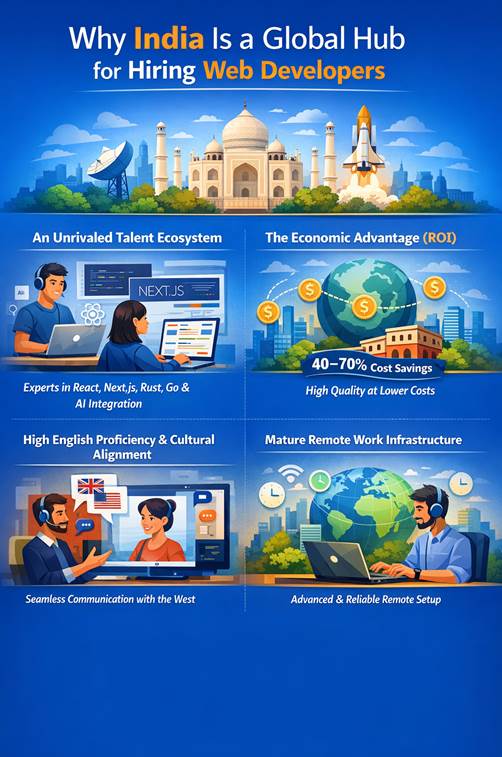
The narrative around hiring in India has evolved. While cost was once the primary driver, today, the focus completely shifted on quality, speed to market, and technical versatility. Here are why businesses are doubling down on Indian talent this year:
1. An Unrivaled Talent Ecosystem
India produces a massive number of engineering graduates annually. In 2026, this isn’t just a quantity play; the quality of education and private bootcamps has pivoted toward “New Age” stacks. When you hire web developers in India, you aren’t just getting HTML/CSS coders; you are accessing experts in React, Next.js, Rust, Go, and AI-integration.
2. The Economic Advantage (ROI)
The cost of living in Indian tech hubs like Bangalore, Hyderabad, and Pune remains significantly lower than in San Francisco, London, or Sydney. This allows businesses to hire dedicated web developers at 40–70% less than Western counterparts without sacrificing the quality of the codebase. This “saved” capital is often reinvested into marketing or further R&D.
3. High English Proficiency & Cultural Alignment
Communication is the heartbeat of software development. India has one of the world’s largest English-speaking populations. Most developers have years of experience working with Western companies. This makes collaboration smooth and easy.
4. Mature Remote Work Infrastructure
Post-pandemic shifts have become permanent. By 2026, Indian developers are masters of asynchronous communication. With high-speed fiber internet now standard across Tier-1 and Tier-2 cities, the “remote friction” that used to plague international hiring has vanished.
2026 Salary & Cost Estimates to Hire Developers in India
To hire web developers effectively, you need to speak the language of the market. Salaries in India have seen a steady rise due to the high demand for specialized skills, but they remainhighly competitive globally.
Annual Salary Ranges (Direct Hires)
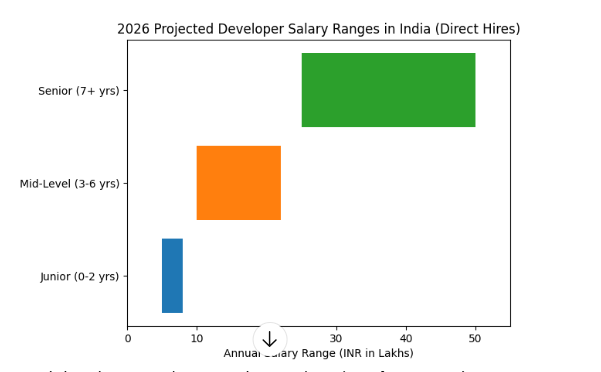
If you are looking to hire full-time employees directly onto your payroll, here are the projected 2026 benchmarks:
| Experience Level | Average Annual Salary (INR) | Approx (USD) |
| Junior Developer (0-2 yrs) | ₹5,00,000 – ₹8,00,000 | $6,000 – $9,500 |
| Mid-Level Developer (3-6 yrs) | ₹10,00,000 – ₹22,00,000 | $12,000 – $26,000 |
| Senior Developer (7+ yrs) | ₹25,00,000 – ₹50,000,000+ | $30,000 – $60,000+ |
Developer Cost by Engagement Model
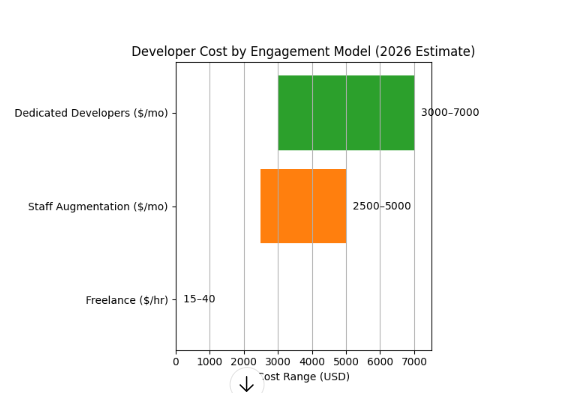
How you hire is just as important as who you hire. Here is how the costs break down by model:
| Model | Typical Cost | Best For |
| Freelance Hourly | $15 – $40/hr | Bug fixes, small UI updates, or MVPs. |
| Staff Augmentation | $2,500 – $5,000/mo | Adding a specific skill to your existing team. |
| Dedicated Developers | $3,000 – $7,000/mo | Long-term product builds with a managed team. |
Global Cost Comparison (Hourly Rates)
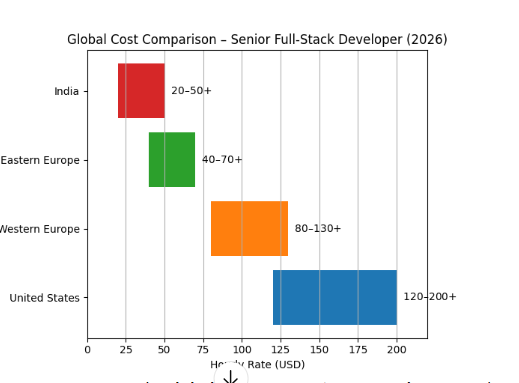
To put this into perspective, let’s look at what you would pay for a Senior Full-Stack Developer globally:
- United States: $120 – $200+
- Western Europe: $80 – $130
- Eastern Europe: $40 – $70
- India: $20 – $50
Note: While you can find developers for $10/hr, in 2026, the “sweet spot” for high-quality, reliable code is usually in the $25–$45/hr range.
Types of Web Developers You Can Hire
The term “web developer” is broad. To hire the right person, you must identify where in the “stack” your needs lie.
1. Front-End Developers
These are the architects of the user experience. They focus on what the user sees, touches, and interacts with.
- Tech Stack: React.js, Vue.js, Angular, Tailwind CSS, TypeScript.
- When to hire: If your website feels “clunky,” isn’t mobile-responsive, or needs a visual overhaul.
2. Back-End Developers
The “engine room” specialists. They handle the server, the database, and the logic that powers the front end.
- Tech Stack: Node.js, Python (Django/Flask), Ruby on Rails, Java, PHP (Laravel).
- When to hire: If you need to build complex features like payment gateways, user authentication, or data processing.
3. Full-Stack Developers
The “all-rounders.” These developers understand both the interface and the server-side logic.
- When to hire: This is the most popular choice for startups. When you hire dedicated web developer talent in a full-stack capacity, you get a versatile professional who can take a feature from concept to deployment.
4. Specialized Roles (Web 3.0 & AI)
In 2026, many businesses are looking for specialized talent:
- AI Integration Specialists: To build LLM-powered chatbots or recommendation engines.
- DevOps Engineers: To manage AWS/Azure/GCP clouds and CI/CD pipelines.
- Security Engineers: To ensure your web application is “hacker-proof” and compliant with global data laws (GDPR, etc.).
Step-by-Step: How to Hire Web Developers in India (2026)
Hiring across borders requires a systematic approach. Follow this 6-step roadmap to ensure you find a “rockstar” rather than a “headache.”
Step 1: Define Requirements & Scope
Don’t just say “I need a website.” Be specific.
- Technical Needs: Do you need a Single Page Application (SPA) or a Multi-Page site?
- Timeline: Is this a 3-month project or a 2-year roadmap?
- Level of Autonomy: Do you have a CTO to guide them, or do you need the developer to make technical decisions?
Step 2: Choose the Right Hiring Model
- The Freelance Route: Use this for “one-off” tasks. High flexibility, but you risk the developer disappearing if a bigger project comes along.
- The In-House Route: Great for culture, but incredibly expensive and time-consuming due to Indian labor laws, benefits, and office overhead.
- The Dedicated Team Model: This is the “gold standard” in 2026. You partner with an Indian agency that provides the developer, the hardware, and the office space, while you retain full functional control over their daily tasks.
Step 3: Source the Talent
Where do you find these developers?
- B2B Platforms: Clutch and GoodFirms are excellent for finding vetted agencies.
- Job Boards: LinkedIn is king in India. Naukri.com is the local giant for direct hires.
- Developer Communities: Check GitHub profiles and StackOverflow contributions to see “proof of work” before you even talk to them.
Step 4: Rigorous Screening
In a country with millions of developers, resumes can be inflated. Use a multi-layered screening process:
- Initial Portfolio Review: Look for live links, not just screenshots.
- Automated Coding Test: Use platforms like HackerRank or Codility to filter for basic logic and syntax skills.
- The “Take-Home” Assignment: Give them a small, paid 4-hour task that mimics your actual project.
Step 5: The Cultural & Soft-Skill Interview
Technical skill is only 50% of the equation. In the interview, look for:
- Problem-Solving: Ask, “Tell me about a time a deployment failed. How did you fix it?”
- Curiosity: Are they keeping up with 2026 trends?
- Communication: Can they explain a complex technical concept in simple English?
Step 6: Onboarding and Documentation
Once you’ve made the offer, the first 30 days are critical. Set up their environment, introduce them to the team via Zoom/Slack, and provide a clear “Internal Wiki” or documentation of your coding standards.
Best Tools to Manage Developers Remotely
To successfully hire dedicated web developers in India, you need a robust “Digital Office.”
| Category | Recommended Tools |
| Project Management | Jira (for Agile), Linear (for speed), or Asana. |
| Real-Time Chat | Slack or Microsoft Teams. |
| Video Syncs | Zoom or Google Meet (Record these for future reference!). |
| Code Management | GitHub or GitLab (Essential for version control). |
| Documentation | Notion or Confluence. |
Common Challenges & Solutions
Hiring in India isn’t without its hurdles. Here is how to navigate them like a pro:
1. The Time Zone Gap
The Challenge: India is 9.5 to 12.5 hours ahead of the US.
The Solution: You don’t need 8 hours of overlap. Aim for 2–3 hours of “Golden Time” (usually morning in the US, evening in India) for sync meetings. Use the rest of the day for deep work.
2. The “Yes-Man” Culture
The Challenge: Some developers may say “Yes” to every request out of politeness, even if it’s technically impossible.
The Solution: Foster a “psychologically safe” environment. Explicitly tell them, “I value your expertise. If my idea is bad for performance, please tell me.”
3. High Turnover
The Challenge: The Indian tech market is hot, and developers often jump for better offers.
The Solution: If you hire dedicated web developers through an agency, the agency handles retention. If hiring directly, offer competitive bonuses and clear career growth paths.
Expert Tips to Hire Dedicated Web Developers Successfully
To get the most out of your Indian partnership, follow these “insider” tips:
- Invest in the Relationship: Don’t treat them as a “ticket-taking machine.” Invite them to company-wide meetings and share your business successes. When they feel “ownership,” the code quality improves.
- Use Agile Methodologies: Working in 2-week “Sprints” ensures that if a mistake is made, it is caught early. Never wait 3 months to see a finished product.
- Prioritize Security: Ensure the contract includes clear IP (Intellectual Property) protection and NDA (Non-Disclosure Agreement) clauses. In 2026, data security is non-negotiable.
Conclusion
The decision to hire web developers in India is one of the most effective ways to scale a business in 2026. By tapping into this massive, English-speaking, and highly skilled market, you gain a significant competitive advantage.
The secret to success lies in moving past the “cheap labor” mindset and embracing a “talent-first” strategy. Whether you need a single freelancer to fix a bug or a dedicated web developer team to build the next unicorn, India has the talent you need—provided you follow a structured, professional hiring process.
Ready to start your journey?
The right developer is out there. Define your stack, set your budget, and start interviewing today.
