



Mark Gibbons
Co-founder, Tapitag



Quick Answer
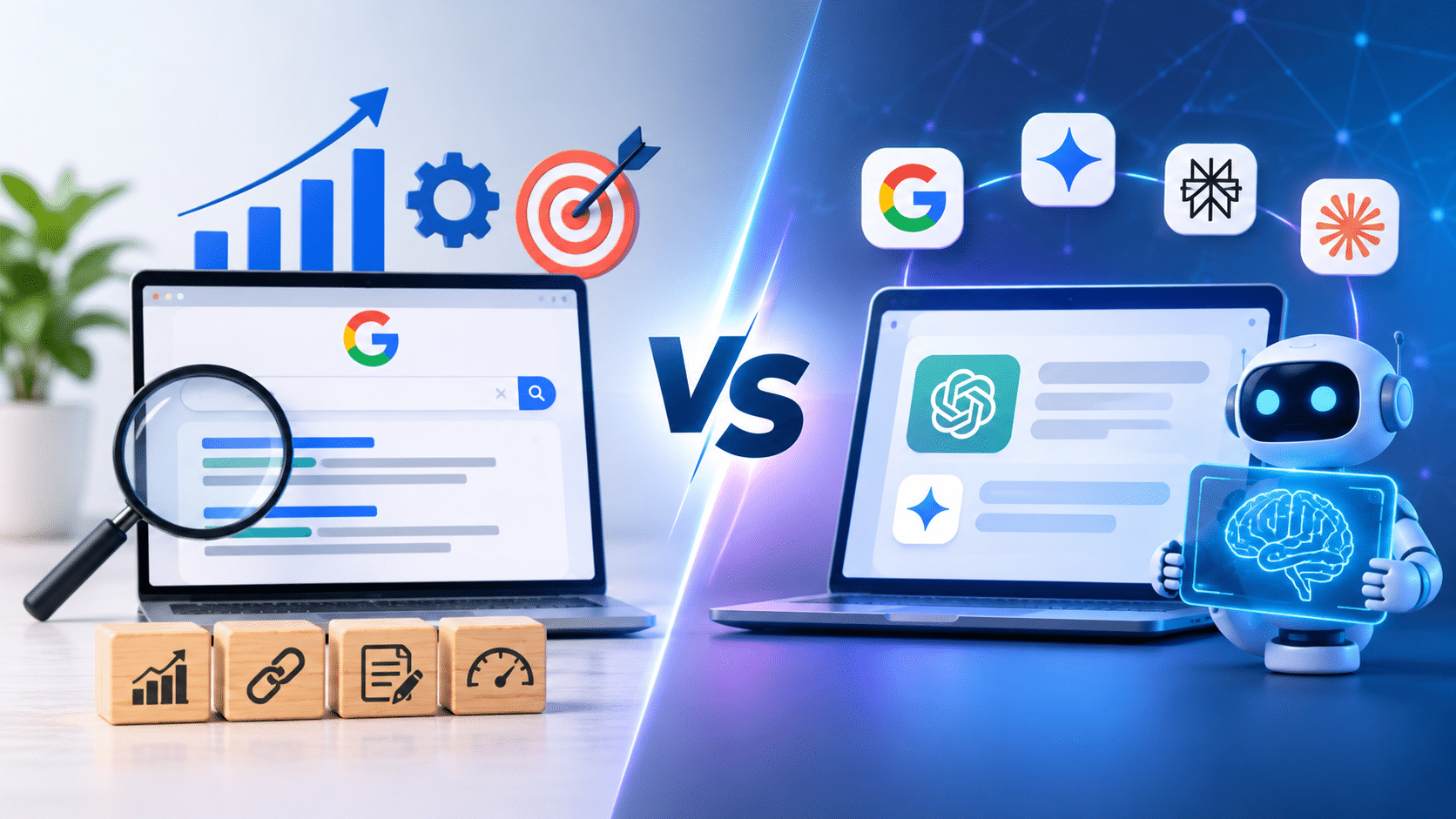
Traditional SEO helps your pages rank in a list of search results and earn clicks. LLM optimization helps AI tools such as ChatGPT, Gemini, Perplexity, Claude and Google AI Overviews mention and cite your brand inside their answers. Going into 2027, most businesses need both. Expect to budget roughly ₹15,000 to ₹1,50,000 per month for solid SEO in India, and USD 3,000 to 25,000 per month for specialist LLM optimization from a global agency.
Ask a friend how they found their last software tool, their last agency or even their last restaurant, and there is a fair chance the answer starts with “I asked ChatGPT.” Search has split into two habits. People still Google. But they also ask an AI assistant a full question and read one written answer, often without opening a single website.
That split is why the same question keeps landing in our inbox: is LLM optimization just SEO with a new label? Short answer, no. The foundation overlaps, but the goal, the tactics, the way you measure and the way you budget are different. This guide covers all of it in one place: definitions, hard data from 2026 studies, how AI tools pick their sources, what each approach costs (in dollars and rupees), a 90-day plan, and how to choose a partner.
One note before we start. This field is young and the research is messy. Where studies disagree, we say so rather than pick the number that sounds best.
In This Article
- What traditional SEO does
- What LLM optimization means (and the jargon around it)
- Why this matters now: the data
- LLM optimization vs traditional SEO: side-by-side table
- How AI tools choose who to cite
- What to actually do: on-page, technical and off-page tactics
- How to measure each one
- Cost: what SEO and LLM optimization really cost
- A 90-day plan to run both
- How it differs by industry
- Common mistakes
- What to expect in 2027
- How to choose an AI SEO Agency
What Traditional SEO Does
Search engine optimization is the work of making your website easy for search engines to crawl, understand and rank. Someone searches “best CRM for small teams”, Google scores pages on relevance and authority, and returns a ranked list. Your job is to sit near the top of that list and win the click.
The core work has stayed stable for years:
- Keyword research that matches the words people actually type
- On-page work on titles, headings, meta descriptions and internal links
- Technical health: speed, mobile usability, crawlability, clean URLs, Core Web Vitals
- Backlinks from trusted websites that vouch for your content
- Fresh, useful content that satisfies search intent
Your website is the destination, which is why site quality matters so much. If yours is holding you back, our list of the top web development companies in India is a good place to compare build partners before you invest in rankings.
What LLM Optimization Means (and the Jargon Around It)
LLM optimization is the practice of shaping your content and your wider online presence so that large language models mention, recommend or cite you when they generate answers. The difference from search is structural. A search engine hands back ten links. A language model hands back one synthesised answer that names only a few brands or sources. You are no longer fighting for position seven versus eight. You are fighting to be one of the names in the answer, or to be absent.
Dedicated LLM optimisation services exist for this reason. The work covers restructuring content so it can be lifted into an answer, building a consistent brand footprint across the web, and tracking how often AI tools mention you compared with competitors.
You will see several acronyms used almost interchangeably. Here is how they usually differ:
| Term | Stands for | What it usually refers to |
|---|---|---|
| LLMO | LLM Optimization | Optimizing for large language models in general, including ChatGPT, Claude and Gemini |
| GEO | Generative Engine Optimization | Optimizing to appear inside AI-generated answers; the most common industry term |
| AEO | Answer Engine Optimization | Winning direct answers: featured snippets, voice answers and AI answer boxes |
| AIO | AI Overview Optimization | Specifically targeting Google’s AI Overviews at the top of results |
| AI SEO | AI Search Optimization | The umbrella label agencies use for SEO plus all of the above |
Do not get stuck on naming. When you shop for services, look at the deliverables, not the acronym.
Why This Matters Now: What the 2026 Data Shows
The case for LLM optimization rests on one trend: more answers are being delivered without a click. Here are the numbers we trust most, with their sources.
| Finding | Source |
|---|---|
| When a Google AI Overview appears, the top-ranking page gets about 58% fewer clicks than similar searches without one (December 2025 data across 300,000 keywords). | Ahrefs, Feb 2026 |
| The click-through drop shrinks further down the page: roughly 51% at position 2, 33% at position 5 and 19% at position 10. | Ahrefs, Feb 2026 |
| Users clicked a traditional result link in 8% of visits to pages with an AI summary versus 15% without one, and only 1% of visits clicked a link inside the summary itself (900 US adults, March 2025). | Pew Research Center, July 2025 |
| Google reports that AI Overviews has over 2.5 billion monthly active users and AI Mode has passed 1 billion (June 2026). | Google, June 2026 |
| A randomised field experiment (January to February 2026) found AI Overviews cut organic clicks to outside sites by 38% on queries where they appear, while reported satisfaction barely changed. | Search Engine Journal |
| Only about 11% of domains are cited by both ChatGPT and Perplexity, so one strategy rarely wins every AI surface. | Industry analysis of nine AI citation datasets, 2026 |
Read these carefully. They do not say SEO is dead. Pages still rank, and AI tools still lean on search results. They say the reward for ranking is shrinking on informational queries, and that a new kind of visibility (being named in the answer) is growing beside it. The studies also measure different things, so treat each percentage as a direction, not a forecast for your site.
LLM Optimization vs Traditional SEO: Side-by-Side
| Factor | Traditional SEO | LLM Optimization |
|---|---|---|
| Main goal | Rank higher in search results and earn clicks | Be mentioned or cited inside AI-generated answers |
| Where it appears | Google, Bing and other results pages | ChatGPT, Gemini, Perplexity, Claude, Google AI Overviews and AI Mode |
| Output format | A ranked list of links | One written answer, sometimes with a few cited sources |
| Key signals | Keywords, backlinks, page speed, user behaviour | Clear entities, quotable facts, brand mentions on third-party sites, structured content |
| Content style | Built around keywords and search intent | Built around direct answers and standalone, citable passages |
| Success metric | Rankings, organic traffic, conversions | Mention rate, citation share, sentiment and accuracy of AI answers |
| Tooling maturity | Mature (Search Console, GA4, rank trackers) | Young; tracking is prompt-based and results vary run to run |
| Speed of results | Commonly 3 to 6 months for new content | Varies; live-search tools can react in weeks, training-based answers take longer |
| Click behaviour | Direct visit to your site | Fewer clicks overall; the visits that happen tend to be better informed |
| Typical monthly cost | India: about ₹15,000 to ₹1,50,000. Global: varies widely | Global agencies: roughly USD 3,000 to 25,000. India-specific rate cards are still rare |
Our verdict: think of them as two layers of one visibility strategy. SEO gets you found when people search. LLM optimization gets you recommended when people ask.
How AI Tools Choose Who to Cite
The AI companies do not publish their source-selection rules, and anyone claiming to know the exact formula is guessing. What we have is independent research, and a few patterns show up repeatedly.
Brand mentions across the web carry real weight
In a study of about 75,000 brands, Ahrefs found that branded web mentions correlated most strongly with brand mentions in Google AI Overviews, stronger than backlinks alone. A 2026 synthesis of nine citation datasets reported that brand search volume was the strongest known predictor of citation likelihood. Correlation is not proof of cause, but both point the same way: models seem to favour brands that the wider web already talks about.
Each AI tool behaves differently
An independent tracker (13,184 citations across four models, data to August 2026) found a clear difference in habits. It is a small sample from one team, so use it as a guide only.
| AI tool | Avg. sources per answer | Mentioned vs cited (brand answers) | Tendency |
|---|---|---|---|
| Perplexity | 19.2 | 67% mentioned, 44% cited | Cites heavily, often LinkedIn, YouTube and Reddit |
| Gemini | 8.1 | 72% mentioned, 41% cited | Leans on Reddit and listicle roundups |
| ChatGPT | 4.5 | 56% mentioned, 47% cited | Favours primary sources such as documentation and vendor pricing pages; usually links what it names |
| Claude | 3.6 | 70% mentioned, 40% cited | Names brands freely without always sourcing them |
The same tracker also saw that ChatGPT and Perplexity shared only about 5% to 8% of their cited domains on the question sets it tested. In plain terms: being cited by one tool tells you little about the others.
“Best of” lists are heavily cited
A 2026 analysis of more than 100,000 AI responses across 100+ brands found ranked “best X” listicles to be the single most-cited content format, at about 21% of citations. That matches what we see. It is the reason we publish comparison content such as our top 10 digital marketing companies and top 10 AI development companies: clear, comparative pages are easy for a model to quote.
Studies disagree on who controls the sources
Search Engine Land reported on an analysis of 6.8 million citations that found about 86% came from sources brands own or manage, mostly their websites and listings. Other studies stress third-party sites, Wikipedia and Reddit. The likely reason is that they sampled different industries and query types. The practical lesson is to work on both: make your own pages strong, and build presence on sites you do not own.
What to Actually Do: On-Page, Technical and Off-Page Tactics
On-page: write answers that can be lifted
- Open each section with a direct, 40 to 60 word answer to the question in the heading, then add detail.
- Make every section stand on its own. A model may quote one paragraph without the rest of the page.
- Use specific facts: named tools, real figures, dates and sources. Vague copy is rarely quoted.
- Add FAQ blocks that mirror real questions from sales calls and search suggestions.
- Use comparison tables and clear definitions (“X is a…”) where they fit the topic.
- Show real authorship: a named expert, credentials and an updated date.
Technical: make sure machines can read you
- Google says there are no extra technical requirements for AI Overviews and AI Mode beyond being indexed and eligible to show a snippet, and that standard SEO fundamentals still apply (see Google Search Central).
- Check that your robots.txt is not blocking AI crawlers you want, such as GPTBot, PerplexityBot or Google’s own crawlers.
- Keep pages fast, indexable and server-rendered where possible; content hidden behind scripts is easy to miss.
- Add schema markup (Article, FAQPage, Organization, Product, Review) so your facts are labelled clearly.
- Keep your brand name, address, services and descriptions identical across your site, Google Business Profile and directories.
Off-page: build the mentions models learn from
- Earn inclusion in independent roundups, “best of” lists and industry reports.
- Collect genuine reviews on the platforms your buyers use.
- Publish original research or data that other sites want to reference.
- Take part in communities such as LinkedIn and relevant forums with real expertise, not spam.
- Run digital PR that gets your experts quoted in trade publications.
If you sell app or software development, deep guides such as our complete guide to mobile app development and comparison pages like the top 10 app development companies show how detailed, evidence-led content earns both rankings and citations.
How to Measure Each One
SEO has mature tools. Google Search Console, GA4 and rank trackers show where you stand, how much traffic you get and what converts.
LLM visibility is harder because answers change from one run to the next. A workable approach:
- Build a list of 30 to 50 questions your customers genuinely ask, split into brand, category and comparison prompts.
- Run them across ChatGPT, Gemini, Perplexity, Claude and Google AI Overviews on a fixed schedule.
- Record whether you are mentioned, cited with a link, or missing, and how you are described.
- Log which competitors appear and which sources the AI cites.
- Track referral traffic from AI platforms in GA4 where it appears, and ask new leads how they found you.
- Compare month on month. Judge trends across several runs, never a single answer.
For Google specifically, Search Console has begun rolling out generative AI performance reports that show impressions in AI Overviews and AI Mode by page, country and device. Google explains the details in its announcement.
Keep mentions and citations separate in your reports. As the tracking data above shows, tools often name a brand without linking it, and the two behave differently.
Cost: What SEO and LLM Optimization Really Cost
Pricing is where most buyers get stuck, because published numbers swing wildly. Below are ranges from public 2026 sources. Treat them as benchmarks for judging quotes, not as price lists. Aresourcepool prepares custom proposals after reviewing your site and market.
Traditional SEO pricing in India (2026)
| Type of work | Typical monthly cost (INR) | Notes |
|---|---|---|
| Basic SEO packages | ₹15,000 to ₹30,000 | Small sites, limited scope |
| Local SEO | ₹25,000 to ₹60,000 | Single or few locations |
| Typical retainer range overall | ₹15,000 to ₹1,50,000 | Most startups and SMEs |
| Ecommerce SEO | ₹50,000 to ₹1,50,000+ | Large catalogues need more content and technical work |
| Enterprise SEO | Up to ₹3,00,000+ | Multi-market programmes with senior oversight |
| Packages under ₹8,000 | Avoid | Usually directory submissions and a generic report |
Ranges are compiled from several public 2026 pricing guides. Tier-2 city agencies are reported to charge roughly 30% to 50% less than metro agencies, and one guide flags pure performance-only pricing with no base fee as a warning sign.
LLM optimization pricing (global benchmarks, USD)
| Option | Typical cost | What you usually get |
|---|---|---|
| DIY tracking and content tools | USD 10 to 1,000+ per month | Visibility dashboards and writing aids; you do the work |
| One-time audit | USD 3,000 to 15,000 | Baseline report, gap analysis, prioritised fixes |
| Fractional specialist | USD 3,000 to 8,000 per month | One senior person, 10 to 20 hours a week |
| Independent consultant | USD 150 to 400 per hour | Expertise and judgment, limited production capacity |
| Specialist agency retainer | USD 3,000 to 25,000 per month | Monitoring, content, schema, reporting |
| Large or enterprise programmes | USD 30,000 and up | Heavy PR, content and entity work across markets |
Ranges are compiled from several public 2026 pricing guides. The widest published range runs from USD 1,500 to USD 50,000+ per month, which tells you how loosely the market is priced. Convert at the current exchange rate for a rupee estimate.
India-specific LLM optimization rate cards are still hard to find. One Indian guide places SaaS SEO from about ₹1.5 lakh per month at the early stage up to ₹8 lakh or more for enterprise GEO programmes. Most Indian agencies we see price LLM work as an add-on to an SEO retainer rather than as a separate product.
What drives the price
- Number of pages and topics to rewrite or create
- How competitive your industry is, and how many markets you target
- Content production volume (it is the biggest cost line)
- Technical work: schema, crawl fixes, site rebuilds
- Digital PR and third-party placement budgets
- Reporting depth, including how many prompts and AI platforms are tracked
Red flags in a quote
- An LLM retainer priced the same as an SEO retainer with no new deliverables. One pricing guide warns this is often SEO relabelled.
- No baseline prompt set or reporting rhythm in the first month.
- Promises of guaranteed rankings or guaranteed ChatGPT placement. Nobody controls these systems.
- Rock-bottom prices for work that clearly needs content and PR.
Is it worth the money?
Compare the cost against what a lead is worth to you, not against other agencies. Paid ads are the usual alternative: one Indian benchmark lists click costs of ₹80 to ₹250 in fintech and ₹150 to ₹400 in B2B SaaS, and ads stop delivering the moment the budget stops. Organic and AI visibility compound, but they need patience. If your customers already ask AI tools for recommendations in your category, waiting costs you more than starting.
How we would split a budget
This is our own rule of thumb, not an industry standard. If you have no SEO foundation, put most of the budget into SEO and technical fixes for the first quarter, with a small slice for AI visibility tracking. If you already rank well, shift towards content restructuring, third-party mentions and measurement. A combined plan from one AI SEO Agency usually costs less than hiring two separate teams, because the groundwork overlaps.
A 90-Day Plan to Run Both
| When | What to do | Outcome |
|---|---|---|
| Days 1 to 30 | Technical SEO audit, fix crawl and speed issues, check AI crawler access, build your prompt list and record a baseline across AI tools | A clear starting point for both channels |
| Days 31 to 60 | Rewrite top pages with direct answers, add FAQs and schema, align brand descriptions on all profiles | Pages that rank and can be quoted |
| Days 61 to 90 | Publish comparison and “best of” content, start earning third-party mentions, run the second round of AI visibility checks | More independent sources backing your brand and your first trend data |
| After day 90 | Monthly prompt tracking, content refreshes, competitor monitoring, quarterly strategy review | Steady growth in rankings and AI mentions |
One tip that holds up across everything above: write for the person first. If a paragraph answers a real question in its first sentence and backs it with a specific fact, Google and a language model can both use it.
How It Differs by Industry
| Industry | Where AI answers matter most | Focus |
|---|---|---|
| B2B services and agencies | “Best [service] company” and comparison prompts | Listicle inclusion, case studies, reviews, clear service pages |
| SaaS | Category and “X vs Y” prompts | Comparison pages, documentation, pricing clarity, integrations |
| Ecommerce | Product recommendations and buying guides | Product schema, reviews, buying guides, consistent specs |
| Local business | “Near me” and best-in-area questions | Google Business Profile, local citations, review volume |
| App and web development | “Which company should build my app” | In-depth guides, ranked comparisons, portfolio proof |
| Health and finance | Sensitive questions where models are cautious | Expert authorship, sourced facts, clear credentials |
Common Mistakes
- Abandoning SEO for LLM work. Many AI tools still pull from pages that already rank, and Google itself says SEO fundamentals still apply to its AI features.
- Chasing a single platform. With so little overlap between tools, a ChatGPT-only plan leaves gaps.
- Publishing thin, mass-produced content. It is easy to produce and easy for models to ignore.
- Ignoring accuracy. If an AI tool describes your pricing or services wrongly, fix the source pages and listings that feed it.
- Measuring once. Answers vary, so one screenshot proves nothing.
- Expecting instant results. Both channels reward consistency over months.
What to Expect in 2027
Nobody can predict exactly how AI search will look a year from now. We can point to the direction of travel and plan around it.
| Trend to plan for | What it means for your business |
|---|---|
| AI answers in more places | Search engines, browsers, phones and apps keep adding AI-written answers. Your content must work as a quotable answer, not only as a page. |
| Fewer clicks, higher intent | Quick questions get answered without a visit. Judge success on leads and revenue, not traffic alone. |
| Brand mentions matter more | Being named in independent reviews, lists and industry roundups becomes a bigger part of who gets recommended. |
| Reporting catches up | AI visibility tools are still rough. Expect improvement, and record a baseline now so you can compare later. |
| Quality bar keeps rising | Mass-produced content is easy to spot. Original experience, real data and named authors will separate trusted pages from the rest. |
The practical takeaway: do not wait for the dust to settle. Fix technical SEO, tighten brand messaging and start tracking AI mentions in early 2027. A baseline taken now is worth far more than one taken after your competitors move.
How to Choose an AI SEO Agency
The market is filling up with agencies that added “AI” to their homepage last quarter. Before you sign, ask:
- Can they show real examples of brands appearing in AI answers, not only ranking screenshots?
- Do they still do technical SEO well? LLM visibility is built on top of it.
- How do they track AI mentions, how many prompts, and how often do they report?
- What exactly is in the first 30 days: audit, baseline, prompt list, target pages?
- Do they separate mentions from citations in reporting?
- Will they promise guaranteed placement? If yes, walk away.
- Do they understand your industry well enough to write accurate, expert-level content?
At Aresourcepool we run SEO and AI visibility as one connected programme rather than two separate retainers. See how it works on our AI SEO services page, or explore our dedicated LLM optimisation services if AI answer visibility is your immediate priority.
Final Thoughts
The question is not LLM optimization or traditional SEO. It is how quickly you can get both working together. SEO keeps your pages visible when people search. LLM optimization keeps your brand in the conversation when people ask an AI for advice. The data shows clicks on traditional results are shrinking on many queries, while the brands named inside AI answers gain attention at the moment a buyer is deciding.
If you want to see where you stand today, our team can run an AI visibility check and show you which questions you are missing from.
Ready to Get Cited by AI, Not Just Ranked by Google?
Talk to our team about LLM optimisation services and a combined SEO plan built for 2027.